

The reason for their unwillingness to retire later is named
Despite the thousands of protests that have taken place in recent weeks in France, President Macron and his team continued to push through the pension reform, which caused discontent among many French people . On Thursday, parliament is scheduled to vote on changes to pensions for residents of the Fifth Republic. Because of what the fuss is happening — let's try to figure it out.
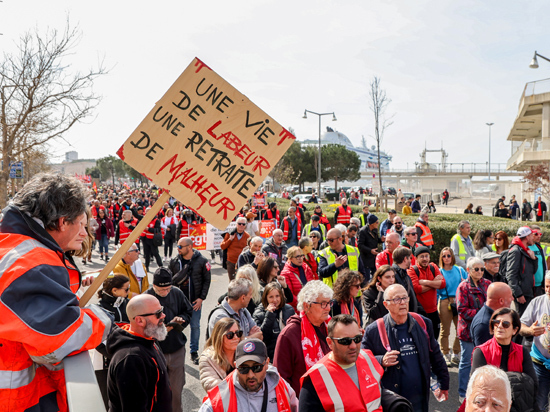
In last year's parliamentary elections, Macron's centrist alliance lost a majority, forcing the French government to rely on conservative votes to pass a pension bill. And with lawmakers on the left and far right vehemently opposed to reform, and conservatives divided, the outcome looks unpredictable.
But the stakes appear to be high for Macron — even if he fails to win a parliamentary majority to implement his plan to raise the minimum retirement age from 62 to 64 (so workers can contribute more money to the pension system), then he may risk imposing unpopular changes unilaterally, willfully. Macron can use his special constitutional powers to push a bill through parliament without a vote.
The French, dissatisfied with the reform, are infuriated not only by the not-too-attractive increase in the age bar, but also by the pitfalls that Macron's plan hides. The fact is that to join the ranks of pensioners two years later than the inhabitants of France are doing now, this is not so bad. Innovations suggest that not everyone who retired at 64 can expect to receive payments in full. To do this, you need to work for at least 43 years. Otherwise, in order to receive the full pension, you will have to wait until the age of 67.
In anticipation of the vote in the National Assembly, the unions staged a new strike, which was attended by representatives of various professions — train drivers, school teachers, port workers, oil refinery workers, and garbage collectors. The strike of the latter (for reference, the average salary of garbage collectors in Paris is about 2,300 euros per month) was eloquently illustrated by the thousands of tons of garbage accumulated on the sidewalks of Paris and other French cities. It got to the point where Interior Minister Darmanen urged Paris City Hall to force some scavengers back to work, calling it a public health issue. But the capital's mayor, Anne Hidalgo, a socialist, said she supported the strike. To this, government representatives warned that if she did not comply, the Ministry of Internal Affairs was ready to act in her place.
Despite another burst of strike activity, the authorities seem to be reassured by the fact that from time to time protesters become less and less. So it happened on Wednesday, when in Paris, according to police, 11,000 people came out to protest less than last Saturday.
French unions would like their country to follow the Spanish path: the left-wing government of neighbors in the Iberian Peninsula, together with the unions, announced a «historic» deal to save Spain's pension system by raising social security spending for those with higher wages. However, President Macron does not like this option of raising taxes. He argues that this will make the country's economy less competitive. The President argues that something needs to be done to maintain the current level of pension payments in France, as the number of pensioners is expected to rise from 16 million to 21 million by 2050 due to an aging population and a declining birth rate. Macron and his government project a €2.6bn deficit in the current pension system in 2023, making it financially unsustainable in the long run. And a gradual increase in the minimum retirement age to 64 years by 2030, according to the Elysee Palace, can somehow help. According to calculations, the reform will bring an additional 17.7 billion euros in annual pension contributions.
In fact, according to a study conducted by the government statistics laboratory in 2022, the French retire on average a few months later than the legal for men and women a minimum of 62 years, while French women really work longer and retire six months later.
According to statistics for 2020, on average French residents of both sexes retired at 62 years and four months. At the same time, more than 16 million French pensioners received an average pension income of 1,400 euros «net» (in terms of the Russian currency, it turns out about 112 thousand rubles), which turned out to be slightly higher than the current minimum wage in France in the amount of 1,353 euros.
It is worth noting that in France there is no universal state pension level. People receive a pension usually as a percentage of their salary in their 25 best years of service. The current pension reform provides for a minimum monthly pension of 1200 euros –compared to the current 1100 euros. According to the Office of Research, Evaluation and Statistics (Drees), 7% of French pensioners receive more than 3,000 euros (that's 2% of all women and 12% of all men).
French pensioners have few fixed expenses, and the national system social health saves them from expensive medical bills, and about 80% of French pensioners own their own home.
In addition, many are preparing in advance for retirement and purposefully saving money. According to an Audirep survey, 71% of respondents say the goal of «having the resources to retire, having enough money for the duration of their retirement» is one of their top savings priorities, while 38% describe it as a «serious concerns.» The first concern for French people preparing for retirement remains «dealing with possible contingencies».
According to the survey, 53% of working French people replenish their pension savings at least occasionally, but only one in five of working respondents (21%) do so regularly. And 70% of those who never or almost never save money for retirement explain that they cannot do it because of a “lack of financial resources”, while 26% of the French do it of their own choice.
The average amount saved for retirement is more than 2,300 euros per year. Half of working respondents believe that their savings will not be enough for retirement, while 23% believe that they will be «enough». True, almost one in two working people admits that they “have no idea how much savings they need” to accumulate enough additional income for retirement.
Why are the French so opposed to raising the retirement age? Perhaps, experts say, the people of France value their retirement much more than in other countries, and for them the balance between work and personal life is of particular importance. If in 1990, according to a survey by Ifop and the Fondation Jean-Jores, 60% of French people said that work is “very important” in their lives, compared with 31% who spoke in favor of leisure, now only 24% consider work a priority, and 41% consider leisure to be very important. So it's no surprise that workers want to take their well-deserved rest early.
In addition, the French enjoy long lunch breaks, a 35-hour work week and 30 days of annual leave per year (compared to, for example, 28 days in the UK). Overtime in France is much less common than in other European countries. So the people of the country are taking a more relaxed approach to work, which largely explains why 71% of people polled by Le Figaro newspaper support strikes against pension reform.
The Wall Street Journal cites several French people in connection with how they manage their pensions.
So 58-year-old schoolteacher Sylvia Roche plans to retire in August, just after her 59th birthday, with a pension of around 2,620 euros a month, about 75% of her current salary. She plans to spend her holidays in Crete and on her return to work as a volunteer in Paris as a school tutor. “I want to enjoy life,” she says. But her 29-year-old son Etienne, who works as a pastry chef in Strasbourg, doesn't expect his own pension to be as lucrative as his mother's: «I don't count on my state pension to live on when I retire.»
Husband and wife Armand and Josiane Cameleir, who retired about 20 years ago, actively travel the world — having already become pensioners, they have visited India, South Africa, Kenya, Peru, Argentina, Norway, Scotland and the USA.
< p>The former owner of the business selling office equipment, 72-year-old Monsieur Cameleir, receives a pension of 3,000 euros per month and earns another 4,000 to 5,000 euros from the investments he made, mainly in real estate after the sale of his company (in general, real estate in France ranks first among the investments that are considered «the most suitable for savings in the long term, for the next 15-20 years, for example, for retirement»). So the pensioner is quite happy with his income: «We can do whatever we want.»
Another couple of French pensioners, 78-year-old Marie Boyer and her husband, receive a monthly pension of about 1,800 euros, but claim that this allows them to live comfortably. When they retired, they bought a house in the French Alps and paid off their mortgage. True, they prefer traveling in France to foreign trips.