


Four Presidential Promises
Vladimir Putin made several important promises to Russians in the Tula region. The President said that real incomes will increase by 2-3%, while prices will rise much more slowly than in 2022. As for utility tariffs, they will remain unchanged for a whole year and a half. Fare in public transport, according to Putin, should be indexed «softly».
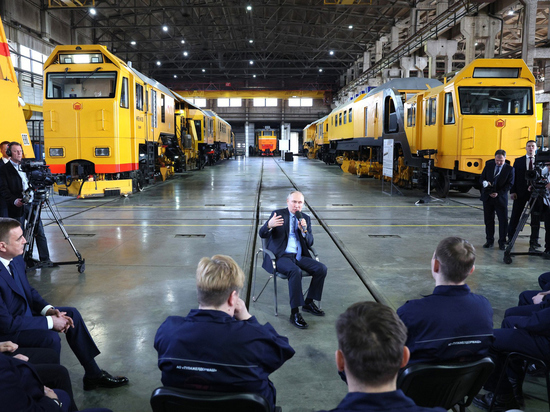
By presidential standards, the visit to the Tula region began early: already at 10 am, VVP was walking around the shops, examining the products, the main consumer of which is the railway workers. And immediately after the tour, he went to a meeting with the workers to discuss the topical issues that had accumulated over the first two months. Although the questions were prepared in advance, not everyone was able to voice them without hesitation in the presence of the head of state. One of the workers, noting that goods and services in Russia have risen sharply in price, forgot what kind of comment he expects from the president. «Lost,» he admitted honestly. Tips from the seats in such situations are not welcome, so the worker had to get out himself. “Is work being done to increase the profitability of people?” he finally formulated.
Putin noted that the problem is the sharp rise in inflation in 2022: salaries simply could not keep up with it. “But we expect changes for the better. This year, real wages should grow by 3-5%, and real disposable income by 2-3%,” the President encouraged. However, he honestly warned: these are average indicators, “somewhere” it may not be as planned. According to Putin, the increase in the cost of housing and communal services, which, according to opinion polls, especially angered citizens, happened due to early indexation of tariffs — from mid-2023, the increase was postponed to the end of 2022, because otherwise the industry would have «nothing to support «. But now the tariffs will increase only from July 1, 2024. “No changes should occur over the next year and a half,” the president promised. (However, the Russians have already noticed that the amounts in bills are growing not only due to tariff increases, but also due to changes in the calculation methodology, as happened on March 1 with general house needs.)
In addition to the income of workers, they were interested in resettlement from dilapidated housing, preferential car loans and import substitution of machine tools. It is clear that many operations at the Tula enterprise are still carried out on Western equipment and the prospects for its replacement and repair are very vague. Vladimir Putin said that the resettlement from the emergency fund will definitely continue: residents of houses recognized as emergency in 2017–2024 will fall under the new stage. With regard to preferential car loans, the president did not reassure anyone. Since March, the program has been resumed for certain categories of citizens — doctors, teachers, and participants in the SVO. But further expansion of support will lead to an increase in the cost of cars, while the state is interested in increasing production volumes, the GDP indicated. However, Putin is sure that the prospects for Russian industry are good — just look at the achievements of agriculture after 2014. “These are no longer Soviet collective farms, but a high-tech industry. Even space facilities are being used,” the president said proudly, expressing the hope that the domestic industry would make the same breakthrough in the foreseeable future.
How to achieve this, the participants of the State Council reported to Putin after the meeting with the workers. True, none of them was invited to Tula. In face-to-face format, the president heard only the governor of the Tula region, Alexei Dyumin, who summed up the results of the «stormy discussions» that had taken place the day before. As one would expect, the cornerstone of the development of industry (as, in fact, of all industries) is financing. Members of the State Council see him as a source of NWF funds, long-term orders for domestic products, as well as income from the sale of foreign assets. On the last point, however, there were some minor discrepancies. Dyumin himself complained that the fate of foreign companies is decided in Moscow offices, and no one asks the regions — they only demand to keep unemployment and ensure income growth. However, the governor of the Moscow region, Andrei Vorobyov, did not support these decadent moods. “Two or three companies left, but the detachment did not notice the loss of a fighter,” he cheerfully reported. “Those who left cannot be called fighters,” Putin corrected edifyingly. “They didn’t fight for their interests.” “Sorry, there is,” the governor unconditionally admitted his mistake.
Alexey Dyumin, in turn, argued with the president on the personnel issue. Too complicated exams in physics and other exact sciences, in his opinion, force school graduates to choose the humanities. As a result, they do not study to become engineers and do not enter the industry. But Putin did not agree with this interpretation: the point is not complexity, but the ability to interest. He told a story about his «girlfriend», who studied foreign languages at the university, and then became interested in other disciplines and defended her dissertation in higher mathematics. «It's an asterisk!» Dyumin remarked reasonably. “These stars are created by teachers,” Putin objected. But Dyumin was in no hurry to apologize. “The tasks that you have set require not stars, but starfall,” he insisted, and here the president had nothing to object to. “Good,” VVP nodded his head.
Finance Minister Anton Siluanov explained to all those present that one should definitely not count on additional funds from the federal budget. Industry support has already grown from 500 to 700 billion rubles. in year. You can only adjust priorities and direct resources to where they are more in demand. “There is an opportunity to maneuver,” the minister said. Siluanov did not support the proposal for preferential mortgages for manufacturing workers. Subsidizing rates on an industry basis is a dead end. “We need to think about having children and get a mortgage at 6%,” the head of the Ministry of Finance advised Russians who dream of improving their living conditions.