


«Some images are unique and can't be found anywhere else»
The mysterious petroglyphs carved into the rocks found in the desert of Qatar intrigue scientists who have long been unable to come to no consensus about the meaning of ancient figures, nor about the time of their appearance.
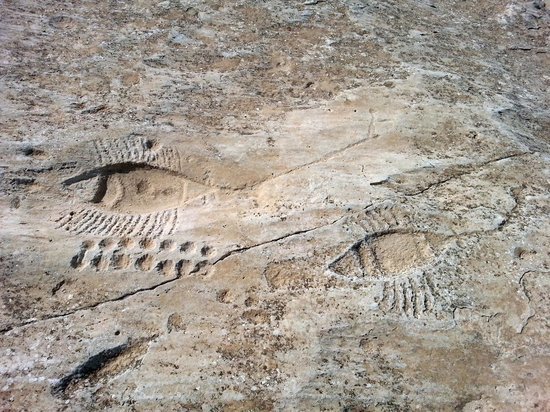 Photo: qm.org.qa
In a deserted and windswept corner of the northeast coast of Qatar, among the sand dunes of a barren desert, lies Al-Jassasiya, the largest and most important rock art site in the Gulf country, says CNN.
Here, centuries ago, people used limestone as a «canvas» on which they carved the symbols, motifs, and objects they observed in the environment.
In total, archaeologists have discovered a total of about 900 rock paintings, or “petroglyphs”, in Al-Jassasiya. These are mainly cryptic cup-shaped signs arranged in various patterns, including rows and rosettes, but also eye-catching images of sailing ships, usually seen from above, but also depicted in a linear profile, among other symbols and signs.
“While rock art is common in the Arabian Peninsula, some of the carvings at Al-Jassasiyah are unique and cannot be found anywhere else,” Ferhan Sakal, head of excavation and site management at Qatar Museums, told CNN, referring to the ship petroglyphs visible from a bird's eye view.
“These carvings show a high degree of creativity and observation on the part of the artists who created them,” said the expert.
There are about 12 notable petroglyph sites in Qatar, located mostly along the coast of the country, although some are carved images can even be seen in the center of Doha's Al Bidda district, which overlooks the Corniche, a popular waterfront.
Al-Jassasiya, located about an hour north of the ultra-modern capital of Qatar and close to the old pearling port of Al-Khuwailah, was opened in 1957. Over the course of six weeks in late 1973 and early 1974, a Danish team led by archaeologist Holger Kapel and his son Hans Kapel carried out a study during which the entire site was meticulously cataloged using photographs and drawings.
The most notable design includes two parallel rows of seven holes, leading some to believe that they were used to play mancala, a board game popular in many parts of the world since antiquity in which two players throw an even and an odd number of small pebbles. into the depressions.
But other scholars have disputed this theory, pointing to the fact that some of the holes at Al-Jassasiya are too small to contain any rocks, while others can be found on the slopes.< /p>
Other speculations include that the bowls were somehow used for divination; or for sorting and storing pearls; or as systems for calculating time and tides.
So, what were they really for, and what did they mean? “This is very difficult to answer,” admitted Ferhan Sakal, who also does not support the theory of board games. – In my opinion, they may have a very ancient ritual meaning and function, so it is impossible to explain them ethnographically.”
But how old are the ancient drawings? “We really don't know,” admitted Sakal, explaining that dating petroglyphs – and rock art in general – is very difficult today.
“There are wild hypotheses about age, ranging from the Neolithic to late Islam he added. “Personally, I don't think all the carved figures were made at the same time.”
A decade ago, one scientific study of nine different petroglyphs at Al-Jassasiya found no evidence that they were more than a few hundred years old, but researchers concluded that more research was needed, including the development of new methods specific to limestone carving.
Although experts cannot say with certainty when and by whom the Al-Jassasiya petroglyphs were created, they all agree that the most exciting — and unusual — carvings at this site are images of boats.
These creations contain important information about the types of boats used in the flourishing fishing and pearling industries (the backbone of Qatar's economy for centuries) as well as their various elements.
Most of the boats seen from above are usually in the shape of a fish with a pointed stern and rows of oars carved with a pointed metal tool.
They contain several details such as intersecting stiffeners and holes, likely showing the position of the masts and foremast.
In some cases, a long line from the stern depicts a rope ending in either a traditional Arabic anchor (a triangular stone anchor with two holes) or a European one (a metal anchor with a long shank and two curved levers, first used in the region about seven centuries ago).
“On some boats, the oars are not parallel, as they should be when rowing, but are directed in different directions,” write Francis Gillespie and Faisal Abdullah Al-Naimi in the book “Hidden in the Sands: Uncovering Qatar’s Past” .
Experts say they can only guess why Ala has so many ship carvings. Jassassiya compared to other coastal petroglyphic sites in Qatar.
“Ships played an important role in the beliefs of ancient peoples who saw them as a symbolic means of transition from this world to the next,” noted Gillespie and Al-Naimi. — Both the Babylonians and the ancient Egyptians believed that the dead enter the afterlife on a ship. Greek myths told of the ferryman Charon, who transported the souls of the dead across the River Styx to the underworld. Perhaps these are echoes of folk memory, rooted far back in prehistoric times.”