


Ancient stone disk with hieroglyphs weighs forty kg
The ancient «tableau», which was used to play ball by the Mayans, was found by archaeologists in Mexico. The amazing find is believed to be over 1000 years old. A round carved stone found in the Chichen Itza complex in the Yucatan depicts hieroglyphic writing and two ball players.
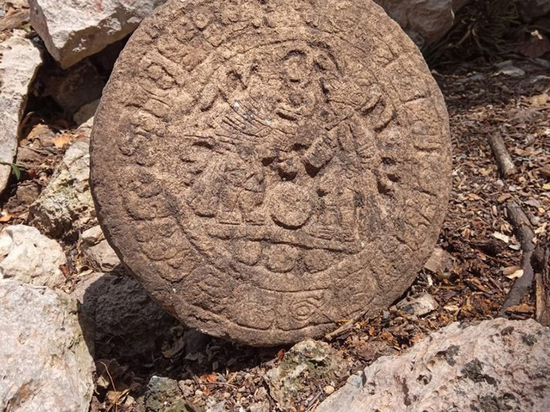 Photo: National Institute of Anthropology and History (INAH)
A stone scoreboard that served as the scoreboard in an ancient ritual ball game was discovered at a famous Mayan archaeological site in Chichen Itza in Mexico's Yucatan Peninsula, according to Reuters.
Measuring just over 32 cm in diameter and weighing 40 kg, the round object, just over 32 cm in diameter and weighing 40 kg, depicts hieroglyphic inscriptions surrounding two players standing next to the ball, according to a statement from the National Institute of Anthropology and History of Mexico (INAH).
you can find hieroglyphic writing, not to mention the full text,” said Francisco Perez, one of the archaeologists who coordinated the research at the Chichanchob complex, also called Casa Colorada.
Describing the carved image, archaeologist Santiago Alberto Sobrino Fernández explained that “the character on the left wears a feathered headdress and a sash that has a flower-shaped element, probably a water lily. In line with the face is a scroll that can be interpreted as a breath or a voice. The adversary wears a headdress known as the 'serpent turban', which can be seen on numerous images at Chichen Itza.
The stone believed to be the plaque dates from between 800 and 900 AD, Reuters notes. .
The game, played with a heavy rubber ball, was a traditional Mesoamerican practice and is believed to have ritual overtones.
INAH researchers are now preparing to take high-resolution images of the text and iconography for detailed study, while preparing them for conservation.
The Chichen Itza complex, declared a UNESCO World Heritage Site, is one of the main archaeological centers of the Mayan civilization on the peninsula Yucatan. According to official figures, about 2 million people visit this place every year.
Chichen Itza was a pre-Columbian city built by the Maya people at the end of the classical period. The city was the main center in the Northern Lowlands of the Maya from the Late Classic (600-900 AD) to the end of the Classic period (800-900 AD) and in the early stages of the Postclassic period (900-1200 AD). .e.).
Among the peoples of pre-Columbian Mesoamerica, a ball game, or tlachtli, was common, in which sports elements could be combined with rituals. The game was played differently in different places. Pre-Columbian ball stadiums have been found throughout Mesoamerica from Nicaragua in the south to the US state of Arizona in the north. While the ancient stadiums discovered vary widely in size, they all have long, narrow fields bounded by walls from which the ball can bounce.
The exact rules of the ancient game are believed to be unknown, however, it can be assumed that they were similar to the rules of racquetball or volleyball, where the goal is to keep the ball in play.
In the most common version, the participants in the game had to hit the ball with their hips, but in some versions it was also allowed to use elbows, rackets, bats and stones. The balls were made from a single piece of rubber and these projectiles weighed four kilograms or more.
Large «matches» of the ball game were held as ritual events, sometimes including human sacrifices. However, the game was usually played just for fun.
The Mayan game of ball is believed to have originated over 3,000 years ago. The importance of this game is emphasized in the Popol Vuh, which tells the story of the Quiche people and their rulers. The game was portrayed as a way to recreate the battle between the forces of darkness and light as a religious rebirth event that the Maya considered an integral part of their continued existence.
By playing this game and making sacrifices, the Maya demonstrated their devotion to their gods. Scholars disagree on what kind of people were ritually killed during the games and what was the frequency of such sacrifices.