


The fireball is 100 times the size of the solar system
Scientists have recorded the largest cosmic explosion ever observed in history. The fireball, «100 times the size of the solar system,» is thought to have originated from the suction of gas into a supermassive black hole.
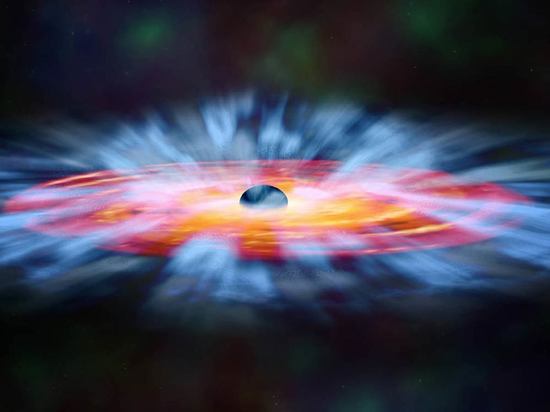
It all started with an unremarkable shimmer in the night sky. But closer observations have shown that astronomers have captured the largest cosmic explosion ever observed — an event believed to have been caused by a giant cloud of gas being swallowed up by a supermassive black hole.
A flare detected at a distance 8 billion light-years, more than 10 times brighter than any known supernova, and currently lasting for over three years, making it the most energetic explosion on record.
“It went unnoticed for a year as it gradually got brighter,” said Dr Philip Wiseman, an astronomer at the University of Southampton, who led the observations. It wasn't until subsequent observations showed just how far away it was that astronomers appreciated the almost unimaginable scale of the event.
“We calculated it to be a fireball 100 times the size of the solar system, with a brightness about 2 trillion times greater than the sun, says Dr. Wiseman. “In three years, this event released about 100 times more energy than the sun releases in 10 billion years of its life.”
Scientists believe the explosion, known as AT2021lwx, is the result of a huge cloud of gas, possibly thousands of times the size of our sun, sinking into the inevitable maw of a supermassive black hole. The cloud of gas may have originated from the large dusty «donut» that normally surrounds black holes, though it's not clear what could have knocked it off course, out of orbit and into a cosmic vortex, The Guardian notes.
According to the British edition, AT2021lwx is not the brightest phenomenon that has ever been observed. A brighter gamma ray flare, known as GRB 221009A, was seen last year, but the event only lasted a few minutes. In contrast, the new event is still intense, which means that the overall release of energy is on a much larger scale.
The explosion was first detected in 2020 by the temporary Zwicky facility in California, which scans the night sky for sudden increases in brightness that could signal cosmic events such as supernovae or passing asteroids and comets. Initially, this event seemed unremarkable, but when subsequent observations made it possible to calculate the distance to it, astronomers realized that they had recorded an incredibly rare event.
“When I told our team the figures, they were all shocked, — says Dr. Wiseman. “Once we realized how incredibly bright it was, we had to come up with a way to explain it.”
This phenomenon happened out of range for a supernova (an exploding star), and so astronomers turned to another common scenario that causes bright flashes in the night sky — the so-called tidal disruption. These events are usually associated with a star getting too close to a black hole and being torn apart, some absorbed and the rest stretched out as a spinning disk.
But simulations have shown that a star would be needed to explain AT2021lwx, 15 times the mass of the Sun. “An encounter with such a huge star is very rare, so we think that a much larger cloud of gas is more likely,” says Dr. Wiseman.
Supermassive black holes are usually surrounded by an extensive halo of gas and dust, and the authors suggest that some of this material may have been destroyed, possibly by a collision of galaxies, and sent inward. As the material spiraled toward the black hole's event horizon (its spherical outer boundary), it must have given off massive amounts of heat and light.