


The private sector and the state are equally responsible for the economy
By suggesting “to take the path of nationalization of the main sectors of our economy”, the head of the Investigative Committee, Alexander Bastrykin, created the ground for numerous interpretations. What exactly this is about is not entirely clear. Maybe about the total seizure of private property in favor of the state in the spirit of the first Leninist decrees of the end of 1917? Hardly. Rather, about those sectors that are critical to national security — transport, energy, medicine, food.
According to Oleg Matveychev, Deputy Chairman of the State Duma for Information Policy, Bastrykin had in mind, first of all, commercial enterprises involved in the implementation of the state defense order and sometimes frustrating their part of the work. Some of them are under the control of foreigners. It looks like the truth, given that earlier the head of the UK announced fraudulent schemes being implemented «even in the defense industry.» The State Duma also sees in his words an appeal to minimize economic costs, which include the luxurious life of private owners of plants and factories, which is absolutely unacceptable in the conditions of the NWO, sanctions and tough confrontation with the West.
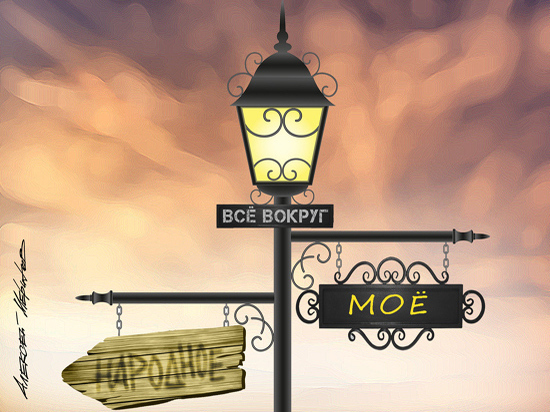 < span itemprop="height" itemscope itemtype="https://schema.org/QuantitativeValue">
Only the lazy did not talk about the facts of outrageous theft and overpricing in the implementation of public procurement in Russia. They have been repeatedly recognized by the Accounts Chamber, which each year reveals thousands of violations worth many billions of rubles. But the point here is not just in the private sector, but in the area of responsibility of officials who give contracts to «lured» companies — without any competition and to a single performer (often in the logic of «it's better to be inferior, but your own, and foreigners can be expelled»). And this problem is unsolvable, since the state's share in the economy is steadily growing, and the public procurement market, as the joint venture notes, «is characterized by a high degree of concentration of large suppliers.»
In general, Russia is following its own special path here as well. There are widespread companies in the world that, for a number of reasons, are owned by the state, but operate as purely commercial enterprises. For example, Deutsche Bahn and the land bank system in Germany, Framatome and Areva in France, Sinopec, Petrobras, Pemex and Statoil in Norway. All of them operate in a classic market environment, which makes it possible to avoid unreasonably expensive construction projects or pompous projects, obviously failed «investment» decisions. Russia also has such vertically integrated companies. The fundamental difference lies in their systemic inefficiency and wastefulness: they are only formally commercial, but in reality they “expand the area of state thinking” to the private sector. As a result, there is a sharp contraction of the competitive space, production efficiency drops and a super-nourishing broth for kickbacks and corruption appears.
That is, we need to move in the opposite direction, optimizing the public sector (where more than half of GDP is created today), and not trying to nationalize the private sector. Otherwise, scandalous stories from the category of those that happened with the Sukhoi Superjet passenger aircraft, the development of which took about 10 years and billions of dollars that disappeared no one knows where, will be endlessly repeated. In addition, someday the SVO will end, and then what about the state-owned to the limit, massively transferred to the war footing industry? Today, any howitzer fired counts as an investment, which creates a distorted picture of the blissful state of the GDP. The Central Bank has spoken a lot about the need for a structural transformation of the Russian economy, but the thesis of nationalization somehow does not fit in very well with it.
From the point of view of national security guidelines, it is necessary to restore order in the economy, officials say. This is a certain general message, voiced, in particular, by Bastrykin. What's next? It seems, however, that order must be restored not only among businessmen, the public sector clearly has its own pain points. Isn't that fair? For example, one of the violations of the law on public procurement is the failure to comply with the standard for access to state tenders for small and medium-sized businesses. The document requires 15% of purchases to be given to SMEs. But, according to the Accounts Chamber, not a single federal executive body even keeps count of this standard. That is, the presidential decree (No. 618) on non-discriminatory access of suppliers to the procurement of goods, works, services is ignored in order to ensure the effectiveness of public procurement.