


What happens on the sidelines of the meeting of the G7 leaders
On Friday, May 19, the G7 summit started in Japan. The main topic of the meeting of the G7 leaders was the search for options for confronting the West with Russia and China. Not without the theme of Ukraine. So, contrary to the official statements of the host, Volodymyr Zelensky is expected to arrive in Hiroshima in person. Let's figure out what will happen on the sidelines of the 3-day summit.
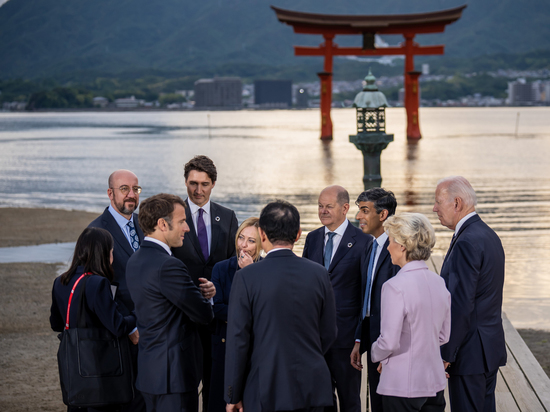
While in the Peace Park, closed until Monday (due to the summit), dedicated to the American atomic bombing of Hiroshima in 1945, the leaders of the Group of Seven take pictures, traditionally plant trees and negotiate (the main objects of which are Russia and China), outside of this «world» hundreds of Japanese protesters took to the streets.
Citizens began to oppose the holding of the summit in Hiroshima on May 15. Protesters, including university students and family members of the victims of the atomic bombing, held signs with the slogans «No to the G7 Summit» and «War Conference». The protesters shouted the slogans «No talks between Japanese and American leaders» and «Withdrawal of US military bases from Japan.»
Friday was no exception — the day of the immediate start of the G7 leaders' conference. The slogans are very specific: «No to the G7 imperialist summit!», «No to nuclear war!», «We will not allow an aggressive war with China!»…
The meaning of discontent is clear. Few people paid attention, but on the eve of the summit (and the information about this appeared on May 10), Japanese Foreign Minister Yoshimasa Hayashi said that Tokyo was in talks to open a NATO liaison office in the country — the first of its kind in Asia. The diplomat, of course, blames Moscow for this decision, saying that because of the start of Russia’s special operation in Ukraine, Japan “had to rethink regional security”: “What is happening in Eastern Europe is not limited only to the issue of Eastern Europe, and this directly affects situation here in the Pacific. That is why cooperation between us in East Asia and NATO is becoming… more and more important.”
Bearing in mind that one of the main issues of the summit is the search for measures to counter the PRC, everything looks very suspicious. This was also noticed in Beijing. According to Chinese Foreign Ministry spokesman Mao Ning, “Asia is a promising land for cooperation and a center of peaceful development. It should not be a platform for those who are looking for geopolitical battles. NATO's eastward expansion and interference in the affairs of the Asia-Pacific region will definitely undermine regional peace and stability.”
And what else remains to be done if Western leaders do not find consensus on the issue of economic «curbing» of China. One can even recall the case of French President Macron, who held talks with Chinese President Xi Jinping last month. The three-day visit «impressed» the French leader so much that he inadvertently blurted out a completely sober thought: «The worst thing would be to think that we Europeans should be someone's followers in this matter and adapt to the American rhythm and the overreaction of China.» A little later, speaking in the Netherlands, Macron repeated what he had said after the Chinese tour — France will not blindly follow the US-led hardliners in the conflict over Taiwan.
This, of course, greatly upset both the United States and its loyal allies. But bad luck — the G7 summit, and there it is already necessary to find common agreements on the Chinese issue, although this turned out to be a very difficult task.
“It is clear why the leaders of the G7 have such difficulties with China, there is a significant dependence of the European Union, and America, on the Chinese economy. — explains Nikolai Topornin, Associate Professor of the Department of European Law at MGIMO, Director of the Center for European Information. – For example, dependence on the Russian economy consisted only in gas and oil, and they have wide-ranging economic ties with China. See what group of goods China supplies to Europe. In any European store you can find a huge number of Chinese products: telephones, computers, televisions, washing machines … Europeans use all of this. As we know, Chinese products are now of fairly good quality and inexpensive, so Europeans are happy to buy Chinese products in order to save money.
And now imagine for a second that a trade war between the EU and China suddenly starts (the European Union can close factories, suspend production for a while, and China will stop supplying essential goods). The interdependence of economies is very high. Even when Ursula von der Leyen and Macron traveled to China, the head of the European Commission then said that now we must treat with understanding the fact that economic dependence on China is growing, and we must do everything to reduce this dependence. Simply breaking the current ties between China and Europe is like death. This will hit every European and living standards in general.”
The expert noted that America (another member of the G7) decided not to transfer the latest developments to China. Thus, the United States is trying to limit China's access to these technologies, but the problem for the West is that China itself has learned to produce the latest technology.
“Western leaders understand that China is Russia's main ally. They will also put pressure in this direction,” comments Nikolai Topornin. – But it is more difficult to put pressure on Beijing than, for example, on Kazakhstan. Therefore, with China, not everything is so simple. With China, it seems to me, a more long-term program of the Western community, calculated for decades to come, will operate. They will not take any radical measures and sudden movements now, but the strategy is clear – China is now their main opponent.”
The fact that Japan announced negotiations to open a NATO liaison office may be a historical reaction of Tokyo, the expert believes. Militarily, according to the political scientist, Japan cannot oppose China, so this country has the only opportunity to count on the US military «umbrella» — to agree to the proposed assistance.
There is no doubt that in relation to Russia (and no one hid it), the West decided to definitely increase the sanctions pressure. On the day the G7 leaders' summit began, the UK imposed sanctions against 86 Russian citizens and companies. The list includes organizations controlled by Rosatom, a number of banks and other companies. London has also banned imports of Russian aluminium, nickel and copper. Restrictive measures have also been introduced against 24 individuals and companies associated with transport services, in relation to shipping companies and defense enterprises.
But the United States announced on the eve that about 300 companies, individuals will enter the new package of anti-Russian sanctions from them , ships and aircraft, export restrictions will affect 70 enterprises in Russia and other countries.
“This will be a significant effort that will significantly limit Russia’s access to goods necessary to maintain combat capabilities,” a US administration official said, stressing that the new restrictions will also affect companies involved in trying to circumvent existing sanctions in Europe and the Middle East. and Asia. How dangerous will these measures, which the leaders of the G7 will actively exaggerate, become for Russia?
“The most severe scenario will not be implemented when it came to completely limiting all exports to Russia, completely blocking the road to all Western goods,” notes Nikolai Topornin. – But they have decided to expand the sanctions package to include an additional number of individuals and entities that they believe are linked to the conflict in Ukraine.
Secondly, they want to limit the loopholes for circumventing sanctions, realizing that there are third countries that allow goods to pass through their territory to Russia. They want to increase the responsibility for circumventing already existing sanctions by third countries. They also want to completely close the transit of dual-use goods through Russia, as they believe that the Russian Federation can use them for military purposes.
There will be another increase in sanctions, which may negatively affect our economy. We have a shortage in certain groups of goods, for example, the supply of microchips and microprocessors of the latest generation. There may be problems with the supply of electronic components of foreign cars, since these categories of goods also fall under dual-use goods. Now they will put pressure on our friendly countries (Kazakhstan, Kyrgyzstan, Tajikistan, and so on) in order to prevent deliveries through them. Of course, we will have to look for non-traditional ways to circumvent sanctions. But it's getting harder. The idea is to isolate Russia more and more in order to provoke the Russian Federation to complete its actions in Ukraine.”
As for the Square, this issue has traditionally been given a special place. Plus, the arrival of Zelensky himself to Hiroshima in person is not ruled out, despite the fact that the Ukrainian side is in no hurry to confirm this. Thus, the National Security and Defense Council of Ukraine officially announced that the president would not go to the G7 summit after all, but would take part in it online. The same is said by the Japanese Foreign Ministry. However, the Western media insistently assert the reality of such a prospect.
Why does Zelensky need a personal presence at the Hiroshima summit? What is behind this step?
“If he comes there, it will be an additional demonstration of support. Secondly, they will probably want to talk with him about what's next, — says Alexei Makarkin, first vice-president of the Center for Political Technologies. – For example, many talk about the possibility of a Ukrainian counter-offensive, and the question is whether it will be. If so, then they will begin to see what results it will bring. If it is not in the form in which it was expected a few months ago or there are some local actions, then it is necessary, probably, to start thinking about other options.
Now there was a leak that America began to look at the option of freezing the conflict. In general, the main question is what to do next.
It is clear that they support, give weapons, additional sanctions are being developed against Russia, but everyone remembers that there will be elections in the United States in 2024. There needs to be some certainty. There will be elections in the UK and, probably, they would also like certainty, to sum up at least intermediate results.”
Now, according to the political scientist, no serious decisions will be made, but they want to understand the immediate prospects of Ukraine. And from this they will develop a route map for further actions by the West: “Now they are already looking at options for what will happen if Ukraine does not have serious success. These options will also be discussed with the President of the country. This will not be on the official agenda, following the results of the summit no unexpected statements will be made (they will say about the continuation of support for Kyiv), but in any case they are looking at different options.
And what about Zelensky? Loud «overcomes» are not seen, even the fact of recent days when Russian forces destroyed the American Patriot air defense system during a massive air strike on targets in Kyiv. Really after that, the leader of the Independent decided to take the chance to prove that he is worthy of the West's inexhaustible support in the form of another pack of weapons?
“This is a chance, of course, but you can convince by concrete results. At the moment, it is clear that it will not be possible to achieve results before Sunday, but you can convince by explaining what he will do and at what time, — Alexey Makarkin comments. – On the one hand, this, of course, is support in the information public space, and on the other hand, it is demand.”
What happens on the first day of the summit does not at all fit with all these plans: the leaders of the G7 laid flowers at the memorial of the victims of the American atomic bombing of Hiroshima (at the same time, the leader of the culprit country, Joe Biden, did not even think to apologize to the people of Japan), the host of the summit, the Prime Minister Japanese Minister Fumio Kishida and his wife Yuko greeted the leaders and their spouses at the entrance to the city's Peace Memorial Museum, where they saw graphic reminders of the August 6, 1945 attack on the city and its horrific aftermath, the planting of cherry blossoms…
They all looked at the museum's truly horrific exhibits, including burnt and torn clothes, the charred contents of a child's lunch box, and strands of human hair from people exposed to radiation, with a plaintive face.
As Kishida stated, “I hope that here in Hiroshima, the G7 and leaders from other countries will demonstrate their commitment to a world that will remain in history” … But let us recall the words from the speech of British Prime Minister Rishi Sunak, delivered on the sidelines of the meeting in Hiroshima: “Russia needs to know that we and other countries remain unwavering in our determination to support Ukraine.”
Support is known, because it does not exclude depleted uranium shells, the use of which has become commonplace for London, despite the detrimental effects of their use. But who mentions it? Here, even traditional okonomiyaki flatbreads, oysters, marinated salmon, Japanese sea bass and chicken ballotin offered by the host, as well as lemon semifreddo served with citrus cream and sake and many other things from the summit menu will be very well absorbed by the G7 leaders. And it is not so important that in a place where the importance of peace should be remembered, the West has completely forgotten about it.