


Deep-sea excavations promise new discoveries about the Great Silk Road
Araeologists' study of ancient shipwrecks in the South China Sea provides insight into the historic trade routes of the Great Silk Road. Archaeologists begin deep-sea excavations of two 500-year-old vessels filled with porcelain and wood.
 The interior of shipwreck No. 1 near the northwestern continental slope of the South China Sea.
Chinese archaeologists say two 500-year-old shipwrecks in the South China Sea, filled with Ming porcelain and stacked logs, provide important clues about the sea trade routes of the Silk Road.
The two wrecks were found in October last year, and culture and archeology authorities have now embarked on a year-long process of deep-sea research and excavation, according to The Guardian, citing government officials.
Marine researchers have discovered two ships in northwestern part of the South China Sea, about 1500 meters below sea level. Officials said the wrecks are «relatively well preserved, with many cultural relics.»
Experts said that one of the wrecks belongs to the Ming Hongzhi Dynasty, which lasted from 1488 to 1505. The ship carried a cargo of stacked persimmon logs and some pottery.
Another wreck is from the Zhengde period, from 1506 to 1521. It is reported that more than 100,000 pieces of porcelain were loaded onto the ship. The photographs show piles of bowls, plates and jugs stacked on top of each other with intricate patterns still visible under a layer of sand and mud.
Archaeologists have said that the two ancient ships were moving in different directions and the wreckage was found less than 20 km apart. The scientists said that this was the first time that returning and arriving ships were found next to each other, indicating that they were moving along an important trade route.
«It helps us study the mutual flow of the maritime Silk Road,» said Tang Wei, director of China's National Center for Archaeology.
The exact location of the wrecks has not been released, but officials have said markers have been placed at the site.
Chinese archaeological research has advanced into deeper waters in recent years, following the establishment of a deep-sea archeology laboratory in 2018 by the National Center for Archeology and the Institute of Deep Sea Science and Engineering, The Guardian notes.
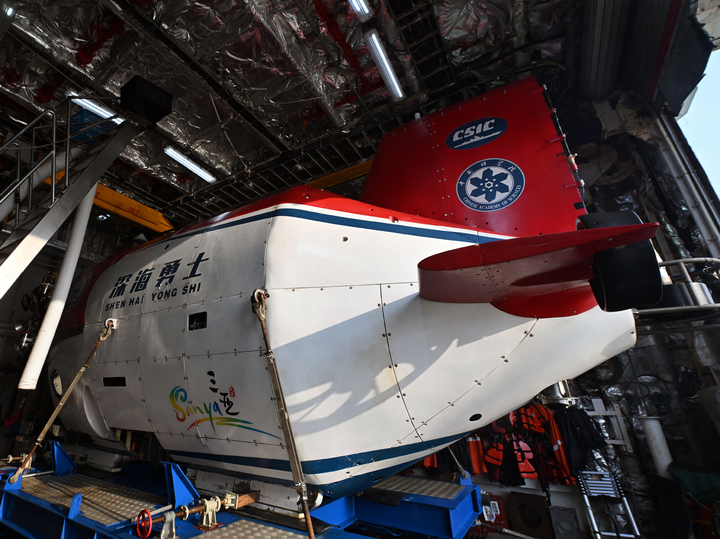 Chinese submersible Shenhai Yongshi («Deep Sea Warrior») with a crew in Sanya, south China's Hainan province, after the completion of the first archaeological excavations near the north -western continental slope of the South China Sea.
Official officials said the researchers were submerged on Saturday by the Shenhai Yongshi submersible, which can propel people to depths of up to 5,000 meters.
The planned research program consists of three stages, about 50 dives are planned from today to April.
“First, we need to find out the condition of the sunken ships, and then we can develop plans for archaeological excavation and conservation,”, says Song Jianzhong, researcher from the National Center for Archeology.
By mid-June, the researchers plan to estimate the area of distribution of both wrecks, collect extensive data and make archaeological records, extract some relics as samples and take samples of the surrounding seabed.
p>