


The expert urged to look at further developments
US Secretary of State Anthony Blinken's visit to China has ended. It cannot be said that the parties achieved any breakthroughs in two days, but the very fact of the dialogue that took place is already a kind of achievement. Analyzing the results of the «two-day diplomatic meeting».
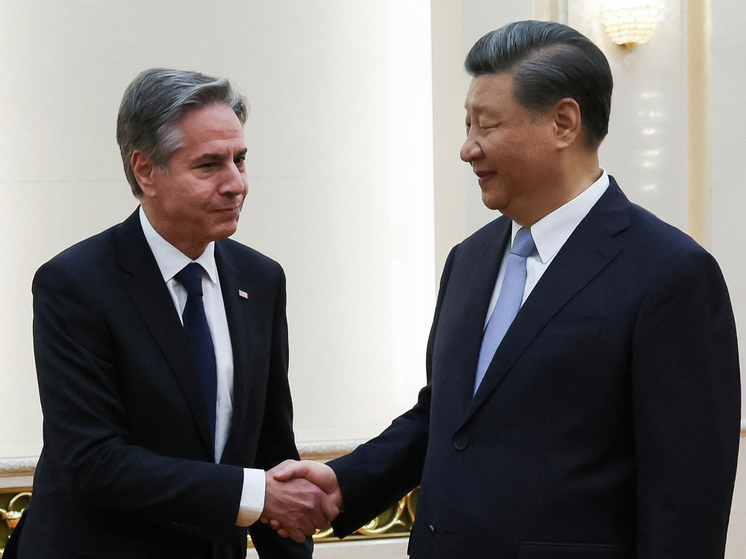
The time of Anthony Blinken's communication with Chinese politicians was melting before our eyes. On the first day of the visit, the head of the State Department spoke with Chinese Foreign Minister Qin Gang for 7.5 hours, with Wang Yi, head of the Office of the Commission of the CPC Central Committee for Foreign Affairs, for about 3 hours, and with Chinese President Xi Jinping for 35 minutes.
From the restrained statements of the Chinese side, it became clear that no significant breakthroughs were achieved. In any case, global disagreements have remained global disagreements. But neither side underestimated the dialogue. For example, Chinese leader Xi Jinping described Blinken's visit as follows: “The two sides have made progress and reached agreement on some specific issues. It's very good.»
In roughly the same vein, and in much the same language, Blinken himself assessed his trip, saying that the United States and China were making “progress” in getting relations back on track, as both sides agreed on the need to “stabilize” bilateral contacts between the superpowers.
But here's the main thing to catch — the American diplomat stressed during his speech after the talks with Mr Xi that key issues remain unresolved between the countries, but noted that he «hopes and expects that we will have better communication in the future.»
As CNN notes, the Secretary of State's talks with senior Chinese officials were seen as a key litmus test of whether the two governments could prevent a further slump in relations at a time of ongoing mistrust.
In general, this was to be expected even before Blinken's arrival in Beijing, when even American officials themselves were preparing the public for the fact that they were not going for achievements, but in fact to probe whether the contacts that had deteriorated in recent times were even alive. If evaluated in this way, then the goal has been achieved.
“I came to Beijing to strengthen high-level communication channels, clarify our positions and intentions in areas of disagreement, and explore areas where we could work together on our interests, agree on common transnational issues, and we have done all this. We are not going to succeed in every issue between us, but in a number of areas, under the conditions that we have set for this trip, we have made progress and are moving forward,” the top American diplomat said at the final press conference.
< p>Of course, Blinken understands and voices that one trip cannot solve everything. This is a process. One certainly cannot but agree with this, especially when from America, right during the diplomat's stay in Beijing, there was a call to return from the Celestial Empire through Taiwan. Such a stubborn initiative was proposed by a group of Republican congressmen. Their rationale was that «the most important thing would be to send a clear message that the US does not need permission from the Chinese Communist Party to meet with friends and allies in Taiwan or elsewhere.»
Blinken managed to hush up the matter by stating that the US supports the «one China» principle on the Taiwan issue and opposes any change in the status quo. The diplomat even expressed his conviction that the conflict over Taiwan «would lead to an economic crisis that would literally affect the whole world,» since «50% of the commercial container turnover daily falls on the Taiwan Strait, and 70% of semiconductors are produced on the island.»
Another unresolved issue is the restoration of communication between the US and Chinese military. As the American press emphasizes, contacts between the country's top military officials remain frozen, and two recent incidents (including the refusal of Chinese Defense Minister Li Shangfu to negotiate with US Defense Secretary Lloyd Austin) raised fears that tensions could escalate into conflict.< /p>
Yes, and on the situation in Ukraine, the United States, represented by Blinken, tried to show themselves as masters of the situation, although it turned out clumsily. The Secretary of State at the briefing said that China allegedly assured the United States that it would not provide military assistance to Russia, although Blinken himself mentioned that Beijing does not provide and will not provide such assistance to the Russian Federation and “there is no evidence that could contradict the assurances of the PRC. '.
In general, Blinken tried to squeeze out the maximum of diplomacy, so as not to inadvertently say too much against the host side. Although there was some tension in the communication between the representatives of the two countries, the lotus flowers in the Great Hall, where Xi and Blinken met, turned out to be (unexpectedly) a symbol of hope for normalization. Even the Chinese newspaper Global Times drew attention to this, noting that the visit fell on the lotus season. And the word «lotus» itself sounds in Chinese as «peace» and «harmony».
Director of the Institute of International Studies at Nanjing University Zhu Feng, in a conversation with Global Times, commented on the results of Blinken's visit to China: “I think that the overall result of Blinken's visit is positive. Both sides expressed their desire to initiate a mechanism for dialogue in order to reduce miscalculations, thereby demonstrating a willingness to manage cooperation in relations.” However, the expert emphasized that Washington should abandon the eternal narrative that China is supposedly the main villain that needs to be suppressed: “The US should really realize that cooperation with China and settling disputes between the US and China will really be in the common interests of people in both countries and internationally. community.»
«MK» in a conversation with sinologist Andrey Ostrovsky asked to summarize the visit of the head of the State Department to Beijing:
— I would say this: with what they came, they left with that. We signed various agreements (which the Americans and the Chinese mutually wanted) to open channels for cooperation. There were no specific agreements. The Americans again recognized that Taiwan is part of the People's Republic of China, and the Chinese voiced complaints about the visits of representatives of the American leadership to the island. This is how it ends.
By and large, there was nothing fundamentally new except for the very fact of the visit and except for the fact that lines for contacts were opened between the officials of the two countries.
– I would not say about improvement, since this visit is taking place, as the parties say, against the backdrop of serious confrontation. Maybe something has become better, but we need to look at further development. Recall that a group of congressmen appeared in the United States who suggested that Blinken, after visiting China, also visit Taiwan, which, from the Chinese point of view, is interference in the internal affairs of the PRC. It's hard to say whether Blinken will go there or not, but we'll keep an eye on it.
– To be honest, I didn't find any hints of something very new. The only exception is that if earlier the parties had practically no contact with each other, now the way for contacts has already been opened. It's better than nothing.
— Yes. Since relations are almost worse than before the Shanghai communique of 1972, try to somehow unfreeze these relations, which became especially aggravated after the Americans shot down a Chinese airborne weather balloon.