


A model experiment to simulate a mission on the Red Planet has begun in the USA
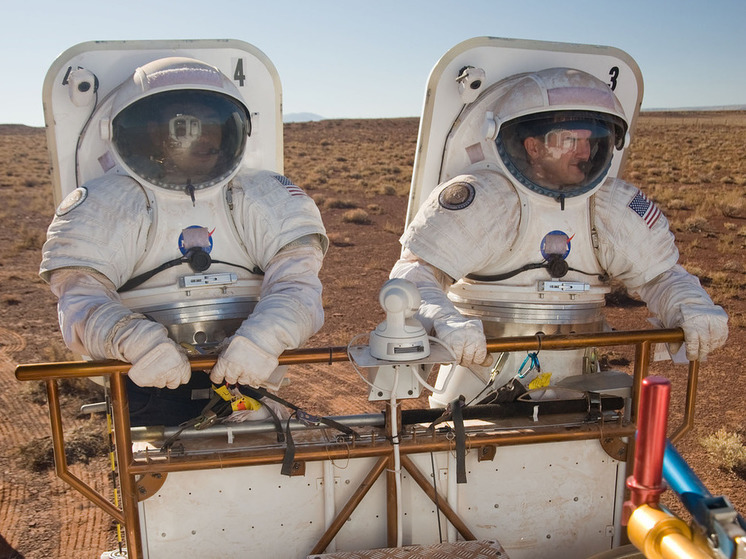
The Americans «flew» to Mars. NASA's annual experiment has begun to simulate the life of earthlings on the Red Planet. Four testers of the CHAPEA project (an analogue of our MARS-500) have already reached the Martian base.
CHAPEA is an abbreviation for – Crew Health and Performance Exploration Analogue
NASA first announced the admission of participants to this experiment back in 2021. The requirements were high: candidates had to be technologists, engineers or mathematicians, have piloting experience or military training. They were offered the same physical and psychological tests as real astronauts.
As a result, the mission was led by Commander Kelly Huston – scientific lady, researcher of human diseases. She was joined by: flight engineer – Civil Engineer Ross Brockwell, EMT Nathan Jones, and Nurse Alice Shannon.
All of them recently settled in the «Martian base» – simulation ground unit at the Johnson Space Center in Houston. Its total area is 158 square meters, the participants of the experiment will have to live in it for 12 months, until July 7, 2024.

The American mission is different from the Russian MARS-500 experiment, which was conducted in 2010-2011. That lasted more than a year (520 days) and was a comprehensive program that included a flight to the Red Planet, work in its orbit, relatively short descents to its surface and return to Earth. NASA has made a kind of «teleportation», – mission participants immediately found themselves on the surface of a 3D-printed habitat called Mars Dune Alpha. The base has crew cabins, a kitchen, work areas and two bathrooms. In addition, almost the same size as the «base» itself – an external environment that mimics the reddish sandy Martian surface. It is assumed that the crew members will spend a lot of time on it, supplementing the illusion with virtual reality glasses. Well, in their free time from walks they will cook food, communicate, clean the room, grow edible plants and conduct scientific experiments.
As in the Russian experiment, the organizers prepared for them emergency situations with serious delays in communication with the Earth , the failure of important equipment.
Let us recall that in November of this year, the Russians are also going on another long «interplanetary journey». This autumn in Moscow, within the walls of the Institute of Biomedical Problems of the Russian Academy of Sciences, the fourth stage of the long-term international experiment «SIRIUS» will start. This is a 365-day isolation experiment. It will be a complex model of significant events during the stay of astronauts on the space station and when landing on another planet. During the experiment, questions of adaptation of the human body to autonomy of stay, problems of long-term and regular extravehicular activity, interaction in a group, leadership in an international crew with different gender composition, and many others will be played.