


Anthoprocene-related geologic feature found in Canadian lake
Scientists say they have found a site that marks a new chapter in Earth's history. They identified a geologic feature that they say best reflects a proposed new epoch called the Anthropocene, a major step towards changing the official chronology of our planet's history.
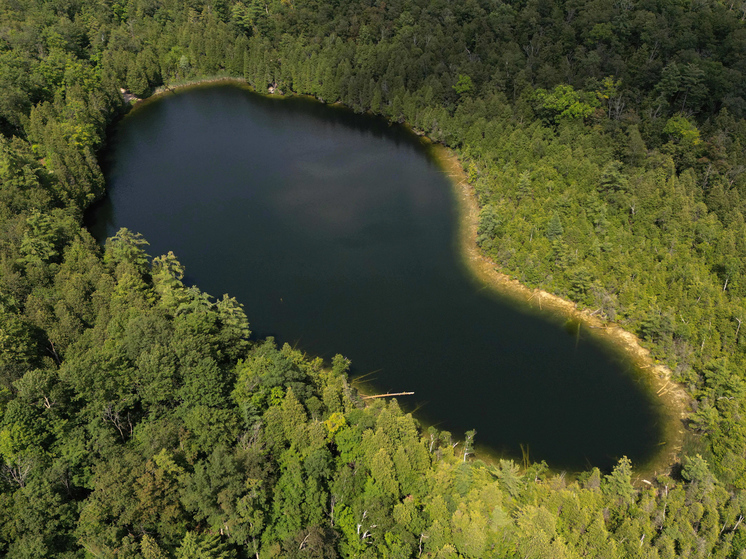
First proposed in 2000 to reflect how profoundly human activity has changed the world, the term «anthropocene» has become a widely used academic buzzword that brings together various fields of research, notes CNN.
“When With 8 billion people impacting the planet, the consequences are inevitable,” says Colin Waters, Emeritus Professor at the School of Geography, Geology and the Environment at the University of Leicester and Chair of the Anthropocene Working Group.
«We have moved into this new state of the Earth, and this must be defined by a new geological epoch,» added Waters.
The AWG, currently composed of 35 geologists, has been working since 2009 to include the Anthropocene in the Earth's official chronology. In 2016, the group determined that the Anthropocene epoch began around 1950 — the beginning of the era of nuclear weapons testing, geochemical traces of which can be found all over the world. Since then, the researchers have considered 12 sites that could provide the key evidence needed to support their proposal, nine of which were up for a vote.
On Tuesday, scientists announced the — Lake Crawford in Ontario, Canada, — which, according to their research, best reflects the geological impact of the Anthropocene.
However, not everyone in the scientific world agrees that the Anthropocene — is it a geological reality, or with the fact that the researchers have enough evidence to officially declare it a new era.
The geological time scale provides the official basis for our understanding of the Earth's 4.5 billion year history. Geologists break the history of our planet into eons, eras, periods of time, epochs and epochs — while the eon is the longest period of time, and the century is the shortest.
For example, we are currently living in the era of Meghalaya, says CNN. This is part of the Holocene epoch that began at the end of the last ice age 11,700 years ago when ice caps and glaciers began to retreat. The Holocene is part of the Quaternary period, the most recent division of the Cenozoic era, which in turn is part of the Phanerozoic era, which covers the period from 539 million years ago to the present.
These geological sections are often named after the place where they were first studied. The Jurassic period is named after the fossil-rich rocks in the French Jura mountains, while the Cambrian period takes its name from the ancient Roman name for Wales.
Andrew Knoll, Fisher Professor of Natural History at Harvard University, says this scale “very helpful” for his work as a paleontologist.
«When I say 'Cambrian', it means not only the time between 539 and 485 million years ago, but also an abundance of information about biota, the environment, tectonics, paleogeography and much more,» Professor Knoll explains. – It's a bit like talking about the Middle Ages or the Renaissance”.
If approved, the Anthropocene would be the third epoch of the Quaternary. It would also mean that the Holocene epoch was especially short — other epochs lasted several million years.
Each subdivision on the official timeline is also represented by a single geologic site, known as the Global Boundary Stratotype Section and Point (GSSP), which best represents what is new or unique in a particular chapter of Earth's history.
Each point usually marked with a «golden spike», often driven into the underlying layer of rock, although this may be a stalagmite or ice core.
For the Anthropocene, the proposed location of the «golden spike» — these are sediments from the bottom of Lake Crawford that reveal geochemical traces of nuclear bomb tests, specifically plutonium, a radioactive element widely found around the world in coral reefs, ice cores and peat bogs.
Crawford Lake was the winner after how the AWG voted in nine candidate precincts in three rounds. Other potential locations included a peat bog in Poland's Sudetenland, Lake Searsville in California, a seabed in the Baltic Sea, a bay in Japan, a water-filled volcanic crater in China, an ice core drilled in the Antarctic Peninsula, and two coral reefs in Australia and in the Gulf of Mexico.
Waters said it was very difficult to choose between the different sites and the votes were close, but he thinks Crawford Lake won because the proposed anthropocene depositional geochemical starting point is particularly accurate.
The lake is small, measuring 2.4 hectares, but it is exceptionally deep, almost 24 meters, and the deposits found at the bottom can be separated into annual layers for sampling for geochemical markers of human activity. This analysis allows scientists to see changes with annual resolution, says Francine McCarthy, professor of geosciences at Brock University in Canada, who studied the lake.
“The shape of the lake limits the mixing of the water column, so the bottom waters do not mix with surface waters. The bottom of the lake is completely isolated from the rest of the planet, except for the fact that it gently sinks to the bottom”, she explained.
Andrew Cundy, professor and chair of environmental radiochemistry at the British University of Southampton and member of the AWG, said that «the presence of plutonium gives us a clear indicator of when humanity became such a dominant force that it was able to leave a unique global «imprint» on on our planet”.
However, the choice of Lake Crawford is not the final decision on whether the Anthropocene will be recognized as the official geological unit of time.
The AWG will submit a proposal to formalize the Anthropocene to the Subcommittee on Quaternary Stratigraphy later this summer. If the members of the subcommittee agree with a 60% majority, the proposal will then be submitted to the International Commission on Stratigraphy, which will also have to vote and agree with a 60% majority in order for the proposal to be submitted for ratification. Both bodies are part of the International Union of Geological Sciences, which represents more than 1 million geoscientists worldwide. A final decision is expected at the 37th International Geological Congress in Busan, South Korea, in August 2024, CNN notes.
But some experts don't think the Anthropocene is rising to epoch-defining levels.< /p>
Stan Finney, general secretary of the International Union of Geological Sciences and professor in the Department of Geological Sciences at California State University Long Beach, said the stratigraphic evidence for the Anthropocene is relatively minimal — hardly the duration of human life — given the supposed starting point around 1950.
The scientist noted that the beginning of the Anthropocene could be determined in any number of ways, including the industrial revolution, which would lead to a much longer interval than offered at the present time.
“There is no doubt that humans have greatly influenced the earth system, and today we are facing incredible consequences. But it was a continuous phenomenon”, he said.
He also believes that the desire to formally recognize the Anthropocene may actually be more political than dictated by the geology on the ground. The term was coined in 2000 not by a geologist, but by the late atmospheric chemist and Nobel laureate Paul Crutzen, apparently in a rash remark at a conference.
Finney believes it is more accurate to describe humanity's profound impact on Earth as an ongoing geological event rather than as a formal epoch with a precise global start date. It is also possible, he said, that stratigraphers may decide that the Anthropocene does not rise to the level of an epoch, but it could be the fourth epoch of the Holocene — a much less memorable Crawford era.
Other scientists object to the term «anthropocene» because it implies the participation of all mankind in activities that have irrevocably changed the planet. Some researchers say that these changes are the work of a powerful and elite minority, and that this era would be more properly called the Capitalocene.
Waters thinks the AWG has a strong case for formalizing the Anthropocene, but he said that naming a new geological epoch «is a very conservative process» so there is no guarantee that the proposal will succeed. has already demonstrated its importance by opening a discussion between the natural, social and human sciences. Thus, the precise geological origin of the supposed epoch may not ultimately matter all that much.
“It is firmly established that human societies have a geological effect on the world and on earth systems. And that part is useful, he said. – It basically says, «Look, we're in business. We have transformed the world, and we must continue to think about it”.