

The impact of solar storms on human life is named
Sun activity reaches its peak earlier than scientists expected. As the sun approaches the peak of its current solar cycle, our star becomes more active. And, according to scientists, this peak may come earlier than predicted.
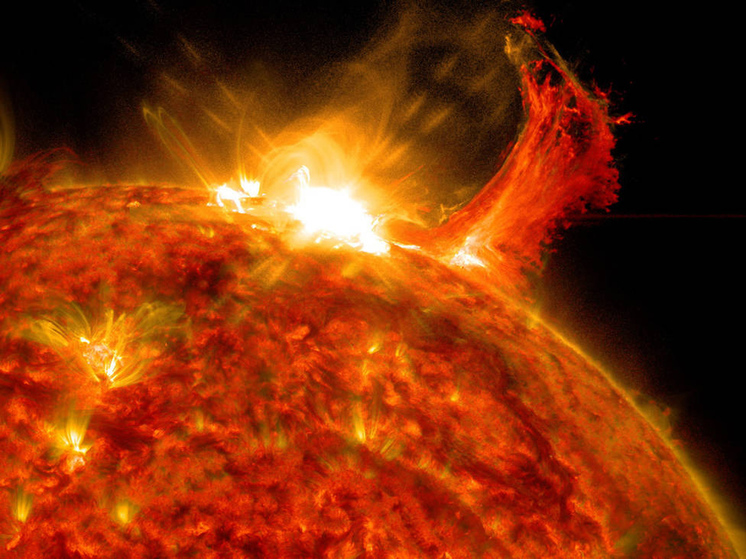
Approximately every 11 years, the Sun experiences periods of low and high solar activity, which is related to the number of sunspots on its surface. These dark regions, some of which can be as large as the Earth or larger, are driven by the Sun's strong and ever-changing magnetic fields, CNN tells CNN.
During the solar cycle, the sun will move from a quiet period to an intense and active one. During peak activity, called solar maximum, the Sun's magnetic poles reverse. The star will then settle down again during its minimum.
The peak of activity was originally predicted to begin in July 2025. Experts now believe that the cyclical peak is likely to occur in mid-to-late 2024.
The current solar cycle, known as Solar Cycle 25, has been filled with more than expected activity. Scientists at the National Oceanic and Atmospheric Administration's Space Weather Prediction Center in Boulder, Colorado, have already tracked more sunspots than were counted at the peak of the previous cycle.
“No two solar cycles are the same,” says Mark Misch, a researcher at the Center for Space Weather Prediction. – This solar maximum is the space weather equivalent of the hurricane season. This is when we see the strongest storms. But unlike the hurricane season, which lasts several months, solar maximum lasts several years.
The increased activity also included strong solar flares and coronal mass ejections, or large clouds of ionized gas called plasma, and magnetic fields that blast out of the Sun's outer atmosphere. Solar storms generated by the sun can affect power grids, GPS and aviation, as well as satellites in low Earth orbit. These events also lead to radio outages and even create risks for crewed spaceflight.
A well-known example occurred when a series of coronal mass ejections occurred on the Sun on January 29, 2022, causing the Earth's outer atmosphere to warm and expanded. This expansion resulted in the burning of 38 of the 49 Starlink satellites launched by SpaceX.
But an increase in activity is not unusual, and it will only continue as solar maximum approaches, CNN notes.
“It's completely normal, – says Dr. Alex Young, associate director of science for NASA's Heliophysics Science Division at the Goddard Space Flight Center in Greenbelt, Maryland. – What we see, in general, is quite expected. As you get closer to solar maximum, you see more and more sunspots appear in clusters. Sometimes these clots will be larger and last longer”.
As solar maximum approaches, sunspot clusters will form more frequently, resulting in increased activity.
“As we become more dependent on technology, on the power grid, on satellites, on aircraft and on GPS, the impact of space weather is increasing because these systems are affected by solar storms,” notes Mark Misch. – While this particular cycle is not remarkable from the sun's point of view, it is from our point of view”
The new solar maximum predictions were led by Scott McIntosh, Associate Director of the National Center for Atmospheric Research, and Robert Limon, Jr. researcher at the Goddard Institute for Planetary Heliophysics, along with his staff. The Institute is a partnership of the University of Maryland, Baltimore County, the University of Maryland, College Park and American University with NASA.
Instead of tracking sunspots, the researchers focused on what they call the «terminator», the point at which activity during one solar cycle disappears from the surface of the Sun, followed by a sharp increase in solar activity in the next cycle.
< p>Sunspots are considered the cornerstone of solar cycle prediction, but Robert Limon said he and his colleagues believe that tracking the magnetic activity that causes sunspots can provide more accurate predictions.
Once the solar maximum is reached, activity can persist for many years.
According to Lemon, the number of solar flares actually peaks after the maximum, according to Limon. The increase occurs in the rising phase of even solar cycles and in the falling phase of odd cycles.
“Effects peak a couple of years after the maximum, so the biggest impacts here on Earth will occur after the maximum,” the scientist said. – That's when you expect to see the biggest fireworks. Even if there are fewer sunspots, they are more productive”.
Although it usually takes about four years to go from solar minimum to solar maximum, according to Mark Misch, there is no simple peak for maximum because the sun is so changeable.
According to Dr. Yang, sometimes there are two peaks during some solar cycles when the northern and southern hemispheres of the sun are out of sync. This can happen when the number of sunspots in one hemisphere peaks at a different time than in the other hemisphere, resulting in a prolonged maximum.
A solar maximum can last about two years before everything subsides, which is means that the chance of solar storms could remain high longer than the actual peak, points out Mark Misch.
However, a more positive side effect of increased solar activity is the auroras that dance around the Earth's poles, known as the northern lights (aurora borealis) and the southern lights (aurora australis).
When charged particles from coronal mass ejections reach the magnetic fields of the Earth, they interact with gases in the atmosphere, creating multi-colored light in the sky.
Geomagnetic storms triggered by the sun in February and April caused the aurora to be visible in places where they are rarely seen, including far south in New Mexico, Missouri, North Carolina and California in the United States. as well as in the southeast of England and other parts of the UK.
Depending on location, auroras may not always be visible overhead, but they can also cause a colorful display on the horizon, according to Dr Young. For those interested in seeing more intense auroras in the future, he says, it might be worth heading to Alaska, Canada, Iceland, Norway, Scandinavia, or the upper peninsula of Michigan.
According to Mark Misch, while solar storms are most likely to occur at peak times, they can occur at any time during the cycle.
Space Weather Prediction Center teams use data from ground and space observatories, magnetic maps of the Sun's surface, and ultraviolet observations of the Sun's outer atmosphere to determine when the sun is most likely to trigger solar flares, coronal mass ejections, and other space weather events that could affect the Earth.
According to Bill Murt, the center's program coordinator, the center provides forecasts, watch hours, warnings to those affected by space weather as soon as possible, in advance, from several hours to several weeks.
Solar flares can practically instantly affect communications and GPS as they destroy the Earth's ionosphere or part of the upper atmosphere.
Energetic particles emitted by the sun can also disrupt spacecraft electronics and affect astronauts without proper protection for 20 minutes to several hours.
Material ejected with acceleration from the Sun during coronal mass ejections, can reach Earth between 30 and 72 hours later, causing geomagnetic storms that impact satellites and create upper atmospheric electrical currents that travel through the earth and can affect power grids.
Regions east of the Appalachian Mountains, the Upper Midwest, and within the Pacific Northwest are more prone to power outages, according to a USGS study, as the ground in these areas conducts current differently depending on its composition.
Storms also affect the flight patterns of commercial airlines, which are ordered to stay away from the Earth's poles during geomagnetic storms due to loss of communications or navigational capabilities.
Predicting when the next major solar storm will impact Earth is difficult. Extreme storms have happened before, such as the one that knocked out the power grid in Quebec in 1989, and the Carrington event of 1859.
The latter remains the most intense geomagnetic storm ever recorded, causing telegraph stations spark and catch fire.
If such an event were to occur today, it could cause trillions of dollars in damage and shut down some power grids for a significant amount of time.
The sun and its mysteries were mesmerizing humanity for thousands of years. The sun is the anchor of our solar system and provides the heat and light necessary for life to survive, but many questions remain about its interior, which determines its magnetic activity, notes CNN.
“On the one hand, it influences on our daily lives, says Mark Misch. – From the beginning we have organized our societies according to the seasons of the sun. But at the same time, it is a window to space”.