

Some levels of psychological selection cannot be passed even by experienced military pilots
A new recruitment for the detachment has been announced at the Cosmonaut Training Center. Whom its specialists want to see in their ranks and why people are needed in orbit at all, we talked with the deputy head of the Yu.A. Gagarin for Science and Development Vladimir Dubinin and his colleague, the head of the research laboratory for the selection and training of cosmonauts Boris Kryuchkov, who, by the way, celebrates his 80th birthday on July 17.
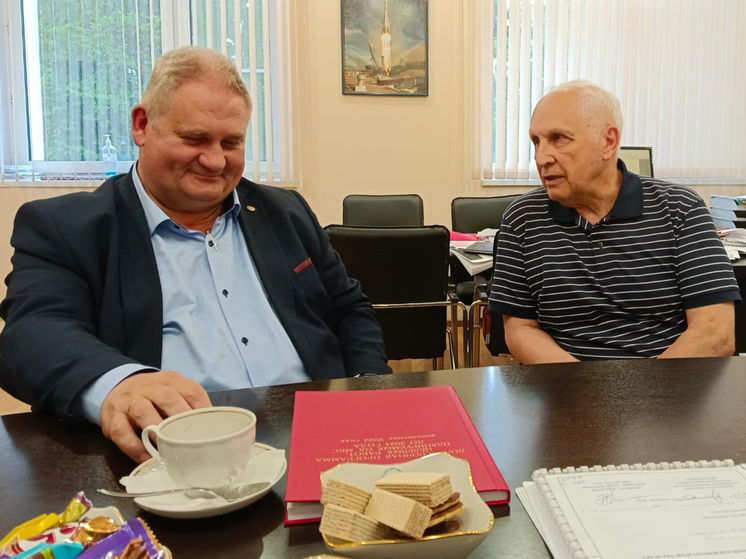 From left to right: Vladimir Dubinin and Boris Kryuchkov.
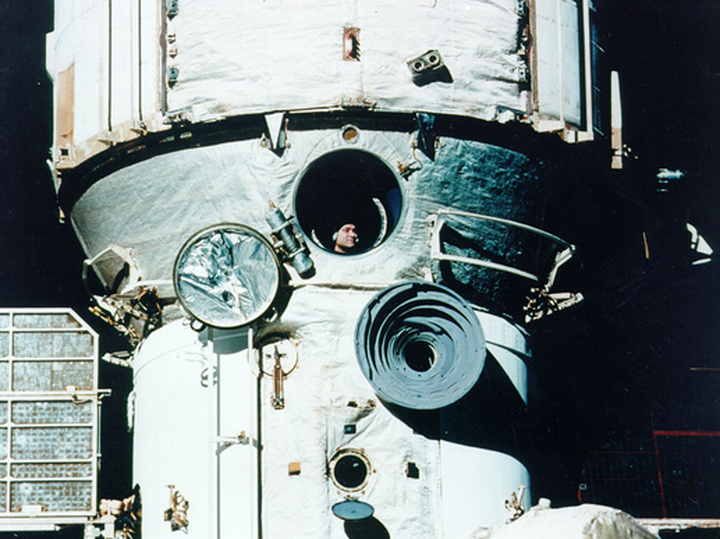 One cannot do without a man in space. Valery Polyakov at the Mir station. Photo: IBMP RAS
There are those who claim that manned cosmonautics has become obsolete, that with the existing satellite constellations it is possible to stop sending people into Earth orbit every year. And who, if not Vladimir Dubinin, a specialist in optoelectronic means and geographic information systems, who began working at the CPC almost 30 years ago, could say more about the capabilities of satellites. But he dispelled doubts:
— Geospatial data, of course, can be obtained using satellites, — says Vladimir Ivanovich. – The process of formation of sensors for remote sensing of the Earth (ERS), by and large, has been completed. We have devices with visible, ultraviolet, infrared, radio sensitivity ranges, and they have been working for the good of the country for a long time, but we still cannot do without an astronaut, since only he can most successfully solve operational problems.
The scientist gives an example of the uniqueness of the astronaut's mission:
– We conducted the Lens experiment at the Mir station in the 1990s, during which a crew member saw from a height such that he could not “see” the satellite’s “eye” in any way: flying over the Atlantic, he saw an underwater relief at a depth of 120 meters! It became clear to the organizers of the experiment that the phenomenon of atmospheric transparency manifests itself in this way. That is, it worked like a well-known lens, and the human eye universally adjusted to it — the equipment would not have worked like that.
The phenomenon in which the «eye-diamond» showed itself was nevertheless accidental and could not have practical significance. But the employees of the Center remembered him and began to specially train the cosmonauts in the detection and operational observation of certain phenomena from a height.
— We, in fact, began to teach them to «read», like a book, the surface of the Earth, — Boris Kryuchkov joins the conversation. — It would seem that for this you just need to know geography well … But, as it turned out, just knowledge is not enough for quick orientation from space. That is why we developed special techniques, simulators for astronauts, taught them how to “look” at the Earth correctly when flying on a laboratory aircraft.
As it turned out, at first they «looked» not quite correctly — they observed from space according to the technique used in aviation. It’s like there: if you need a specific object, for example, a ship, the pilot looks for it. But objects of observation from space are natural formations that do not have clear forms.
According to Boris Kryuchkov, an interesting technique for the rapid development of space geography was once proposed by cosmonaut-scientist Yuri Baturin. To begin, according to her, the survey of the area should not be through the lens, but with the global identification of the place, city, gradually narrowing the search area, and only having found the right one, turn to the camera for help.
— A person, moreover, should have a quick reaction, — adds Boris Ivanovich. “After all, a city, a lake, or a forest massif you fly by quickly—the cosmonaut has only a few minutes for all this. Moreover, it is not a fact that the object will appear in front of him in good “quality” — it may be in a haze from a fire, at an angle — the picture may be different.
b6b08a4.jpg» class=»article__picture-image» alt=»» />Boris Kryuchkov.
I wonder if astronauts can «see» the Earth at night.
“Not yet, but in the near future an infrared device for observation in the dark time of the day should come to the station,” Vladimir Dubinin answers. – In the future, far infrared devices will help astronauts with the early detection of dangerous asteroids.
In general, all the best recent developments, according to my interlocutors, should eventually migrate to the new Russian orbital station being developed. Until recently, it had the abbreviation ROSS (Russian Orbital Service Station). However, now it is simply called ROS, which, according to my interlocutors, is more correct: “What does “official” mean? Auxiliary? ROS is not an auxiliary station, it is the main, main one. In general, to the delight of many, the extra term was recently removed from the name.
“The new station will have greater spatial coverage,” says Vladimir Dubinin. — If at the current inclination of 51 degrees we do not see either the Northern Sea Route or the permafrost — we even see Moscow at an angle, then from the new station with an inclination of 97 degrees, our entire territory will be in full view. And it is the person on board the ROS who will have the ability to form complex measurements, tune the equipment to specific objects according to his own decision, and analyze the result. It should be noted that the ROS orbit is planned in the range of the lowest possible altitudes corresponding to sun-synchronous orbits, and this immediately provides advantages in terms of observation detail in relation to automatic systems placed in orbits with altitudes greater than one and a half times or more.
– A high-latitude station is an old dream of the CPC specialists, – Boris Ivanovich confirms, – this was justified in many R&D works with reference to its very large capabilities. The ROS is planned to be equipped with surveillance devices for all occasions. For example, according to the scientist, sailors are looking forward to operational information about the thickness of ice in the rapidly changing Arctic of late. Now we do not see it, and ice is a changeable thing, and specialists need to know its dynamics in order to lay routes for ships. The satellites we have alone cannot solve the problem here.
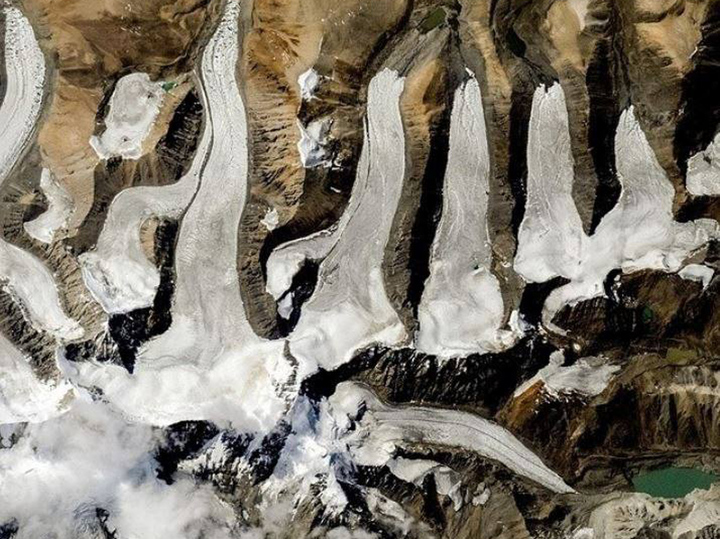 Knowledge of space geography allows cosmonaut Oleg Artemyev to take such wonderful pictures: Glaciers of the Himalayas mountain system, view from space. Photo: Oleg Artemyev
There is, according to my interlocutors, another «option» for the future Russian station — it can be used to extend the life of expensive orbital vehicles by repairing or refueling them directly in orbit. Our country has vast experience in a wide variety of repair and restoration work performed by cosmonauts in orbit. Consider also Hubble. The Americans once made five expeditions to this orbital telescope. As it turned out, in orbit after the launch of the Hubble, it turned out to be out of order — the main mirror was mounted with a defect, and the question was: how to fix it. It was required to either send a repair robot or people. We came to the conclusion that it is better to send people. The astronauts flew up to the Hubble on a shuttle, installed an optical corrector, and then the mirror worked normally. The telescope lasted longer than its resource, was serviced in five missions, and everyone was very pleased with this. It would also be possible to repair our faulty satellites, but using ROS.
“We “drag” a failed satellite to it, this is a non-trivial task, we look at what the problem is, we eliminate it in the EVA mode or, by immersing it in a sealed compartment, we send it back,” Vladimir Dubinin draws a diagram of such “maintenance”. . So, it will be at our national station that it will finally be possible to place a short-radius centrifuge, proposed by the Institute of Biomedical Problems of the Russian Academy of Sciences.
“It is assumed that such an installation will be able to return all human systems to their usual, earthly state in a short time by simulating the impact of the appropriate gravity on them,” says Dubinin. – This is very important so that after a long flight and landing on the Earth or another planet, albeit with reduced, but still not zero gravity, the astronaut can feel normal and begin the research program.
Despite the fact that the CPC is always ready to help with the setting up of experiments from other institutes at the station, its scientific department acted as the director of its own research.
— We already have a whole series of them, says Vladimir Ivanovich. – For example, now we are testing a very interesting material on the ISS (in cooperation with its developer, Belgorod University named after V.G. Shukhov) as a protection for astronauts from the effects of increased radiation.
There is an interesting experiment to study the adaptive capabilities of the astronauts' capillary system, which is subjected to a particularly strong load in space. In weightlessness, the liquid is redistributed to the head, and after landing — to the legs. Such drastic changes require a recovery period of up to two weeks for a person after returning to Earth's gravity. But if you better understand what happens to capillaries in weightlessness and apply certain preventive measures, rehabilitation will be faster. In principle, such changes in the capillary system are also inherent in long-term patients, which means that the result of our research can be applied in practical medicine. The goal of scientists is to study the dynamics of blood flow even more deeply in weightlessness and after the return of our astronauts to Earth.
Another interesting work, which has no analogue anywhere in the world. This is an end-to-end simulation on a large CPC centrifuge of all parts of a space flight at once. Nobody in the world has done this before.
— Now experts are testing the astronaut for the tolerance of overload up to 8 g, given that the acceleration of the spacecraft during launch or landing fluctuates between 2 and 4 g. We combined the loads during launch and landing with a specific effect on the vestibular apparatus, which usually overtakes an astronaut after arriving at the station, explains Vladimir Dubinin. — There is a way by which you can cause the conditions of «chatter» in flight (they suffer from seasickness), plunging the future astronaut into conditions similar to weightlessness. This is done while rotating on the same centrifuge. To do this, you only need to lower the headboard on which the astronaut lies in the spacecraft, 7-15 degrees below the usual level and set a special rotation speed. Thus, in 40 minutes, a person who is preparing to experience all flight modes — launch, orbital section and descent — will better understand what awaits him, not only from the stories of experienced space explorers.
Announcing a new open recruitment for cosmonauts, specialists are waiting for representatives of various professions with the necessary set of knowledge and good physical training. When selecting them, the Cosmonaut Training Center takes into account all the useful methods developed in Russia and abroad — including NASA, the European, Japanese, Canadian space agencies, China. However, differences still exist.
“Roscosmos has created its own unique technology for selecting astronauts, based on a harmonious combination of various methods and means, which makes it possible to select really worthy candidates for astronauts in a fairly short time,” says Boris Kryuchkov. – For example, if the Japan Space Agency tests the level of knowledge of mathematics by testing applicants orally and in writing, our methods, both in mathematics and in physics, are designed so that only oral tests are enough for us. We immediately understand whether this person will master a complex technique or not. In general, in addition to tests for compliance with the requirements for education and professional suitability, the technology includes medical, psychological selection, tests for physical fitness.
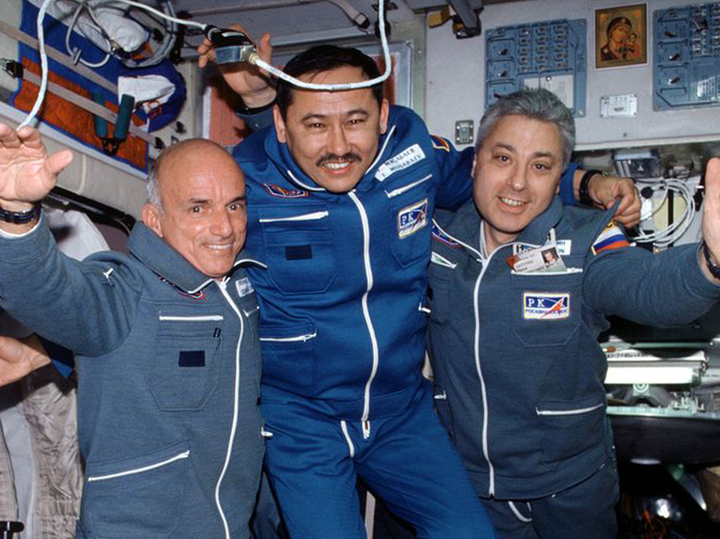 Soyuz TM-32 crew: Dennis Tito (USA), Talgat Mussabaev and Yuri Baturin.
Boris Ivanovich gives as an example a stand for manual docking of a spacecraft to the station, which, even on Earth, very well reveals the level of spatial orientation of a cosmonaut candidate during the selection period. Some levels of psychological selection, according to him, even experienced military pilots cannot always pass.
“The pilot often flies one on one with the sky, and in space a person must work to achieve the goal in a team,” explains Kryuchkov. – To understand whether this or that cosmonaut candidate will be able to find a common language with his comrades in conditions of prolonged isolation, in weightlessness, a complex system of tests helps. For example, one day a girl comes to us for a preselection, passes various tests perfectly, and there remains a jump from a three-meter springboard… She stands on the tower for a long time, and then turns around and announces to everyone that she refuses to participate in the preselection any further. What happened? She never jumped and got scared. This is the test, that a person must check whether he can cope with his fear. We proceed from the fact that he can be left alone in space with the most sophisticated technology, he can be alone in outer space and at the same time he will not have the right to panic. Therefore, tests for courage are both men and women. We must select the best of the best to ensure that they overcome everything.
It happens, according to Boris Ivanovich, that not all standards are immediately given to the applicant, but he comes back next time and passes everything perfectly.
— This is highly appreciated by us, which means that a person can achieve his goal, even overcoming serious obstacles, — says the scientist.
Vladimir Dubinin gives a reverse example:
— Somehow, at an interview, they ask a question to one young man: “Do you drive a car?”. “No,” he replies. — «Have you tried it?» — “Yes” … If he had said that he hadn’t even tried, a different opinion would have formed about him — maybe he didn’t want to yet — this, in principle, is not scary for an astronaut, because you don’t need to drive a car in orbit. But in our case, it turned out that he wanted to, tried to pass the exams, but, having survived another failure, he gave up. What we see: a person is not able to fight for the achievement of the goal.
– In addition to good health, athletic physique, we pay attention to the experience of working in extreme conditions, we ask if a person has worked as a rescuer, has he dealt with complex equipment. What does he even know how to do? Maybe skydiving, sailing a yacht? Boris Ivanovich confirms. Life experience can say a lot about a person. For example, our only woman in the cosmonaut corps today — Anna Kikina — is a model of a person with a forged team spirit, strong psychological hardening, because she was not just engaged in rafting — overcoming stormy mountain rivers, but was a group commander, actually led the crew in extreme situations.
Prepared for future cosmonauts and a humanitarian block of questions. Do they speak at least one foreign language, how literate are they in their native Russian, do they know well the history of the country and the history of cosmonautics in particular?
“If he mumbles about who Sergey Pavlovich Korolev, Alexander Pavlovich Alexandrov (Soviet cosmonaut, Hero of the Soviet Union. — Auth.) or Alexander Yuryevich Kaleri (cosmonaut, one of the members of the selection committee of the TsPK. — Auth.) is, we will just be offended,” says Dubinin. Because it's impossible not to know! I do not forgive ignorance about such pillars of Russian cosmonautics even to my students (in the autumn semester I teach remote sensing of the Earth at the Moscow Power Engineering Institute). On the eve of the next exam, which is scheduled for October 4 (Launch Day of the first Earth satellite. -), I ask the student: “What is the date tomorrow, what is it connected with?”. He answers: «October 4», and … further — silence. In general, I don’t allow such people before the exam, as well as those who won’t say what April 12 is connected with or who invented the incandescent light bulb.
Sometimes we ask potential astronauts “strange” questions that are not directly related to astronautics. For example, how long ago and at what production was our applicant in the theater? What books did you read? All this shows how full-fledged a person is in front of us, which is very important in our business.
At my request to compare the level of education in the exact and humanities of candidates of different generations, both interlocutors smile sadly: “Of course, the level is not improving …”.
— There was a case that even after a well-known technical university, graduated with honors, the guy did not pass our tests in mathematics and physics, — says Boris Kryuchkov. At the same time, they did not ask him anything «transcendental». Previously, this was impossible to imagine. And why is this happening? — you ask. I partly know the answer, my wife is a physics teacher at school. So she says that there is a sharp decrease in the number of hours for the study of this subject. Previously, it was allocated 6 hours a week, then it was reduced to 4. Today, only 2 (!) hours are devoted to physics … The second problem associated with our children's ignorance of history stems partly from what society presents to children. I once bought an atlas about astronautics for my grandson, began to read, and there the whole history is presented only by shuttles and Apollos, and not a word about the first Soviet satellite, about our other outstanding achievements, in which our country was a pioneer.
But nevertheless, with a noticeable drop in the general level of education among young people, the leaders of the scientific block of the CPC also note advantages that were not noted by previous generations, and even by themselves. This is knowledge of computer technology, the ability to program, good knowledge of foreign languages, experience in testing space or aviation equipment.
The young people who will be accepted into the cosmonaut corps, if everything goes according to plan, will have to work on a new orbital station with a different orbital inclination after completing the training, and, possibly, someone from the current set will fly to the moon. This does not mean that they will now be subject to any special requirements — for example, to have an innate resistance to increased radiation or the absence of an allergy to moon dust. For now, everything will be the same as during the previous sets. However, experts are already supplementing the training with some special elements, taking into account the fact that, perhaps in the future, the current members of the cosmonaut corps will have to land on other bodies of the solar system. For example, they test the performance of only crew members who have arrived from orbit, because they will not have the opportunity to lie down when they arrive on the moon. Again, as in the distant 1960s, when the Soviet Union was preparing a lunar detachment of cosmonauts, they began to learn how to fly a helicopter. Why by helicopter? — you ask. Because it is the only vertical takeoff and landing technique to date, most reminiscent of the one that will be used on the moon.
class=»article__picture-image» alt=»» /> Model of a Russian lunar station. Photo: Roskosmos
– We are already studying the features of the camera work of our cosmonauts after a space flight, using the schemes that we used to train with then Alexei Leonov, Vladimir Shatalov on Mi-4 helicopters, — says Boris Ivanovich. — For example, we simulate on a helicopter a glide path (landing trajectory. — Auth.) to the Moon on instruments, with a closed porthole shutter. The pilot must pass along the glide path for a certain time before the flight and after the space flight.