


Roskosmos announced the start of preparations for the launch
Representatives of the Space Research Institute of the Russian Academy of Sciences arrived at the Vostochny cosmodrome to check the Luna-25 equipment before launch. It is scheduled for the first half of August. The device, if everything goes according to plan, will reach the area planned for research in the vicinity of the south pole of the moon for 10 days, and upon arrival, it will conduct studies of the lunar exosphere and soil for a year.
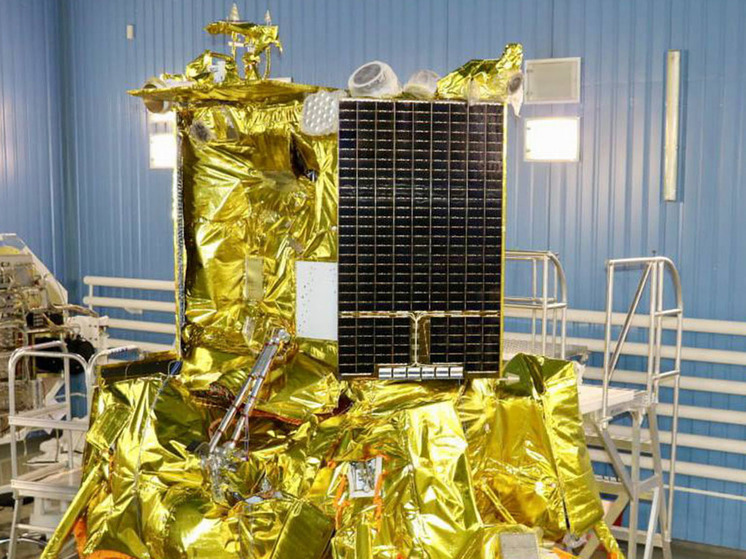 Luna-25 apparatus. Photo: Roskosmos
The Luna-25 spacecraft is the first Russian lunar vehicle that continues the sequence of Soviet automatic lunar stations. Its launch and landing on the Moon is the first part of the Russian lunar program implemented by the NPO named after S. A. Lavochkin (part of Roscosmos) and the Space Research Institute (IKI RAS) for the study and practical use of the Moon and circumlunar space.
< p>According to preliminary calculations of specialists, the device is planned to land in the vicinity of the South Pole of the Moon at a point corresponding to 69 degrees south latitude and 40 degrees east longitude, not far from the Boguslavsky crater.
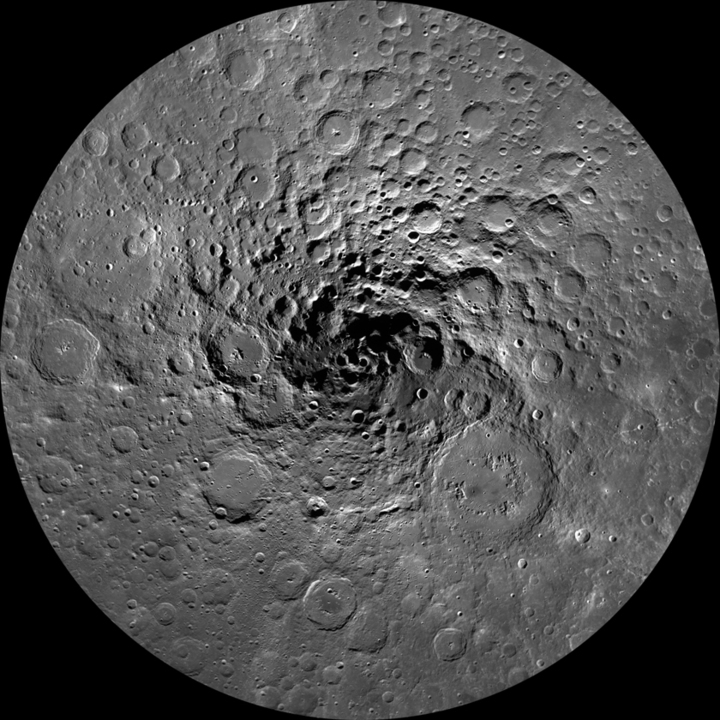 South Pole of the Moon
— The apparatus, if everything goes as it should, will land in the polar region for the first time in the history of astronautics, — says Maxim Litvak, head of the laboratories of the IKI RAS. — It is important for us that the place meets all the necessary criteria: the slope of the terrain, which should not exceed 15%, the illumination by the Sun, which should be at least 40% of the lunar day (they last about two Earth weeks). — In addition, constant radio visibility of our apparatus from the Earth should be ensured. The flight of the spacecraft to the Moon should take from four and a half to five and a half days. Having reached the lunar polar orbit, the station will stay on it for three to five days, after which it will brake and go down to the area proposed by the scientists of our institute.
It is noteworthy that the Indian apparatus «Chandrayan-3» has been on its way to the Moon since July 15, but its orbit is calculated in such a way that the landing should take place two days later than the landing of our «Luna-25». So, if we succeed, Russia will be the first in the history of cosmonautics to land its «envoy» in the polar region of the Moon. We wish the Indian spacecraft to land just as well, the two spacecraft on the surface will be separated by approximately 10 degrees east longitude.
The goal of the Luna-25 project is primarily to develop the soft landing technology — we must learn anew land on other planets, secondarily in the study of the surface of our satellite in the region of the south pole.
The design of «Luna-25» is divided into two parts: lower and upper. The lower one is a landing gear with cushioning supports. On this device, the propulsion system of the apparatus is fixed, with the help of which the trajectory of the flight to the Moon is corrected, braking during deorbiting and soft landing. The lower part also contains fuel tanks, sensors, antennas and a dredge arm.
In the upper part there is a panel with service equipment and scientific instruments. Here are the solar panels, the radiator of the thermal control system, the power source and the electronics of the station.
— Solar batteries are not directed upwards, as in all previous stations, but to the sides. This is because the Sun at the lunar pole rises very low above the horizon, almost like in our Norilsk. Having risen on the lunar pole to a high mountain, we will never lose sight of it. On the one hand, landing a spacecraft on a mountain would be beneficial for the power supply of our station, but on the other hand, it would create a big risk during landing.
According to Igor Mitrofanov, the idea to land the spacecraft on the south pole of the moon was first based on the data that were obtained at the beginning of the century, including from our Russian neutron telescope LEND, installed as part of the cooperation program between Roscosmos and NASA on the American lunar orbiter LRO (Lunar Reconnaissance Orbiter LRO).
“These data showed that the polar regolith contains many volatile compounds of cosmic origin, starting with water and ending with complex molecules that comets brought to the Moon,” says Igor Georgievich. — We compare the pole on the Moon with a natural refrigerator — here for hundreds of millions of years, layers of hoarfrost of all cosmic volatile substances that have ever fallen on our satellite have been accumulated and preserved.
Luna-25 instruments will study the composition of these substances and assess the mass fraction of frozen water in the regolith. If there is enough water, people who fly to the Moon after automatic devices will not have to take water with them from Earth. It will be needed not only to quench thirst, but also to produce oxygen, and in the longer term, hydrogen rocket fuel for future interplanetary flights.
So, the scientists who arrived at Vostochny will have to complete the installation of scientific equipment, in particular the ARIES-L ion energy-mass analyzer, within two weeks. This is a device created at IKI RAS, which will measure the composition of the lunar exosphere (a more rarefied plasma-dust shell than the atmosphere). In addition, scientists will be able to use this device to study the interaction of the solar wind with the lunar surface.
Employees of IKI RAS will also have to measure the background radiation on board the spacecraft. This background must be known for the experiment with the ADRON-LR neutron and gamma detectors. On the Moon, he will study the elemental composition and hydrogen content in regolith using active neutron gamma spectroscopy. The device will illuminate the soil with neutrons to a depth of about 60 centimeters.
In addition to the above-mentioned devices, the scientific equipment includes the following:
BUNI, which provides the collection, storage and transmission of telemetric scientific information;
LASMA-LR is a laser mass spectrometer for measuring the chemical, elemental and isotopic composition of regolith samples;
LIS-TV-RPM is an infrared spectrometer for studying in the visible and infrared ranges the mineralogical composition of the surface layer of the Moon's regolith and its water content;
PML is a dust monitor for studying the physical characteristics of the lunar dusty exosphere and surface regolith, which is scattered due to the fall of micrometeorites;
LMC is a manipulator arm with a range of 1.5 meters for taking soil samples from a depth of up to 40 cm and delivering them to the LAZMA-LR analytical device. During the period of operation, he will have to take at least 30 samples with a volume of up to 2 cubic cm each;
— STS-L — a television system for panoramic shooting of the surface in the landing area, for shooting the surface during landing of the vehicle and for stereo shooting of the working field LMK.
The launch of Luna-25 into space will be carried out by the carrier rocket Soyuz-2.1b in a convenient “astronomical window” on August 11 (backup date August 12). «MK» will monitor the implementation of the mission.
Help «MK» A lunar day lasts 28 Earth days, that is, a period equal to its circulation around the Earth. Accordingly, a day on the Moon lasts about 14 days, and the same number of nights.