


Laser mapping makes amazing find
Laser mapping helped find a lost Mayan city in the jungle. Three four-hour flights high above the jungles of Campeche in Mexico's Yucatan peninsula have unearthed a hidden gem: a lost city that was probably abandoned over 1,000 years ago.
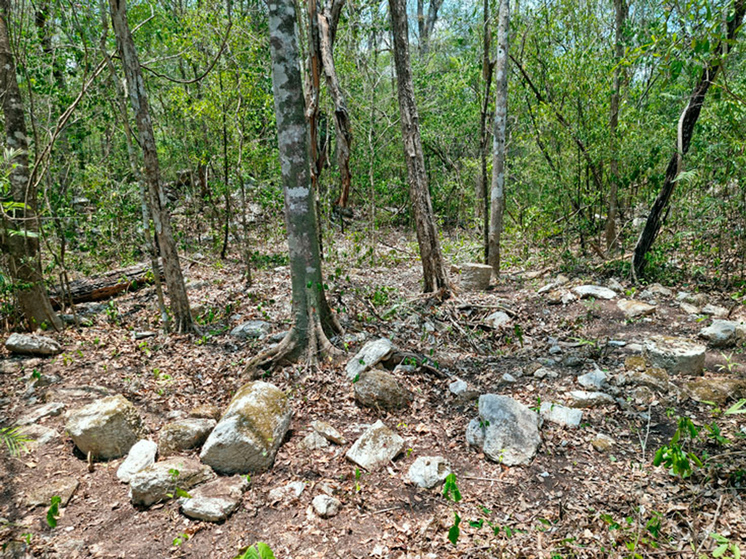 < span class="article__picture-description" itemprop="caption">Photo: inah.gob.mx
For Juan Carlos Fernandez-Díaz, an assistant professor of civil engineering at the University of Houston, who discovered the city in March during an aerial archaeological survey of the area, the whole thing took one day, says CNN.
< p>Over the past decade, the scientist has been a pioneer in the archaeological application of lidar – airborne equipment for detecting light and rangefinders, which can detect structures hidden by dense crowns of trees and other vegetation — relics that in some cases reveal traces left by a vanished civilization.
Subsequently, archaeologists surveyed the site, which they called Okomtun, for six weeks in May and June and found structures 15.2 meters high, reminiscent of pyramids, ceramics and carvings, which they believe date from the period between 600 and 900 AD , known as the late classical period in the history of the Mayan civilization.
“When we see lidar images, we see that there is something amazing, but the real discovery comes only after a lot of research”, said Fernandez -Diaz, who is also a co-investigator at the National Center for Airborne Laser Mapping.
While LiDAR showed the location of the structures, archaeologist Ivan Shpriyts — researcher at the Slovenian Academy of Sciences and Arts — was still facing a huge obstacle when he and his team went to survey the area.
Unused trails and roads brought them fairly close to the dig site, but the explorers had to cut their way through the dense jungle, using machetes and chainsaws to chop down trees and cut through other vegetation to get to what Spreitz describes as a «big spot»; .
“When we got there, we saw that the buildings were really massive”,» said the archaeologist.
The Mayan civilization is best known for its pyramidal temples and impressive stone structures that were found in southern Mexico, in Guatemala, Belize, Honduras and El Salvador, CNN notes.
Ivan Spreitz and his team discovered three squares with large buildings and a ball court. He said that the abandoned city he found was similar to other Maya cities of the same period, but also had «certain features».
“For example, we have some very curious architectural complexes of buildings that are located almost concentric circles. So we can only guess what it could be. Perhaps there were markets”, — said the archaeologist.
During the six-week study, Spreitz and his colleagues conducted an archaeological survey and dug a test hole measuring 2 by 2 meters, and the found fragments of ceramics helped them to understand the age of the site. They plan to return next year for further investigation.
 Photo: inah.gob.mx
Remote sensing technology, first used in archeology at the turn of the century, revolutionized the field, especially for researchers working in densely populated areas that are difficult to explore on foot, such as Central America, Spreitz said. «Now we can practically see through the vegetation,» he said.
From an aircraft or, in some cases, a drone, a lidar sensor keeps track of the time it takes for each laser pulse to return and uses that information to create a three-dimensional map of the environment below, notes CNN.
“The simplest analogy is like playing tennis, you know, you basically throw the ball at the wall and see the ball come back and basically measure the time it takes to get to the wall and back. And because it is a laser, it travels at the speed of light” explained Juan Carlos Fernández-Díaz.
He has mapped over 20,000 square kilometers of the jungles of Central America and has been involved in 45 archaeological projects, including the discovery of the largest and the oldest Mayan temple near Tabasco in Mexico, and tens of thousands of Mayan structures and settlements in the jungles of Guatemala.
A study of such sites could shed light on the origins of cities and social life, and whether large building projects were required in the past to support powerful elites and any kind of centralized authority. However, in the case of the newly discovered city, many questions remain unanswered, CNN points out.
It may take years to completely excavate Okomtun and gain a deeper understanding of the site and why it was abandoned. According to him, many once densely populated settlements, especially in the south and central part of the Yucatan Peninsula, were abandoned in about 200 years in the ninth and tenth centuries.
Ivan Spreitz says that people left these cities in a number of ways. reasons — soil depletion, overpopulation, depression, prolonged drought and hostilities, — but researchers don't know what was the main cause or sequence of events.
Although LiDAR saves time in the research process — in some cases, one day in the air can replace the entire life of an archaeologist on earth, — Spreitz says the work he does is still quite expensive.