


The currency of some countries can become a ballast for our economy
The Russian ruble, although at times its exchange rate staggers to different countries, in spite of all the sanctions, expands its influence in the world. A new confirmation of this was the statement of the Deputy Prime Minister of the Russian Federation Victoria Abramchenko on the transition to rubles in the export of agricultural products. The draft of such a decree is being discussed in the government and it is expected that the document will be signed by the president.
And the president, by the way, during the plenary session of the Russia-Africa humanitarian forum, announced the need to switch financial settlements with African countries to national currencies, including the ruble.
According to Abramchenko, for the agro-industrial complex, such a document will simplify access of friendly countries to the food market and pay for products in national currency. “This is the protection of Russian exporters from friendly countries from the thoughtless sanctions pressure imposed by Western countries,” she stressed.
It looks like Russian food is following in the footsteps of gas. Recall that since the spring of last year, Russian pipeline gas has been sold for rubles to «unfriendly countries.» Thus, Moscow protects financial receipts for gas from possible blocking.
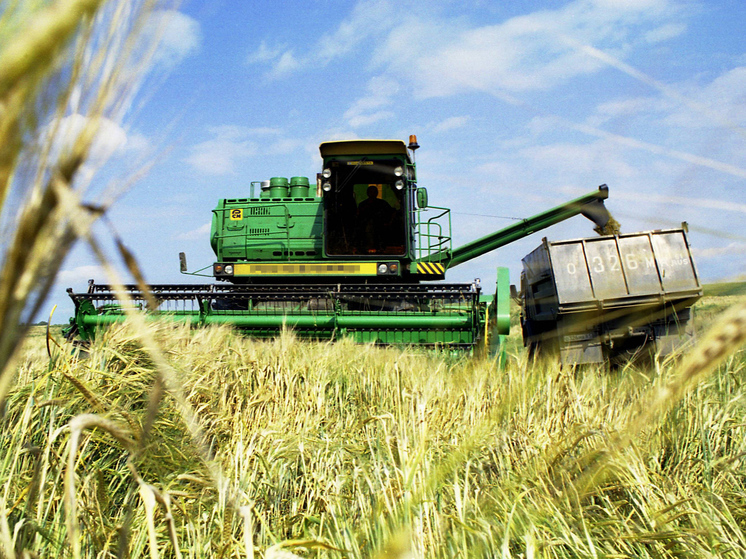
Everyone knows that Russia is a major exporter of agricultural products. At the end of 2022, it brought food sales to $41.6 billion. The most exported crop is, of course, grain, in the last agricultural season we exported a record 60 million tons. Other sectors of the agro-industrial complex are also becoming “on the wings”. The volume of chicken export last year increased by one and a half times compared to 2021. In the first 6 months of this year, almost 60% more pork was supplied to foreign markets than in the same period in 2022. Russian vegetable oil is also in high demand among foreign buyers.
In total, agricultural products are supplied to 160 countries of the world. And it is clear that Moscow wants to reliably protect the financial proceeds from its supplies from outside encroachments — blocking as a result of Western sanctions. However, it is not entirely clear whether the Russian economy will benefit if we switch to national currencies in payments for agricultural supplies. After all, our counterparties, in general, will not be the richest countries in Africa, Asia and Latin America.
And here is not the best example from the energy sector. As you know, the situation with settlements with our Indian partners, who buy energy resources for rupees, is stuck. By the end of the year, they may accumulate in Russia about 40 billion dollars — in terms of rupees. What to do with such a mass, if India buys energy resources for 50 billion dollars, and supplies us with its goods for 3.5 billion? And after all, rupees are not so easy to convert into some other currencies.
Will such a trade imbalance result if we switch to mutual settlements with other countries in national currencies?
— The main task of such financial mutual settlements is to remove the risks of blocking them, — says financial analyst, candidate of economic sciences Mikhail Belyaev. — When using national currencies, such dangers are excluded. However, this arrangement is beneficial in trade with countries with which we maintain a zero trade balance. That is, you get as much currency as you pay with your own. As soon as there is a disproportion due to trading operations, the question immediately arises: what to do with this excess currency? The counterparty may have restrictions in external relations with other states and, in fact, there is nowhere to “attach” this currency.
— Of course. If they have a positive trade balance, Russian rubles will always find a use. At least use them in settlements with third countries that also trade with us.
Here, perhaps, is the main problem in the transition to mutual settlements in national currencies. With the accumulation of «illiquid assets» on the accounts, it is not clear what to do with it. It is possible to conclude an additional agreement that, in order to pay off this imbalance, the country must additionally deliver its goods. But it may also be that the trading partner has nothing special to offer…
— Back then it was easier, the state trade and planning worked. And today these operations are carried out by private companies. And it is necessary to find a structure that would agree to such risks. As I said, the main thing here is to remove trade from risks.
That is why the problem of creating a collective supranational currency that would serve countries interested in this kind of settlements and payments, such as BRICS, is now clearly emerging.
— It's not about them. And rubles, and dollars, and euros are instruments that serve resources. There is a lack of a normal monetary policy aimed at stimulating domestic production. I sometimes compare our business environment to a pool filled with jelly instead of water. And in order to increase the speed of swimmers, we change bedside tables, lanes, invent new swimming trunks, goggles and caps. But it is still impossible to swim in jelly …