


Russian cosmonauts previously conducted a similar experiment to grow a thyroid gland
The stem cells from which spherical «mini-brains» will be grown in space arrived on Friday around 13:00 Moscow time at International Space Station. They were delivered there by the American cargo spacecraft Cygnus («Swan»).
 Cargo ship Cygnus
According to NASA, the total weight of the cargo was more than 3.7 tons. These are food, equipment and materials for scientific research, including a unique experiment on growing three-dimensional spherical models of the human brain from stem cells.
These cells, obtained from the skin of an adult, under the influence of various chemical influences, can transform into cells of any type in the body.
At the station they will try to «send» them on the formation of neurons to send electrical and chemical signals to the brain, as well as on the creation of two more types of brain cells – microglia and astrocytes. The task of extra cells is to maintain contacts between nerve cells and protect the brain from infections.
All three cell types are expected to «assemble» together, forming small spheres – «spheroids» that can be used to model diseases of the human brain and to test drugs.
According to American scientists, space weightlessness can become a more favorable environment for growing spheroids than gravity. Having grown mini-brains-spheroids, the astronauts, under the guidance of cell biologists, will test gene therapy on them.
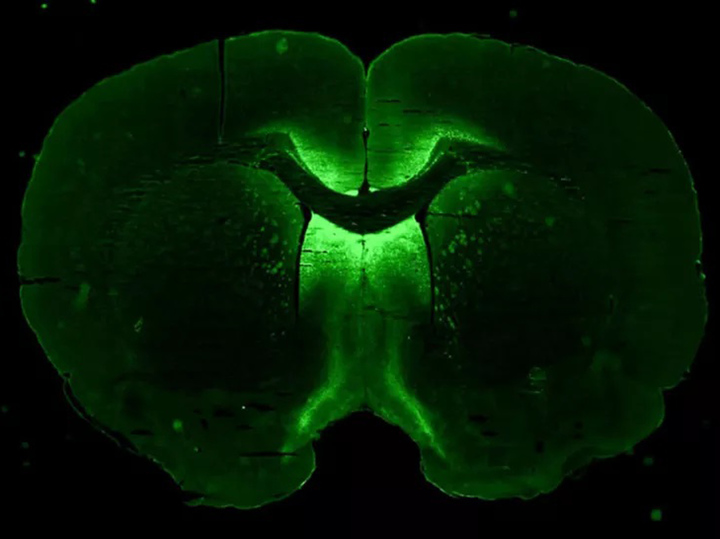 A three-dimensional structure that was obtained by scientists in the laboratory from brain cells. Glowing green cells are neurons. Image courtesy of NASA Axonis Therapeutics, Inc.
By the way, this is not the first time such an experiment will be carried out in space. First, about 6 years ago, American scientists created mouse cartilage tissue on the ISS, then, in 2018, Russian cosmonaut Oleg Kononenko received cartilage tissue from human cells and a fragment of the first living organ – mouse thyroid gland using a domestic magnetic 3D bioprinter. It was a clot of tissue levitating in a container of special gel.
As explained at the Institute of Biomedical Problems of the Russian Academy of Sciences, a 3D bioprinter is the same printing device that uses living material instead of ink, from which any three-dimensional form can be printed. Of course, it is much more difficult to work with living cells, since you need to make sure that they are not damaged while in the «cartridges»; printer. To insure, scientists have learned how to create the so-called cellular aggregates – spheroids, representing balls with a diameter of about a millimeter, consisting of hundreds of cells.
It is easier for such balls to line up into something like an organ, levitating in weightlessness in a special gel.
Russian biologists have confirmed the plus space microgravity during the formation of cellular tissues, – it does not allow cells to settle to the bottom and helps to form symmetrical spheroids. A 3D printer is an analogue of the eardrum from living cells (spheroids were assembled from them) and collagen.