


Colossal Whale
An ancient colossal whale recently discovered in South America may be the heaviest animal ever to have lived on Earth, according to a new study.
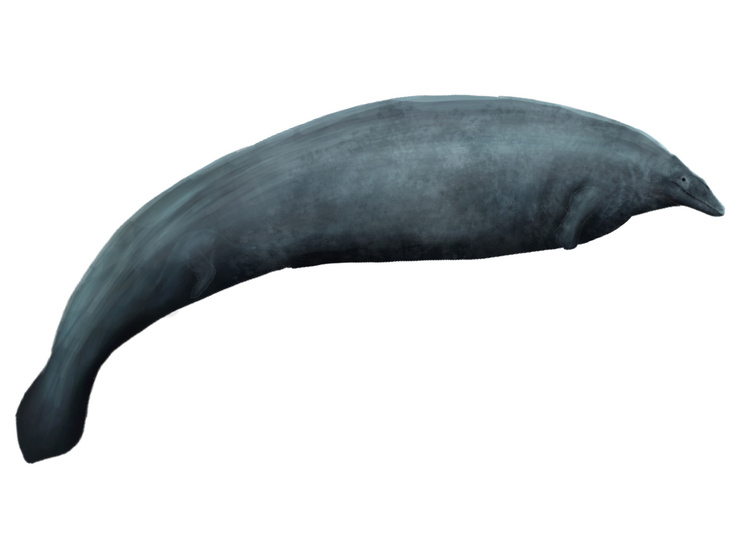
A colossal ancient whale found in Peru could be the heaviest animal on record, according to a new study.
Weight of 85 up to 340 metric tons (187,393 to 749,572 pounds), the weight of the now-extinct whale Perucetus colossus is equivalent to or greater than that of the blue whale, hitherto undisputedly considered the animal with the largest body mass. This study is published this week in the journal Nature.
The partial skeleton of Perucet, consisting of 13 vertebrae, four ribs and one pelvic bone, is estimated to be between 17 and 20 meters long. According to the study, the «stature» of the fossil specimen is less than that of the 25-meter-long blue whale, but its skeletal mass still potentially exceeds the mass of any known mammal or marine vertebrate, including its giant relative.
Moreover, perucetus probably weighed two to three times as much as the blue whale, which weighs a maximum of 149.6 metric tons.
“Perucetus could have weighed nearly two blue whales, three Argentinosaurs (a giant sauropod dinosaur), over 30 African forest elephants, and as many as 5,000 people,” notes Giovanni Bianucci, associate professor of paleontology at the Faculty of Earth Sciences at the University of Pisa in Italy.
Perucetus probably swam slowly due to its enormous mass and swimming style that was undulating, meaning its flexible body moved in sinuous waves from head to tail, CNN reports.< /p>
Perucet bones “consist of extremely dense and compact bone,” Bianucci said: “This kind of thickening and heaviness of the skeleton, called pachyosteosclerosis, which is characteristic of perucets and sirens, is not found in any living cetacean.” Sirens are large aquatic herbivorous mammals such as manatees, sea cows and dugongs, CNN explains.
According to an Italian scientist, the ancient whale's weight and size may have been an evolutionary adaptation to life in shallow and choppy coastal waters, «where a particularly heavy skeleton acts as a ballast» for stability.
Bianucci says the discovery is the latest result «intensive activity» by a diverse group of researchers that began in 2006 in the Ica Valley in southern Peru in one of the most important fossil assemblages of Cenozoic vertebrates, which occurred about 66 million years ago.
Other specimens previously found in the area include “Peregocetus pacificus, the oldest tetrapod cetacean to reach the Pacific Ocean, Mystacodon selenesis, the earliest ancestor of modern baleen whales, and the huge macroancestral sperm whale Livyatan melvillei,” he added.
< p>“The extreme mass of the Perucetus skeleton suggests that evolution may produce organisms with characteristics that are beyond our imagination,” Bianucci said.
According to Bianucci, the first Perucetus vertebra was discovered by Peruvian paleontologist Mario Urbina Schmitt more than 10 years ago. Schmitt, co-author of the study, is a researcher and field collector in the Department of Vertebrate Paleontology at the Natural History Museum of the National University of San Marcos in Lima.
The excavation in the Paracas silt-clay formation “took several years due to the hard rock that the fact that the fossil was inside the core of a mountain, the extreme size of the bones, and the harsh environmental conditions of the Ica Desert,” he explained.
Approximately 39 million years old, Perucetus colossus is a newcomer to the cetacean family of basilosaurids, which includes whales, dolphins and porpoises, according to CNN. The name of the giant creature indicates its geographical origin — Peru; «cetus» is the Latin word for whale; and “kolossós”, which in ancient Greek means “big statue” or colossus.
“Discoveries of such extreme body shapes are an opportunity to redefine our understanding of animal evolution,” wrote anatomy professor J.G.M. Thewissen and researcher David Waugh. “We seem to be only vaguely aware of how amazing the form and function of whales can be,” they added.
According to the study, gigantism or peak body mass in cetaceans was reached about 30 million years earlier than previously considered.
Given the amount of heavy bone, perucet “should have had many and lighter tissues,” Thewissen and Waugh wrote. “This is a fundamental difference compared to land-dwelling animals, in which all tissues contribute to the weight that must be supported by body parts such as limbs. In contrast, in water, heavier tissues can be offset by lighter tissues to become neutrally buoyant, and overall mass is less important.”
According to experts, the Perucetus specimen appears to have reached sexual maturity, but, perhaps still growing, given the unfused ends of his vertebrae.
According to Bianucci, the authors of the study did not have the skull or teeth of an extinct animal at their disposal, but its known characteristics indicate that perucetus probably fed near the seabed and was not an active predator.
This behavior when feeding is unusual compared to most whales, which use their relatively light skeletons to chase fast-moving prey, Thewissen and Waugh write.
Bianucci says the study authors have three hypotheses about Perucetus' diet. The ancient whale may have eaten plants like the sea cow, but such a herbivorous diet would be the only case among cetaceans. Secondly, the ancient creature could feed on small molluscs and crustaceans on the sandy bottom, as the modern gray whale does. And thirdly, perhaps Perucetus was a scavenger that fed on vertebrate remains.
“Of course, we will continue to explore the Ica Desert to find other fossils that will allow us to tell even more details about the extraordinary evolutionary history of cetaceans,” Bianucci said.