


The mystery of the mysterious Ötzi's violent death continues to intrigue scientists
The true appearance of the icy mummy of a Copper Age man has been restored using new DNA analysis. Ötzi the Iceman, whose frozen remains were found by tourists in a ravine high in the Tyrolean Alps in 1991, has become perhaps the most carefully studied corpse in the world.
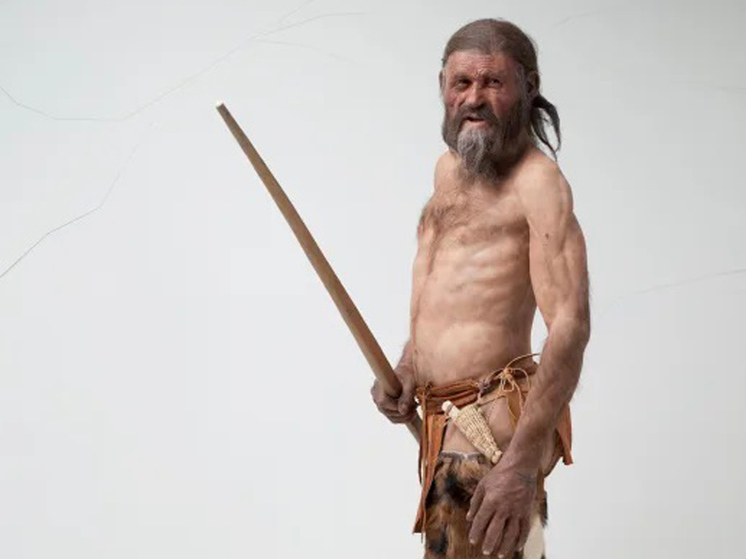 Photo: South Tyrol Museum of Archeology
The mystery of his violent death, who he was and how he ended up on a mountain pass, has aroused interest far beyond the field of archeology. Every year, thousands of people visit his mummified remains, kept in a special cold room at the Archaeological Museum of South Tyrol in Bolzano, Italy, according to CNN.
A new study of ancient DNA recovered from Ötzi's pelvis suggests he has there are still some secrets he must give up. An analysis of its genetic makeup showed that the 5,300-year-old mummy had dark skin and dark eyes — and was likely bald. This contrasts with Ötzi's reconstruction, which depicts a pale-skinned man with thick hair and a beard.
«It was previously thought that his skin darkened during the mummification process,» says Albert Zink, head of the Eurac Research Mummy Research Institute, a private research center based in Bolzano.
“It seems that the mummy's dark skin color pretty close to Iceman's skin color in life,» continues Zink, who co-authored the study, published Wednesday in the scientific journal Cell Genomics.
No wonder Ötzi was dark-skinned, Albert Zink noted, pointing out that many Europeans at the time probably had darker skin pigmentation than many modern Europeans.
“Early European peasants still had rather dark skin, which eventually changed to lighter skin as an adaptation to climate changes and farmers' diets. Peasants consume much less vitamin D in their diet compared to hunter-gatherers, he explained. – It seems that Iceman still consumed quite a lot of meat, which was also confirmed by our analysis of his stomach, which showed the presence of mountain goat and deer meat”.
Albert Zink co-author Johannes Krause, Director of the Archaeogenetics Department of the Max Institute for Evolutionary Anthropology Planck in Leipzig, Germany, said the findings suggest that the Iceman was much more like the mummy itself in life.
«It is remarkable how distorted the reconstruction is by our own preconceived notion of Stone Age man from Europe,» Krause said in a statement.
While ancient DNA analysis has shown that Ötzi had male-pattern baldness, it is impossible to be sure to what extent he had already lost his hair in life, says archaeologist Lars Holger Piele, co-director of the Ice Secrets project. in Norway. He studied Ötzi, but did not take part in the latest research.
“Ötzi could well have gone bald for genetic reasons, but the almost complete baldness that he now has, in my opinion, is more likely due to what happened after his death,” says Pilet. – Hair on the skin often falls out during the stay of the body in and out of ice (and sometimes in water) as the epidermis decomposes”.
According to the study, the genome sequenced from DNA taken from Ötzi's pelvis was more complete than the previous genome, which was pieced together in 2012, when the ancient DNA field was still in its infancy. Pilet says the latest research is also helping to unravel the mystery of Ötzi's lineage.
“Applying new techniques makes Ötzi a scientific gift that just keeps on giving,” added Pilet.
A 2012 study found that his genome contained traces of a steppe people who only arrived in Europe centuries after his death. A new study shows that this early result was likely due to contamination of modern human DNA.
“Advances in sequencing technologies have allowed us to create a high coverage iceman genome. This allowed us to get more accurate results”, Zink said.
The genome also seemed to rule out the previously suggested genetic relationship between Ötzi and modern Sardinians.
When researchers in the new study compared Ötzi's genome to those of other ancient humans, they found that he had more in common with early Anatolian farmers — from the territory of modern Turkey, — who had little contact with their European hunter-gatherer contemporaries.
“This doesn't completely change what we know about Iceman, but it clarifies a few things,” explained Zink. «This shows that Iceman most likely lived in a relatively isolated area with limited contact with other populations and low gene flow from populations associated with hunter-gatherer ancestors.»
Almost every detail of Ötzi and his belongings has been analyzed, painting an intimate picture of life 5,300 years ago.
The contents of the stomach gave information about his last meal and where he came from, his weapons showed that he was right-handed , and his clothing gave a rare glimpse of what ancient people actually wore. Zink said the team hopes to uncover more details, such as the makeup of his microbiome.
This is not the first time a chapter in Ötzi's fascinating story has been rewritten, according to Piele.
Originally believed that Ötzi froze to death, but a 2001 x-ray revealed an arrowhead in his shoulder, which could have been fatal. He also had a head injury, possibly received at the same time, and his right arm shows a defensive wound.
“The whole Iceman story is intriguing, including the mystery of his violent death – and the question is why he was there, high in the mountains, when he was killed”, states Zink.