


One goal — two paths
The Russian automatic station «Luna-25», launched to the natural satellite of the Earth on August 11, while following the Indian apparatus «Chandrayan-3», launched there same 14 July. Both, let me remind you, are heading for the polar region, where no one has landed yet. You and I have witnessed the «lunar race» in the truest sense of the word, although the creators of space technology do not like such a comparison and, in general, any kind of pumping up of emotions in this subtle sphere. Therefore, we will simply analyze the current potential of states in the field of lunar exploration together with independent space expert Igor Lisov.
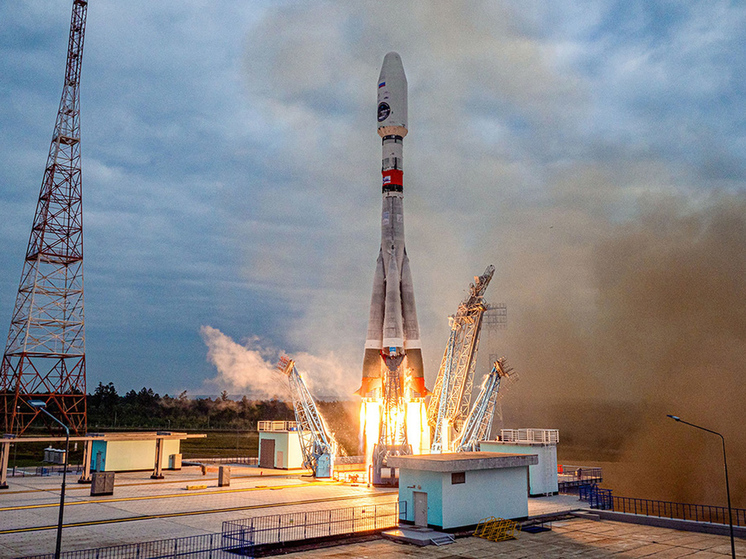 Photo: Roskosmos
— Of course, this is a pure coincidence. The Indian Space Research Organization (ISRO), like Roscosmos, planned to launch its lunar station several years earlier. First — in 2020, then the date was repeatedly postponed. According to the data for 2022, ISRO even wanted to postpone the mission to a later date — to the summer of 2024, but in the end decided to launch in 2023. For the same year, Roskosmos managed to plan the launch of Luna-25.
— The long journey of Chandrayaan-3 in ISRO is explained by a more economical method of delivering the device, which, according to them, is controlled mainly by the gravitational forces of the Earth and the Moon, while the Russian one was launched on a shorter lunar trajectory by a fairly powerful rocket.
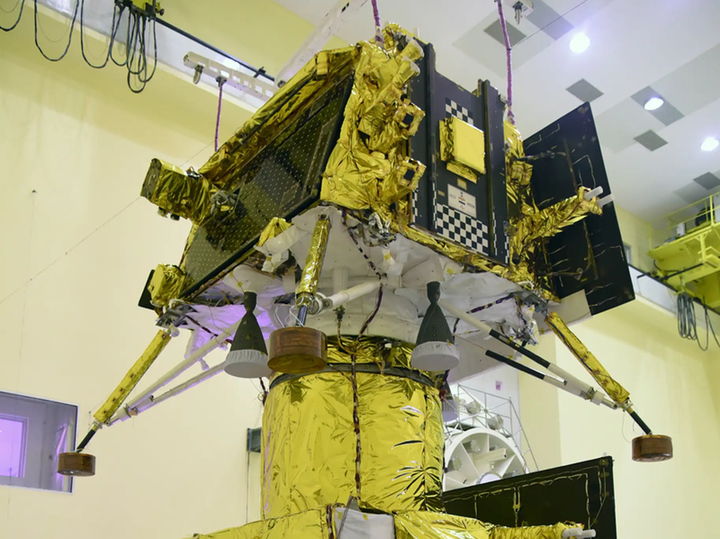 «Chandrayan-3»
The configuration and tasks of Chandrayaan-3 almost repeats Chandrayaan-2 of 2019. As far as we remember, that mission ended in a hard landing and loss of communication with the device. Therefore, the Indians decided to repeat the task this year.
— Theoretically, yes, but I would not do it, because after the break since 1976, when we sent our Luna-24 apparatus to the Moon, a lot has changed. Since the 2000s, almost all space agencies, including Roskosmos, have essentially started all over again. Today, perhaps, there is not a single specialist left who assembled our “extreme” Luna-24 47 years ago. By the way, the Indian lunar rover «Pragyan» (Cognition) was originally planned for our «Luna-27» — such an agreement was reached in 2011. But, having become convinced over time that we were harnessing too much, the Indians decided to send their rover to the moon on their own.
— Yes, judging by the declared programs of one and the other. They do not have fundamental differences. To the tasks you have listed, I would also add the study of dusty plasma.
– Langmuir probe RAMBHA-LP for plasma research;
– a device for measuring the thermal conductivity of soil ChaSTE (thermal probe immersed in regolith to a depth of 10 cm);
– ILSA seismograph;
— LRA corner reflectors for laser ranging of the Moon, provided by NASA$
— LIBS laser spectrometer and APXS alpha-X-ray spectrometer for determining the elemental composition of the rock (both mounted on a six-wheeled lunar rover).
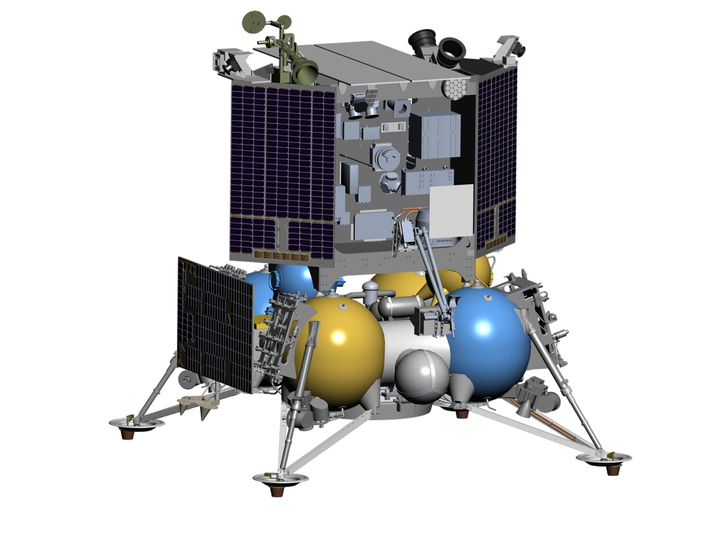 «Luna-25» Photo: NPO them. Lavochkin
«»
– ARIES-L ion energy-mass analyzer for measuring the composition of the lunar plasma-dust shell;
– ADRON-LR neutron and gamma detector for studying the elemental composition and hydrogen content in regolith;
– BUNI, providing collection, storage and transmission of telemetric scientific information;
– LAZMA-LR – laser mass spectrometer for measuring the chemical, elemental and isotopic composition of regolith samples;
– LIS- TV-RPM — infrared spectrometer for studying in the visible and infrared ranges the mineralogical composition of the surface layer of the Moon's regolith and the water content in it;
— PML — dust monitor for studying the physical characteristics of the lunar dusty exosphere;
< p>– LMK – a manipulator arm with a range of 1.5 meters for taking soil samples from a depth of up to 40 cm and delivering them to the LAZMA-LR analytical device.
– STS-L – television system for panoramic shooting surface in the landing area.
— I have not heard of such plans.
— Yes, then Chang'e-5 station «delivered about 2 kilograms of regolith from the visible part of the moon. In the near future they plan to deliver soil from its reverse side.
— Yes, it has been moving towards the northwest for the fourth year (1.5-2 kilometers in total). They asked him to hike to interesting geological sites, examine each stone for their own pleasure.
– I don't think so. They don’t have much time for such “pranks”.
On August 14, the Space Research Institute of the Russian Academy of Sciences completed an express analysis of telemetry and measurement data from scientific instruments on board the Luna-25 automatic station, performed on August 13, 2023 year at a distance from the Earth of about 310 thousand km. All devices showed full performance and readiness for lunar exploration.