


A scientist has revealed the secret of oligarchy in planetary science
At the initial stage, about a dozen planets the size of Mars could fly around the Sun. Scientists have discovered a super-Earth that orbits its star in… a week. He spoke about this and much more last week at a ceremonial meeting at the Institute of Geochemistry and Analytical Chemistry of the Russian Academy of Sciences. IN AND. Vernadsky (GEOKHI) Mikhail Yakovlevich Marov.
 Academician Mikhail Marov
The academician delivered a scientific report, “Planetary cosmogony: a modern view,” highlighting some sensational discoveries in this area.
According to Mikhail Marov, in general we are talking about reconstructing the process of the origin of planetary systems based on modern observational data. The scientist has been and continues to study this topic for the past 30 years. His research group includes employees of the Institute of Applied Mathematics. Keldysh and the Institute of Physics of the Earth RAS.
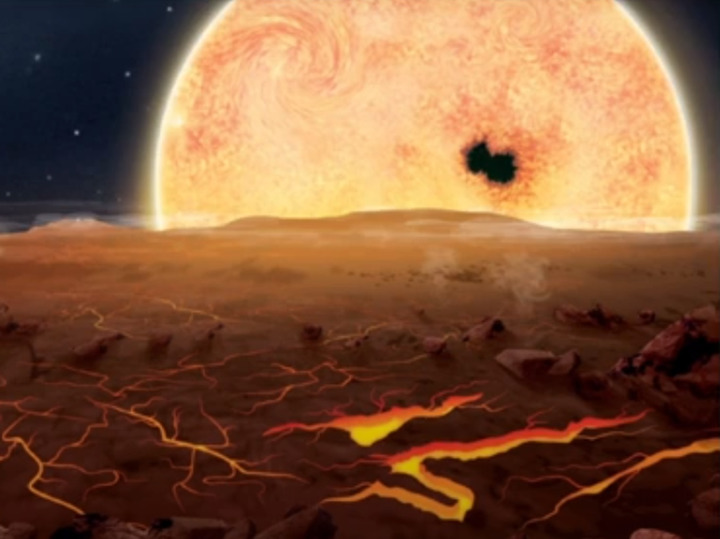 This is what the artist imagines the surface of a hot planet orbiting its star to look like in a week. Photo: Still from video
The scientist reminded the audience that the source of the processes that lead to the formation of a planetary system are gases dusty protoplanetary disks around stars.
– Planets – this is a side process of stellar evolution, they are formed from stars of a late spectral class, that is, stars with a not very high surface temperature, – noted the academician.
According to him, more than 5 thousand exoplanets (planets existing outside the solar system) have now been discovered, 2/3 of which are part of their planetary systems, that is, they are not alone. Among them, bodies with sizes between Jupiter and Earth predominate. And despite the fact that many of the exoplanets resemble ours and are in the habitable zone, among other solar systems there has not yet been found one that even approximately resembles our solar system.
— There are planets very close to their star, – says Mikhail Marov. – If our Earth makes a revolution around the Sun in one year, then, for example, a supergiant has been discovered that resembles our Jupiter, the period of rotation of which around its sun is – less than a week! It is absolutely clear that at such a distance the planet can heat up to 1.5 thousand degrees on the surface.
Against the background of the dissimilarity of other “worlds” on ours, a kind of sensation, according to the speaker, was the recent discovery of eight planets in the TRAPPIST-1 star system. It is located in the constellation Aquarius at a distance of 39.5 light years from the Sun. There are Earth-like bodies there that may have moderate climatic characteristics, which opens up a wide field of research for astrobiology, that is, in essence – search for life.
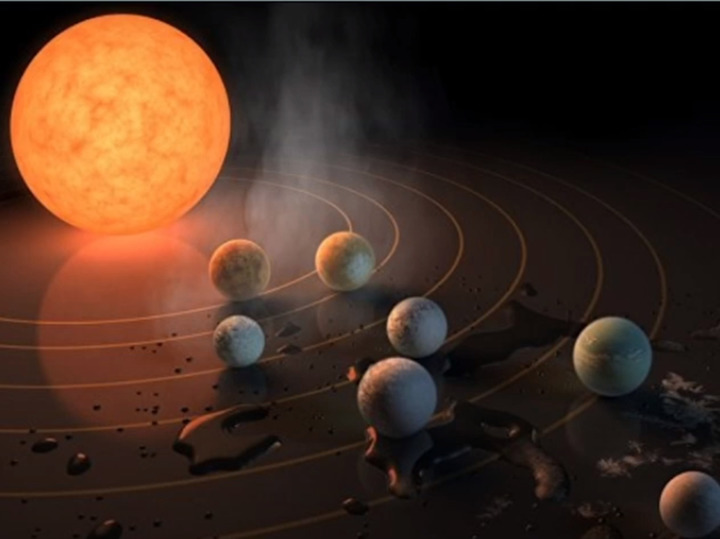 TRAPPIST-1 planetary system < /span>
Returning to our Solar system, Marov noted that it is also at the initial stage its development could have had a slightly different configuration than it does now:
— For example, 10 planets like Mars could revolve around it, but later it came to the one we have today. <…> We assumed that impacts and collisions occur not between individual particles in the disk itself, but at the level of condensations — dust clusters.
According to the researcher, the new physics of the formation of planetary embryos lies in the oligarchic growth of planetesimals – celestial bodies in orbit around a protostar. They are formed as a result of gradual “absorption”, that is, the accretion of smaller bodies.