


“There is a transition to other formats of trade”
Preparing the New Year’s table is in full swing: in the last week of December, shopping trips take on the characteristics of a national sport. Although today you can buy food in a supermarket or even order it online and have it delivered to your home, traditional markets are still popular — those where you can taste, touch and smell, and even bargain. MK correspondents decided to take a walk through the Moscow markets on New Year's Eve and see what they cost and how many visitors there are?
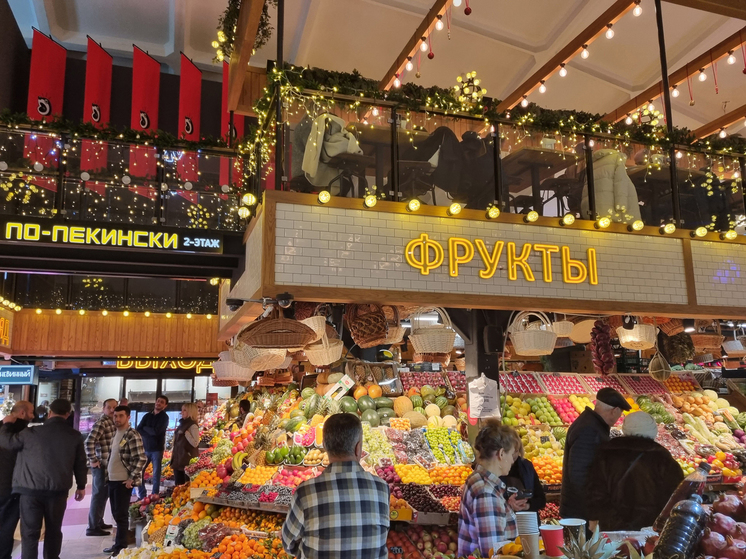
Dorogomilovsky market is considered one of the most expensive among Muscovites, even its name is telling. There are a lot of rave reviews about him on the Internet — about “uniqueness and exclusivity” products sold there (but it is possible that this is written by representatives of the market administration).
In the first half of the day 5 days before the New Year, there is no excitement on Dorogomilovsky. But you can see expensive tangerines: Abkhazian and Turkish (mini) for 500 rubles, and Spanish ones for 600. The seller admitted that the prices are “a little” They raised it for the new year. The prices for tomatoes are not encouraging: beautiful small Uzbek tomatoes are sold for 1200-1500 rubles per kilo. Ryazan pickled cucumbers, delicious looking — 200 and 250 rubles. for 1 kg.

I ask two girls: what did they come to the market for?
— We're just after the cheese! Yes, for the New Year's table. No, we don’t need anything else here, the prices are too high.
The situation is completely different at the Usachevsky market, which has been operating for several years in a new trading format: market + food court. Unlike Dorogomilovsky, all products, including vegetables and fruits, have price tags here. Those who buy food for cafes and restaurants in bulk have not yet arrived here, and therefore walk the aisles with huge carts. People are most actively buying meat, including tongue and pork feet (for jellied meat), sausages, and cheeses. One of the shoppers, loaded with bags of candy, was purchasing slices of various smoked meats. But in the rows of vegetables and fruits there is desolation, the sellers are bored. Maybe they are bored just because of the inflated prices? For example, Lukhovitsk pickled cucumbers are sold here for 350 rubles (at Dorogomilovsky for 200). The notorious sweet tomatoes from Uzbekistan, the dream of any housewife — have the same exorbitant price: 1200-1500 rubles.
Traditional New Year's hot dish — duck, and there is an assortment of birds presented here. True, those who are going to bake duck with apples or cabbage for the New Year will have to fork out some cash. Price — 1450 rubles per kilo, and they weigh at least 3 kg. Simple arithmetic: a New Year's duck will cost almost 4,500 rubles. A goose will be even more expensive, but neither one nor the other — not a delicacy (well, it seems to be so).
The price of ducks at the Danilovsky market, which has also been operating as a food court for almost 10 years, is a little more humane. Here, fat farm ducks were priced at 900 rubles per kilo, and sellers assure: the ducks are perfect, they will not contain excess fat, nor, on the contrary, empty bones.
— How long can a bird like this handle? — I'm asking the price for a small carcass.
The merchant immediately puts it on the scale: 2.3 kg. You will have to pay approximately 2100 rubles — already more pleasant than at the Usachevsky market, but one cannot ignore the specific structure of the duck. No matter what the traders say, there is bound to be fat in it: this means that a considerable amount of this weight will be rendered during baking. Well, no one is ever interested in a duck skeleton. In general, of course, it is much more convenient to buy duck legs and breasts separately. True, they cannot be called cheap either — 1500 and 1600 rubles per kilo, respectively, — but at least there is no skeleton left. By the way, in one of the corners on Danilovsky you can buy smoked farm duck — for 3500 rubles.

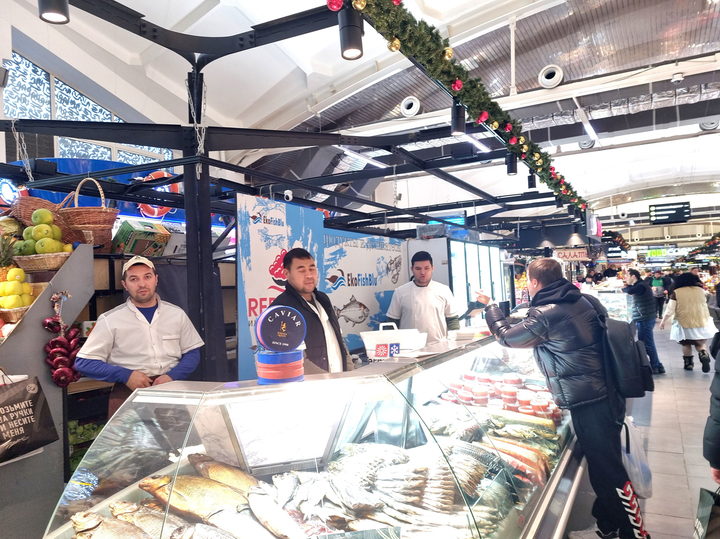
However, those who want to spice up their New Year's table with high-quality domestically produced products will have to fork out money at the Danilovsky market anyway. There is no way to call red fish from the Far East cheap. For 100 grams of lightly salted salmon you will have to pay 900 rubles here, and exquisite chinook salmon is even more expensive — 1000 rubles per hundred grams (that means ten per kilo?). Sellers — charm itself, they willingly offer to try before buying. The fish is truly beautiful — but, perhaps, not worth the money.
Another possible delicacy — high-quality Russian-made cheeses (import substitution!), made in the Altai Territory. Here the average price for brie, camembert, gorgonzola and other delights — 3000 rubles per kilo, neutral semi-hard cream cheeses are cheaper.
The leitmotif of the last weeks — price of eggs: walking past the corresponding counters at the Usachevsky market is like walking through a museum. Here are eggs from a variety of farmsteads — and the Moscow region, and Diveevo, and the Vladimir region, etc. Starting from 140 rubles and up to… 350.
— Why such a price — 350 rubles? Are the chickens special, purebred?
— Well, they are somehow fed in a special way with expensive food, and the environmental conditions of their detention — The seller shrugged.
In appearance, the 350-ruble eggs are no different from others, only their shades are somewhat unusual. For comparison, in a regular store “free-range eggs C1” costs 170 rubles per dozen. There are also a lot of eggs on Dorogomilovsky: quite small and ugly ones from Voronezh — 200 rubles, a little more attractive from Rostov — 250 rub.
Good question: Are markets relevant today? After all, there are supermarkets and even home delivery services for groceries. As told by «MK» , as of April 1, 2023, there were 18 retail markets operating in Moscow. This is slightly less (91.7%) than it was in 2022.
— The number of retail spaces in these facilities also decreased by almost 10% over three months. In January-April 2023, in the structure of retail trade turnover, the share of retail markets and fairs amounted to 5.4% (for the comparable period in 2022 — 6.9%), — Ilyashenko explained.
The decline in market attendance, according to the expert, is due to several factors. The first — The price level for food products in markets is usually higher than in retail chains. Mostly individual entrepreneurs trade in the markets; they cannot compete with retail chains on prices, and the population is now trying to save money. The second factor — the rapid growth of online commerce and, in particular, the development of express delivery of food products. Third – opening of new large shopping complexes that provide both tenants and buyers with more attractive conditions compared to markets.
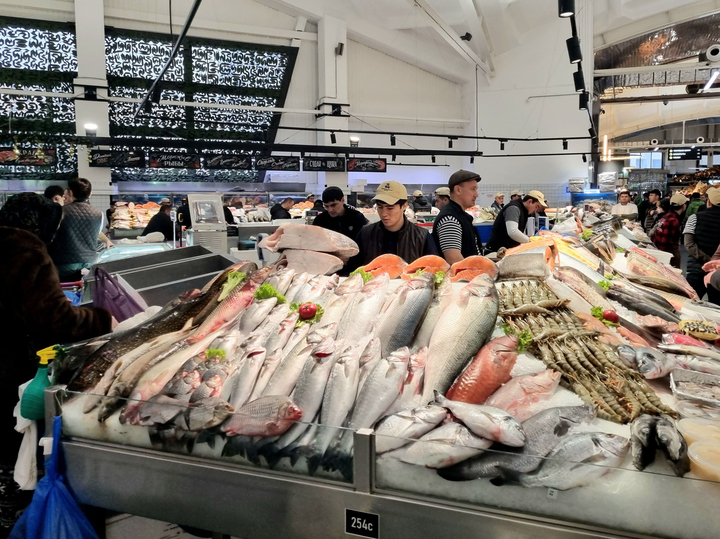
— In general, we are witnessing a transformation of trade in markets: a fashion for non-mass, exotic food products, as well as the consumer’s desire to buy “farm-grown and environmentally friendly” food. products dictate their terms. After reconstruction, markets acquire a single conceptual space, combining both sales points and catering points (food courts, food malls), where the buyer comes not only for high-quality and fresh products, but also for the emotions of visiting something unusual and interesting, — the expert summarizes.