


Experts from a number of universities have now pinpointed the age of a star dune in a remote area of Morocco
Experts from a number of universities have now pinpointed the age of a star dune in a remote area of Morocco and revealed details about its formation and about how she moves through the desert.
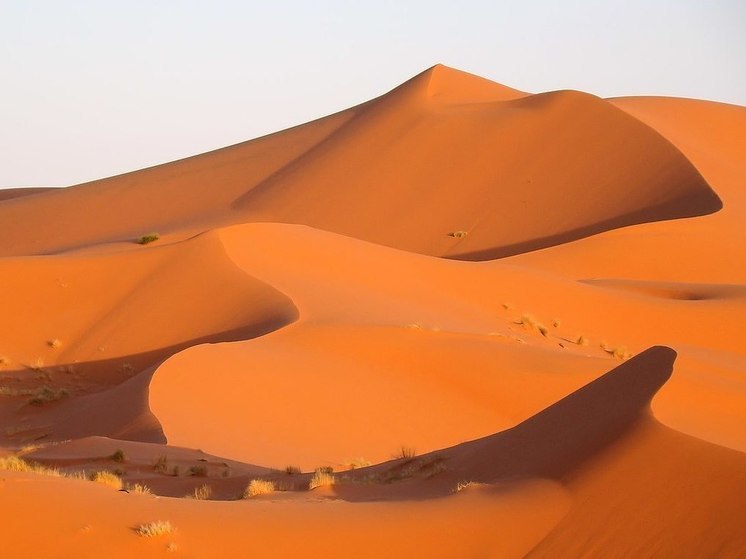
The team, which also included scientists from the University of London, traveled to south-eastern Morocco to study a 100-metre-high, 700-metre-wide dune in the Erg Chebbi sand sea known as Lala Lallia, which means “the highest in Berber sacred point”, writes The Guardian
Professor Geoff Daller, from the Department of Geography and Geosciences at Aberystwyth, said: “This is extraordinary stuff, one of the natural wonders of the world. From the ground they look like pyramids, but from the air you can see the top and branches radiating from it in three or four directions that make them look like stars.
Researchers found that the very base of the dune was 13,000 years old , but were surprised that the upper part of the structure had only formed in the last 1000 years or so. “She turned out to be surprisingly young,” says Professor Dallaire.
The base continued to grow until about 9,000 years ago. “Then the surface stabilized, – notes the scientist. – We think it was a little wetter than today. We can see traces of old plant roots, suggesting that the dune was stabilized by vegetation. It seems that this went on for about 8,000 years. Then the climate began to change again, and this star dune began to form.”
Dallaire argues that the dune was formed due to the fact that the wind blows in two opposite directions — from the southwest and northeast, which leads to the accumulation of sand. A steady third wind, which blows from the east, slowly moves the dune west at a rate of about 50 cm per year.
“This is important when you think about building roads, pipelines or any other infrastructure, said Dallaire . “These things are actually moving.”
Fluorescence dating techniques have been used to detect the last time minerals in sand were exposed to sunlight to determine their age.
Professor Dallaire said: “We are not looking at when the sand was formed– this is millions of years ago, – but when it was postponed. Quartz grains have the property of being a mini rechargeable battery. It can store energy that it receives from natural radioactivity. When we get him back to the lab, we can force him to release this energy. It appears in the form of light. We can measure this and the brightness will tell us when a grain of sand last saw daylight.
One catch is that they must collect sand grains without exposing them to light. The scientists did this by cutting holes in the dunes and hammering an old piece of drainpipe to collect samples, explains the team, which also included scientists from the University of London, traveled to southeastern Morocco to study a 100-meter-high, 700-meter-wide sand dune. sea of Erg Chebbi, known as Lala Lallia, which in Berber means “the highest sacred point,” writes The Guardian.
“This part is not very high-tech,” notes Dallaire. Work in a laboratory, which is much more high-tech and sensitive, must be performed under the same conditions as in a darkroom.
The same luminescence technique was used to date the remains of what is believed to be the oldest known wooden structure in the world, — the location of logs on the banks of a river bordering Zambia and Tanzania, which predates the appearance of modern humans.