


There was less oxygen than expected
Hopes of discovering extraterrestrial life have been dashed as NASA says there was less oxygen on Jupiter's moon than expected.
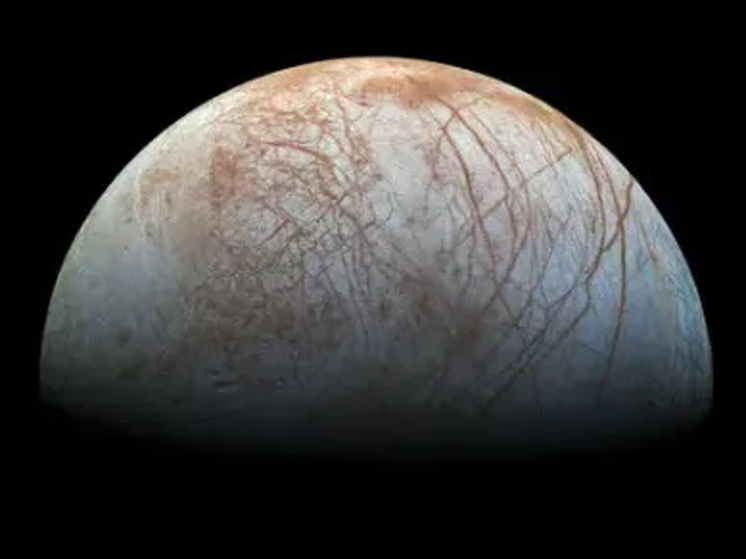
A new study suggests that the icy surface of Jupiter's moon Europa has less oxygen than thought, and this could affect whether life, if any, may be hiding in Europa's underground ocean.
Even with little or no oxygen, microbes can still swarm in the ocean believed to exist miles beneath Europa's icy crust, The Guardian reports. As for what else, «who knows,» said NASA scientist Kevin Hand, who was not involved in the study published Monday in Nature Astronomy.
More work is needed, Kevin Hand said. confirm these findings, which contradict earlier telescope observations of condensed oxygen in Europa ice, indicating higher oxygen concentrations.
The new study is based on data collected by NASA's Juno spacecraft. during a particularly close flyby of Europe in 2022 – at a distance of just 219 miles (353 km), notes The Guardian.
The American-European team estimates that every second, between 13 and 39 pounds (6 and 18 kg) of oxygen are produced on Europa's surface.
Previous estimates had a much wider range: up to 2,245 pounds (1,100 kilograms) of oxygen were produced per second. So, “unless Europa's oxygen production was significantly higher in the past,” the new measurements provide “a narrower range for maintaining habitability,” the researchers write.
This oxygen is produced along with hydrogen, when Jupiter's radiation destroys Europa's global shell of frozen water, The Guardian emphasizes.
Lead author James Szalay of Princeton University said the Juno flyby turned out to be the first time that a spacecraft “directly sniffed” surroundings of Europe. “We were eager to get a peek behind the curtain of her complex habitat,” he said in an email.
Although it was “a much narrower range than we previously thought, there is still a lot we can learn,” , notes James Szalay.
It is unknown how much oxygen enters the atmosphere of Jupiter's moon, how much remains in the ice, and how much may end up in the underground sea.
NASA plans to launch Europa Clipper this fall. The spacecraft will make dozens of close flybys of Europe – almost the size of our Moon – while orbiting a giant gas planet.