


Asteroid deflection test results lead to unexpected consequences
In 2022, NASA proved that humans can redirect city-killer asteroids away from Earth, but with unintended consequences that could put our planet in danger. A pair of Italian astronomers discovered that when the Double Asteroid Redirection Test (DART) knocked the 560-foot-wide asteroid Dimorphos off course, the impact created a cloud of 37 new cosmic rocks that hurtled toward Mars.
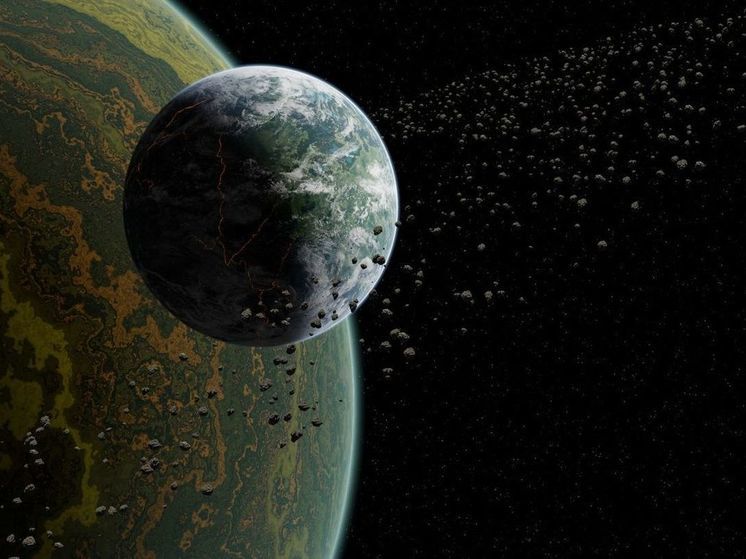
If one of these boulders falls on the Red Planet, it could create a crater with a diameter of 200 to 300 meters — from 656 to almost 1,000 feet, writes the Daily Mail.
Astronomers have warned that if NASA needs to knock a killer asteroid off its collision course with Earth in the future, it will be critical to think about where the debris from such a spectacular crash will go. so that they don't end up colliding with our planet.
During the DART mission, NASA used an unmanned spacecraft that crashed into Dimorphos at 14,000 mph to see if it was possible to push the space rock out of orbit. In the weeks that followed, NASA scientists confirmed that it had worked: a so-called «kinetic impact» changed the asteroid's orbit in space.
A kinetic impact means one object colliding with another, and is one possible strategy NASA could use in the event of an impact with an asteroid that threatens life on Earth, explains the Daily Mail.
Dimorphos is part of a system of two asteroids orbiting a larger asteroid called Didymos. After colliding with DART Dimorphos entered Didymos orbit in 11 hours and 23 minutes — 32 minutes less than it took the spacecraft before colliding with it.
However, with such a collision, collateral damage occurs. Scientists discovered that the mission DART left behind 37 newly formed boulders flying in outer space on a completely different course.
On their current trajectory, these boulders could collide with Mars, concluded study co-authors Marco Fennucci of the European Space Agency (ESA) and Albino Carbonani of the Observatory of Astrophysics and Space Sciences in Bologna, Italy.
The boulders range in size from four to seven meters in diameter — from 13 to 23 feet, writes the Daily Mail.
According to observations by the Hubble Space Telescope, the boulders escaped the attraction of the Dimorphos/Didymos pair, choosing a separate path from a tail of dust and stones long 6000 miles resulting from the collision.
And their orbit may overlap with that of the European Space Agency's Hera mission, which is due to cross Dimorphos in 2026 to take a closer look at the effects of the DART collision.
"All observations made so far, prove that DART was a successful asteroid deflection test because it succeeded in changing the orbital period of Dimorphos and did not create any other boulder that could fall to Earth,» the astronomers wrote.
«On the other hand, the results presented in this paper suggest that future missions involving interactions with near-Earth asteroid surface material must be carefully planned,» they added.
In the long term, these blocks may cross the orbit of Mars, writes the Daily Mail. The Red Planet has a thin atmosphere, so the likelihood that a small meteor shower will overcome it and reach the surface is higher than on Earth. However, this could take thousands of years.
"Numerical simulations indicate that all swarm chunks will cross the orbit of Mars several times in the future [20,000 years from now],” Fenucci and Carbon-ani.
These simulations included a computer-generated swarm of 37 new boulders, and astronomers claimed they were a fairly accurate prediction of the behavior of real boulders.
«Therefore, due to orbital crossings occurring during long-term evolution, it is possible that some of the boulders will collide with Mars in the future,» they concluded.
This could happen within 6,000 years, which, may have an impact on a future human colony on Mars.
Overall, however, the DART mission was considered a success, the Daily Mail notes.
For the first time in history, people have deliberately changed the movement of a celestial object. Dimorphos was not on a collision course with Earth, but as a two-asteroid system it provided a unique opportunity to monitor changes in the small asteroid's orbit around the larger one. This test was proof that it is possible to knock asteroids off course so that they do not cause destruction on Earth.
If a killer asteroid threatens humanity in the future, this means that people should be able to divert its trajectory and avoid disaster — they might just want to plan where the debris will go.
The scientists published their findings on arXiv.org, a publishing server for the physics community.