


The problems of high inflation and personnel shortages seem unsolvable
One of the main problems of the Russian economy at this stage is its overheating. The head of the Central Bank, Elvira Nabiullina, has been persistently warning about this for several months now. The other day, Minister of Economic Development Maxim Reshetnikov agreed with a similar diagnosis, although he, however, reacted to the threat of overheating much more calmly. But be that as it may, the atmosphere in the economy is clearly heating up, which is clearly seen primarily in the example of rising prices and personnel shortages. The state has not yet been able to solve both of these problems.
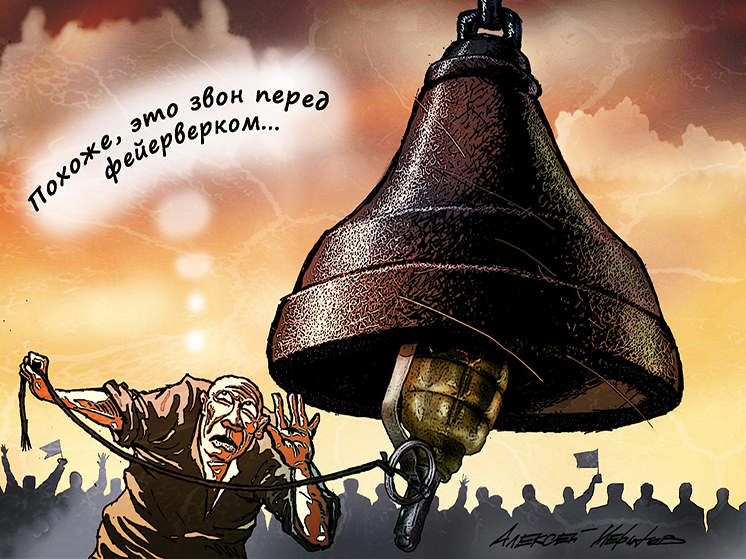
The term “overheating of the economy” itself came to us from the West. We are talking about a situation where demand grows faster than supply, and the level of GDP is higher than the economic potential of the country. “Inflation is an indicator of such overheating when it rises above the target level,” explains Nabiullina, comparing the Russian economy to an overheated car engine using its resources at full capacity. Something similar happened in 2021, after the crisis caused by the coronavirus pandemic: “When the economy tries to accelerate, unemployment quickly decreases and the labor shortage worsens,” notes Alfa Bank chief economist Natalia Orlova. A year later, the CBO and sanctions launched the process of full-scale structural restructuring, including the reorientation of export supplies to China and India, accelerated import substitution, and the flow of financial and human resources from the civilian sectors to the military-industrial complex.
In 2022, demand in the economy was mainly supported by government orders, while consumer activity stagnated. In 2023, both the budget impulse and demand from the population increased — partly due to direct payments to military personnel and mobilized personnel, partly due to rising wages at manufacturing enterprises of the military-industrial complex, partly due to the fact that buyers were forced to reduce consumption in the previous year, made deferred large purchases (real estate, car). The dynamics of wholesale prices allows us to identify sectors where demand significantly exceeds supply. According to Rosstat, prices for agricultural machinery, medicines, repair and installation of machinery and equipment, cars, aircraft, ships, building materials, paper are rising.
As Elvira Nabiullina noted, in the conditions of technological and financial sanctions, companies are not able to sharply increase production, “instantly launch new production and find additional labor for them.” In addition, with a weak ruble and complicated logistics, importing raw materials and equipment becomes prohibitively expensive for businesses. And for ordinary Russians, the overheating of the economy is felt through household inflation. It's simple: the cost of goods and services cannot help but increase given high demand (including for travel within Russia), insufficient supply, and the accelerated pace of retail lending — both in mortgages and consumer lending.
“The overheating of the economy is most clearly expressed in industry,” says Alexander Shneiderman, head of the sales and customer support department at Alfa-Forex. — The total number of new orders, especially for companies involved in government defense procurement, is growing. However, this is not happening as quickly as last year. This is due to very expensive loans, which businesses use with great caution: the profitability of not every manufacturing enterprise exceeds the interest costs that must be paid to the bank for using the money. The unhealthy situation with the labor market also contributes to overheating. With an abnormally low unemployment rate of 2.8% (Rosstat data for February), companies are trying to retain employees, including by increasing the costs of the wage fund — so that the enterprise simply functions. At the same time, there is not much money left for production.”
Against this background, as the expert notes, Maxim Reshetnikov’s recent statement, made at a plenary meeting of the State Duma, looks very strange: “Restrictions from the labor market are not as significant as expected.” After all, the same Reshetnikov, back in September 2023, called the personnel shortage the main internal risk, a brake on the development of the Russian economy, along with an excessive tightening of monetary policy. According to the head of the Ministry of Economic Development, by 2030 the economy will need an additional 2.3 million workers.
Demand for labor significantly exceeds supply, says Rostislav Kapelyushnikov, chief researcher at IMEMO RAS and deputy head of the HSE Center for Labor Studies. The main explanation that comes to mind is that the economy is overheated, a huge amount of money has been poured into it, and unemployment has artificially decreased. In the classic scenario, this is a short-term episode: after it, both the economy and unemployment return to their usual state, to normal. In economic science, a special term has been coined for this, “the natural rate of unemployment,” for most countries it is estimated at 3–4%. However, in Russia, according to Kapelyushnikov, the imbalance in favor of demand is becoming a chronic phenomenon. This is no longer a temporary deviation from the norm: we are talking about a consistently low unemployment rate for many years to come. Moreover, the explosive growth of vacancies began back in 2020 (and not in 2022, as many think) and was associated with the structural restructuring of the economy that began under the influence of the pandemic. It covered absolutely all industries.
“The personnel problem remains acute,” says leading expert at the Center for Political Technologies, economist Nikita Maslennikov. — There is a slowdown in business activity, albeit weak for now. The burden of additional labor costs is becoming unbearable for many businesses. There are more and more open positions, and the number of new hires is practically stagnant. Such a circumstance transfers the situation from the physical plane to the qualitative: from the position of a particular entrepreneur who is not able to find a worker of a certain qualification even for a high salary, this is a disaster.”
The fact that the Ministry of Economic Development, albeit not immediately and with reservations, did recognize the fact of overheating of the Russian economy, is very indicative: such a problem really exists, and it carries real risks for the country. The fundamentally important question is: how long will the period of maintaining the Central Bank’s tight monetary policy ultimately turn out to be (that is, the period of high key rates) and whether it will be possible to reduce inflation to at least the 4.8% mark indicated in the forecast for 2024. According to Maslennikov, even a small overheat is dangerous for the economy, since it tends to grow back quickly, like a newt’s tail.
“It is necessary to equalize the balance of supply and demand in order to prevent prices from going wild,” says MK’s interlocutor. — If inflation is persistently above 6%, there will be neither investment nor investment growth. Last year it amounted to 7.42%, and in May of this year it reached 8% in annual terms. One of the obvious tools to influence the imbalance (the underlying macroeconomic basis of overheating) is to maintain the Central Bank's key rate at a high level. This takes on particular significance in the current extreme conditions, when the country is under sanctions and continues to conduct a military action.”
“The most obvious indicator of overheating is that inflation in annual terms is not decreasing. The reason is consistently high demand, fueled by the budget impulse. In December, when the regulator raised the key rate to 16%, it was 7.4%; now, six months later, it’s already 8%,” notes Igor Nikolaev, chief researcher at the Institute of Economics of the Russian Academy of Sciences. — We must not forget about such a factor as the planned, man-made weakening of the ruble: our average annual exchange rate according to the scenario conditions of the Ministry of Economic Development is 94.7 per dollar. This means that by the end of the year the dollar could reach a hundred. And on July 1, Russians will also see indexation of utility tariffs, which did not happen in 2023. Rising inflation is always bad for the economy: general uncertainty is increasing, investment activity, which was at its peak in the first half of last year, is declining today.”
“The economy has apparently exceeded its potential level,” the Bank of Russia Research and Forecasting Department stated back in September 2023 in the “What Trends Are Saying” bulletin. We are talking about the maximum possible (potential) output that occurs when production capacity is fully utilized. If the economy exceeds this level, it means it is overheating. But since the potential is an unobservable quantity, it is impossible to document the fact of excess, all that remains is to theorize. Which doesn't always look convincing.
The level of resource use is a completely different matter; it is precisely monitored. And it signals that the economy lacks, firstly, workers and brains (unemployment is at a historical low of 2.8%), and secondly, free capacity (personnel and equipment are loaded at more than 80%, according to Central Bank monitoring data). The situation is aggravated by the fact that business today does not have the opportunity to attract investment in the construction of new enterprises, in the purchase of new equipment, in technological developments. And not only because of sanctions, inflation, a weak ruble, personnel shortages and other circumstances, but also because of prohibitively high, essentially prohibitive rates on bank loans.
While acknowledging the fact of economic overheating, the authorities have not yet proposed convincing methods for combating it. As Nikita Maslennikov reminds us, many tasks are beyond the competence of the Central Bank, being the exclusive prerogative of the government. First of all, this is the creation of a stable and effective tax system (it is necessary to determine the parameters, mainly, of the profit tax), this is the optimization of preferential credit programs (how much money, to which businesses, why), these are clearly justified projects of technological sovereignty. «What is needed is what in the language of professionals is called taxonomy. So that it would be possible to calculate the mechanisms of stimulating credit support for this «road map», «- explains the expert.
Since there is nothing like this in Russia yet, we can safely predict that the overheating will persist. In this vicious circle, in this tightly sealed steam boiler, from which you can't let off steam, the economy will not cool down to a normal state anytime soon. And this means that hopes for accelerated economic growth will have to be postponed until better times. Apparently, Maslennikov sums up, this year the GDP dynamics will approach the lower limit of the Central Bank's forecast range of 2.5–3.5%.