


At the Institute of Medical and Biological Problems of the Russian Academy of Sciences, the 198th day of the experiment on the annual isolation of a group of testers is underway
Participants in the annual isolation experiment SIRIUS-23 tested a new anthropomorphic robot on a moving platform during a simulation work on the surface of the Moon.

Let us remind you that five Russians are participating in the experiment, which began in November last year – employee of the Cosmonaut Training Center named after. Yu.A. Gagarin Yuri Chebotarev, Khabarovsk Airlines pilot Anzhelika Parfenova, allergist Ksenia Orlova, Aeroflot flight attendant, psychologist, journalist, junior researcher at the Institute of Biomedical Problems Ksenia Shishenina, doctor at the Institute of Biomedical Problems Rustam Zaripov and junior researcher at the Institute of Physico-Organic Chemistry NAS of Belarus Olga Mastitskaya.

Starting from May 20, the crew members had a very eventful life: they accepted the “transport ship” that had “arrived” to them, docked it with their “interplanetary complex” (ground-experimental complex of the Institute of Biomedical Problems of the Russian Academy of Sciences). In parallel with this, they tested themselves with insomnia, or, scientifically, sleep deprivation for 36 hours. This is necessary in order to understand how a long absence of sleep will affect their psychological state. The sleep deprivation experiment was combined with one of the most pleasant activities “on board” – unloading the cargo ship, on which the “cosmonauts” received new scientific equipment, food, gifts from relatives and friends.
Then work began on landing “on the surface of the Moon.” This landing operation was divided into two stages. At first, the crew members themselves landed on the surface in small groups and performed “on the Moon” tasks. series of necessary tests. For example, we moved along the surface wearing virtual reality glasses, which create the illusion of being on an earthly satellite, and experienced lunar gravity, reduced by 6 times in relation to earthly gravity, at a stand with a sign.
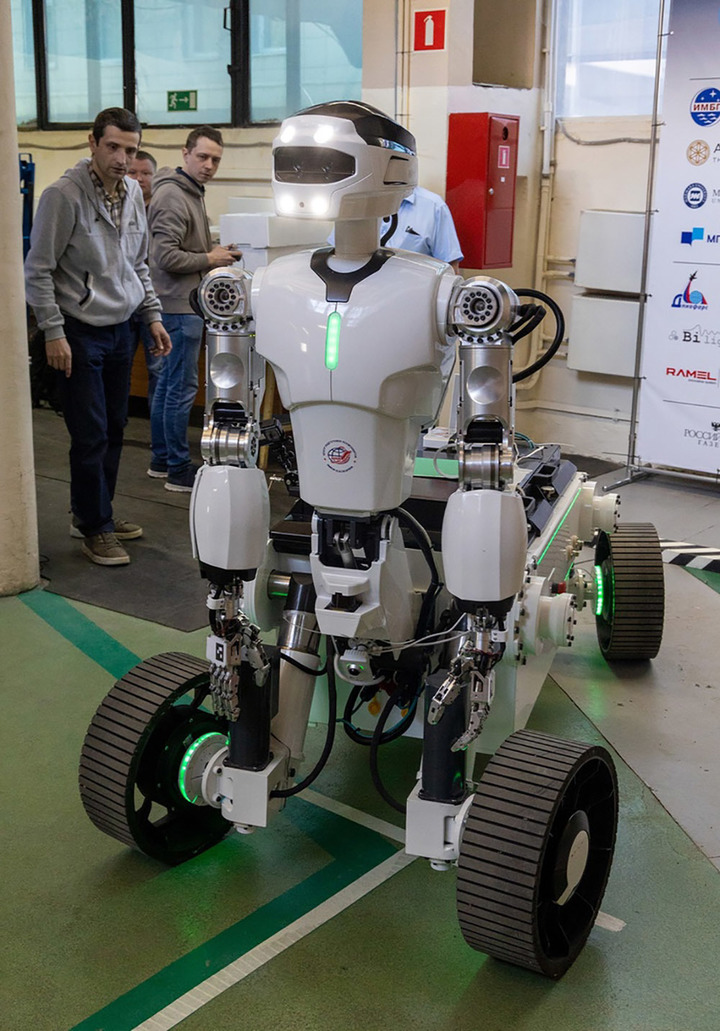 An anthropomorphic robot on a moving platform, a “relative” of the robot Fedor. Photo courtesy of IBMP RAS
Upon completion of the extravehicular activity, the crew members of the experiment took part in the second stage of the research, – using a universal anthropomorphic robot on a mobile platform. It is organized by the Gagarin Cosmonaut Training Center with technical support from the Android Technology Research and Production Association.
The head of the robot is very reminiscent of the robot Fedor, who flew to the ISS. The new robot, unlike Fedor, has four wheels that allow it to move around the surface (in configuration it is somewhat reminiscent of a centaur). The operator (team members did this in turns) controlled it while “in the ship”, wearing an exoskeleton. Using a joystick, he forced him to ride “on the Moon,” and the machine repeated the rest of the movements after the person: lifted cube stones from the surface, moved them to the place indicated by the operator, etc.
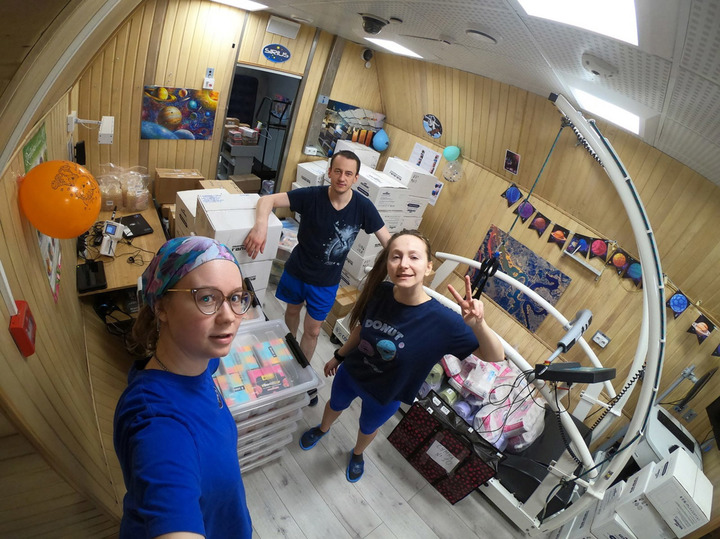 During a sleep deprivation experiment, crew members were dismantling cargo that had “arrived” from the ground. Photo courtesy of IBMP RAS
All this time, the crew members themselves were observed, also remotely, by the organizers of the experiment. They were interested in possible changes in the quality of the “cosmonauts’” camera work. on almost the two hundredth day of the flight.