


Extremely rare cosmic phenomenon baffles scientists
An unusual horned comet, known for a series of flares and dubbed the “devil's comet,” made its closest approach to Earth on Sunday.
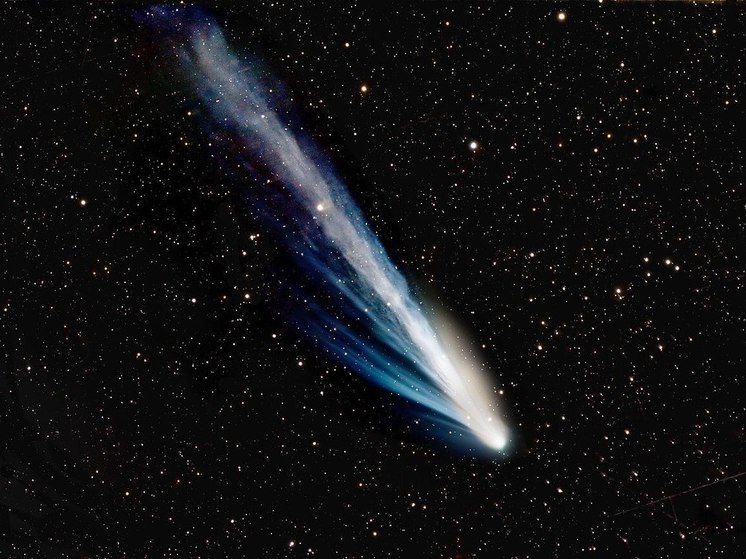
While Northern Hemisphere residents have not seen the comet since the first week of May, those watching the skies in the Southern Hemisphere have a better chance of spotting the fuzzy object with binoculars or a telescope, CNN notes.
Why exactly a dynamic comet takes on a shape that has been compared to the Millennium Falcon from the Star Wars films when it is explosive is still a mystery to scientists. But this celestial object makes only one orbit around the Sun approximately every 71 years, like Halley's Comet, making it a once-in-a-lifetime opportunity to observe it up close.
Given that the comet will not pass Earth again in Over the course of decades, collective observations by astronomers could provide clues to its true nature and behavior, CNN emphasizes.
Officially known as Comet 12P/Pons-Brooks, the celestial object made its closest pass by the Sun on April 21, coming within 119.7 million kilometers of our star.
The comet approaches Earth on Sunday, but it will pass at a distance of more than 230 million kilometers from our planet and will not pose a danger. For reference, the Sun is located 149 million kilometers from Earth.
According to Dr. Dave Schleicher, an astronomer at the Lowell Observatory in Arizona, the comet peaked in brightness in late April and faded steadily over three to four weeks.
“For people living below the equator, the coming weeks and months may be the first good chance to see this phenomenon for the first time since the 1950s,” said astronomer Dr. Teddy Careta, a postdoctoral fellow at the University of Lowell.
Two prominent discoverers, Jean-Louis Pons and William Robert Brooks, independently observed the Devil's Comet—Pons in 1812 and Brooks in 1883. But the comet likely made many orbits around the sun over thousands of years, long before astronomers began to think of comets as anything other than “something weird in the atmosphere,” Schleicher said.
Astronomers estimate that the diameter of the massive comet is between 10 and 20 kilometers, says Dr. Kareta.
The rare visitor has the green color typical of most comets because they contain diatomic carbon molecules that absorb sunlight and emit a color that appears green from our perspective, Schleicher said.
Recently, Comet Pons- Brooks caught the attention of astronomers by displaying intriguing behavior that caused her to take on a horned appearance and fly through our solar system.
Over the past eight months, the comet has experienced several outbursts, causing it to eject gas and dust. While such outbursts are not uncommon for comets, and other comets have been observed to have a crescent or Pacman shape, it is difficult to say what is normal for Comet Pons-Brooks.
“I would say it's a little unusual because of the number of outbreaks,” Schleicher said. “On the other hand, it doesn't seem like you have good records from the past that really give you an idea of what is typical. And I suspect that, given the fairly large number of outbreaks that have occurred in the last eight months, this is certainly a common occurrence in Ponce Brooks.”
Comets are chunks of dust, rock and ice, essentially frozen remains from the formation of the solar system, CNN explains. They also contain frozen elements such as carbon dioxide and carbon monoxide.
According to Schleicher, comets warm up and become brighter as they get closer to the Sun, and some of the frozen gases contained in comets don't need to get very hot. before they start turning into steam.
“We think the main driving force is, of course, heating from the sun,” he said. – A comet is approaching; it was deep frozen for years. The heat will spread from the surface down to where the ice of carbon dioxide or carbon monoxide is.»
Astronomers suspect that the outbursts of Comet Pons-Brooks occurred in repeated events where heat evaporated material inside the comet, which caused an increase in pressure and a breakthrough through the surface. According to Schleicher, while the gas explosion would not be visible to telescopes, the dust it kicked up could cause events similar to those observed with the Ponce Brooks telescope.
Scientists followed the jets of material that were observed to eject from the comet during its outburst at two source regions on its surface. Astronomers are puzzled why “the whole surface isn't exploding like crazy,” Schleicher said.
Observations suggest that most of the surface has become encrusted with ice, or that the ice has evaporated leaving behind only dirt, but astronomers “not quite are sure which of these mechanisms controls the process,” he said.
However, the comet's outbursts appear to have stopped, and it has not shown any activity since February, comments Teddy Kareta.
Astronomers have been observing Ponce Brooks in hopes of learning more details about its rotation rate, or the speed at which it is rotating comets moving in space. Comet Pons-Brookes's orbital period is 57 hours, longer than expected, and astronomers want to know whether its jets of material ejected from the comet are speeding up or slowing down.
A series of coincidental events likely contributed, Dr. Careta said. to the distinctive appearance of Comet Pons-Brooks, but it may also be related to the way we view the comet.
“These are three-dimensional objects,” says Teddy Carriage. “When we take pictures of the night sky, we use a limited range of colors, smoothed in two dimensions. It will make things that might make sense to you if you could get up and walk around and look at them from several different perspectives look much more complex than they actually are.”