


The insectivorous animal turned out to be smaller than its foreign counterparts
The Sarez shrew, a new species of mammal for our country that feeds on insects, was discovered in Russia for the first time. A female and a male shrew were caught in a biologist's live trap in the highland region of the Dagestan village of Gunib.
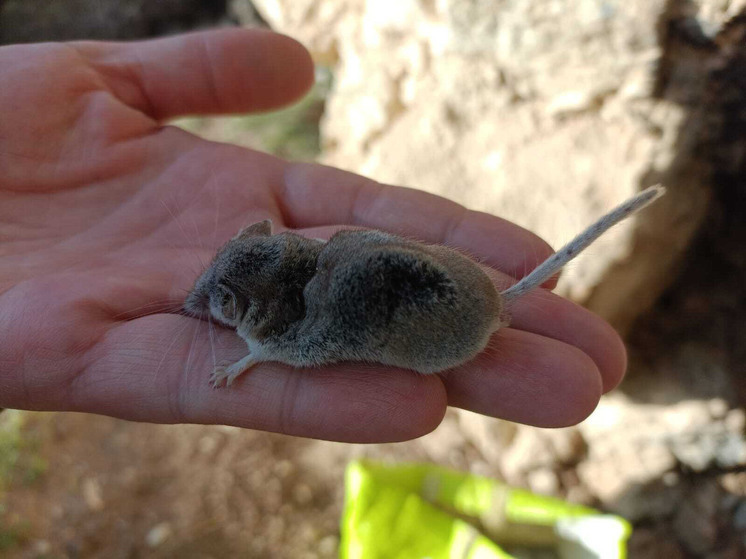 Shrew. Photo courtesy of V. Stakheev
As explained by «MK» at the Southern Scientific Center of the Russian Academy of Sciences, luck smiled on a whole group of scientists: in addition to researchers from the Southern Scientific Center of the Russian Academy of Sciences, specialists from the Institute of Ecology and Evolution. A.N. Severtsov RAS and the Zoological Museum of Moscow State University. M.V. Lomonosov.
According to one of the authors of the work, biologist Valery Stakheev, initially specialists were looking for another animal in the Gunib area – Robert's snow vole. However, two shrews unexpectedly fell into the exposed traps with rolled oats soaked in sunflower oil – female and male.
Shrew animals — a very rare species found in nature. Over the entire history of its study, about 30 animals were caught: 10 – in the Israeli Negev Desert and 20 individuals – in the arid mountainous regions of Pakistan and Tajikistan.
The mammal is distinguished by a light brown body, which is 5-6 centimeters long, and lighter paws and a tail reaching 10 centimeters. The individuals found in Dagestan turned out to be 1.5 centimeters shorter than the foreign ones.
Researchers conducted a genetic analysis, which confirmed the greater similarity of the found individuals with their Central Asian relatives.
According to the Kremlin portal “Wildlife” Russia», a new animal species for Russia will be included in the «Atlas of the distribution of mammals of the European part of Russia», which will be published in 2024.