Planetologist Bazilevsky told what kind of research he would conduct there
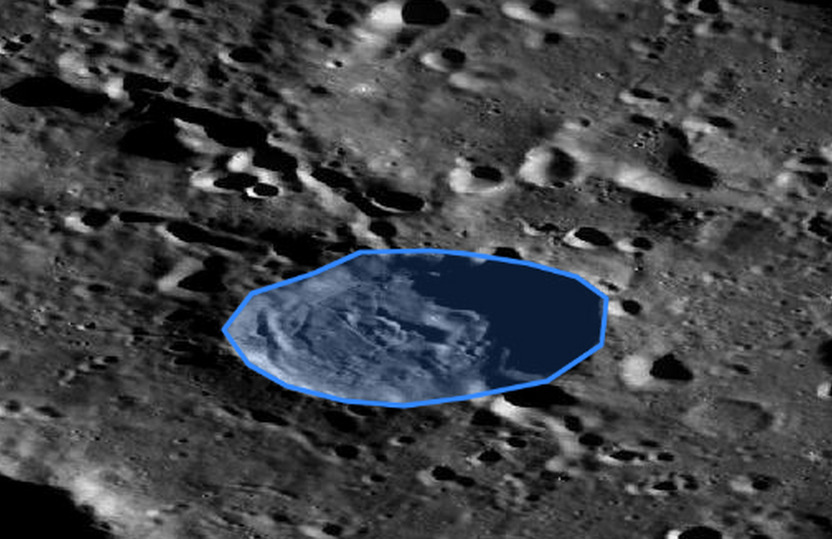
The International Astronomical Union approved the idea of Russian scientists — it named a 34-kilometer crater in the South Polar Region of the Moon after Academician of the Russian Academy of Sciences Eric Mikhailovich Galimov. From June 4, according to the planetary nomenclature — the system of naming details of the relief of the celestial bodies of the Solar System, the name «Galimov» can be used in literature and on maps.

As MK previously reported, a group of Russian scientists wrote a request to the International Astronomical Union with a request to perpetuate the memory of the ex-director of the Institute of Geochemistry and Analytical Chemistry of the Russian Academy of Sciences, a world-famous scientist who dedicated many scientific works to the Moon, Eric Mikhailovich Galimov, naming a recently described crater after him.
The other day, a response came from the International Astronomical Union that the scientific council approved the idea of Galimov’s colleagues and assigned his name to a 34-kilometer crater on the Moon. This decision is enshrined in the planetary nomenclature.
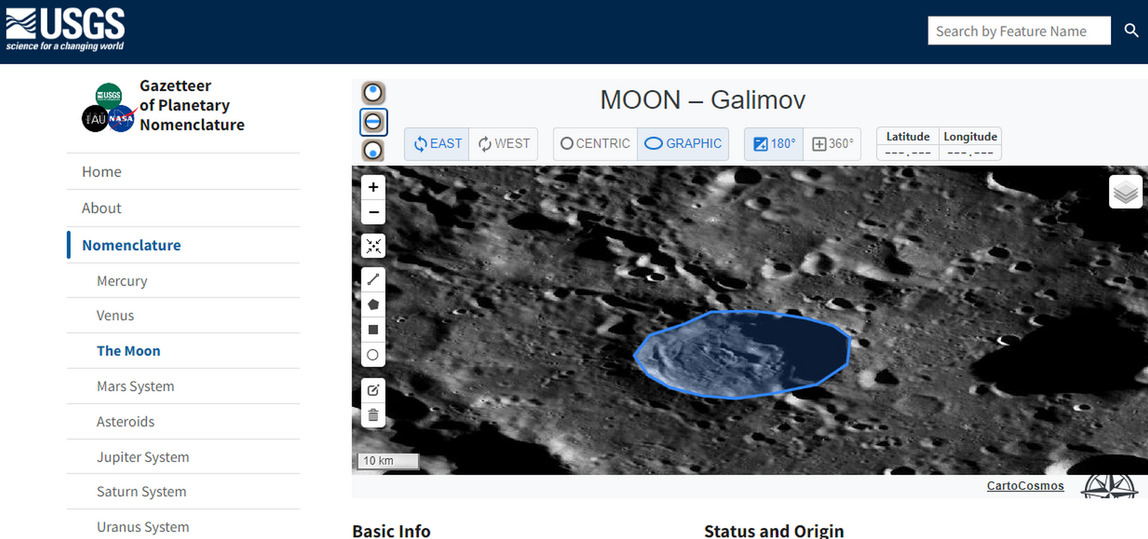 This is what the page about the Galimov crater looks like in planetary nomenclature.
The Galimov crater recently described by Russian scientists may be of interest to geochemists. He explained what might be in it.
Let us recall that a crater with traces of tectonic deformations was discovered using images sent by the Lunar Reconnaissance Orbiter, an artificial lunar satellite (NASA). The formation is located on the mainland, relatively close to the South Pole of the Moon, within the South Pole-Aitken impact basin. A branched network of cracks is observed on the bottom of the crater, which may be a sign of magma intrusion into the subcrater space.
— There is a hypothesis that due to heating by magma, hydrogen could evaporate from the regolith.
— Yes, hydrogen could have been present there in the form of ice, and now, most likely, it is no longer there.
— Yes and no: volatile components of the soil, such as water , probably could fly away, but helium-3 is unlikely to be affected by heating from below. After all, most of it is concentrated in titanium-containing minerals, such as ilmenite, in the upper part of the regolith.
— It flies from the Sun, with its matter, among other components of the solar plasma, forming the so-called sunny wind. Hitting the surface of the lunar soil, it penetrates into it and can be held.
— If I had the opportunity, I would drill a couple of wells there to confirm the hypothesis about the presence of frozen rocks below igneous rocks.