


The work was carried out through the efforts of employees of three institutes
An experiment to model Martian soil and test it for deformation and propagation of a shock wave from the fall of “meteorites” conducted in Moscow by specialists from the Institute of Geochemistry and Analytical Chemistry named after. V.I. Vernadsky RAS (GEOKHI), the Joint Institute for High Temperatures of the Russian Academy of Sciences (JIHT) and the Institute of Space Research of the Russian Academy of Sciences.
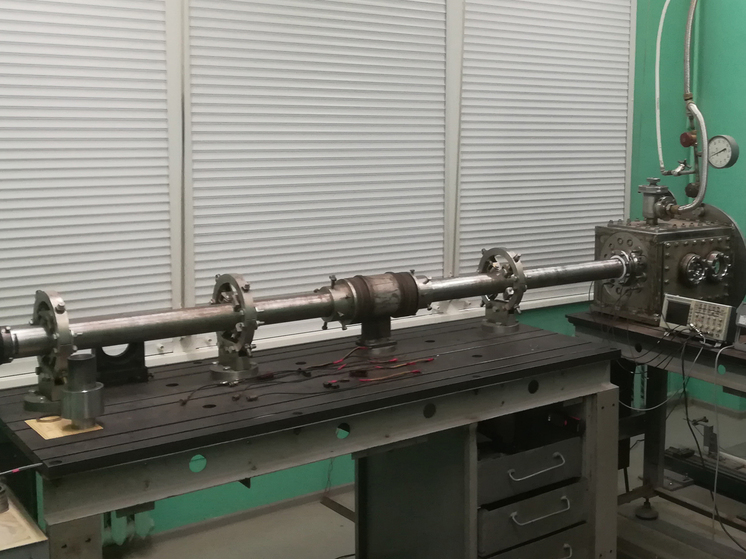 The setup for simulating the fall of meteorites on «Martian» soil. Photo: Timofey Rostilov, JIHT
As reported in the press service of the Ministry of Education and Science of the Russian Federation, the results of the study will help scientists better understand the seismicity of the Red Planet, and will also form the basis for studying the soils of other planets before future space missions.
Despite the fact that earthly vehicles, including Soviet , have already landed on Mars, scientists do not yet have a complete picture of the distribution of shock waves over its surface that arose during meteorite impacts. Modeling meteorite impacts is necessary to gain an understanding of how these impacts affect the geology of Mars. Its study is important for us, since sooner or later a human landing is planned there.
– I ask one of the authors of the work, a senior researcher at the Laboratory of Thermodynamics and Mathematical Modeling of Natural Processes of the Geochemical Institute of the Russian Academy of Sciences, Ekaterina Kronrod.
– There are model estimates of the Martian soil that were obtained from spectral data, from orbital measurements, and from measurements made during landing missions to Mars. Soil characteristics are described in detail in the scientific literature. Since we were only interested in the top layer of soil, it was not very difficult to reproduce it on Earth. According to the density and granulometric characteristics, sand from the bottom of the well suited us.
– Essentially, yes. It is located there in layers: on top it is looser, as it gets deeper – more compressed. Only it is dry everywhere and has a different chemical composition, which was unimportant to us in the experiment, – only the density and size of the granules.
Martian regolith has a multilayer structure, formed under the influence of various geological processes. The top layer, from a few millimeters to several centimeters thick, consists of small particles of dust and sand. The next layer, up to several meters thick, includes sand, gravel and small stones formed by wind erosion, meteorite impacts and mechanical weathering.
The lower layer, ranging in thickness from several meters to tens of meters, consists of compacted regolith and rocks formed as a result of volcanic activity and meteorite impacts. The underlying rock layer, at depths ranging from tens to hundreds of meters, includes basaltic lava flows and sedimentary rocks.
– We simply dried it and poured it into the installation capsule. Then they began to subject them to impacts simulating impacts from micrometeorites that could penetrate deeper into our “Martian” surface. sand to a depth of 20 centimeters.
– To model impacts of meteorites on the Martian surface, reliable reference experimental data on the shock compressibility of regolith on the Martian surface are required. In the experiments, sand was contained in a capsule, which was hit by a metal striker, and we recorded the parameters of shock compression.
– Analogues of regoliths can and should be studied under terrestrial conditions. The experimental data we obtained will help in the future in modeling complex impact processes on Mars. The more a person knows about this planet, the better he can prepare for landing on it.