


Experts compared the profitability and payback of private houses in the regions
With the onset of the summer season, many city residents are increasingly interested in renting country houses. Moreover, many citizens, especially from the IT industry, who work remotely, rent houses not only for the summer, but for permanent residence outside the city. How profitable is such a rental business and how has its profitability changed over time?
 Photo: ru.freepik.com
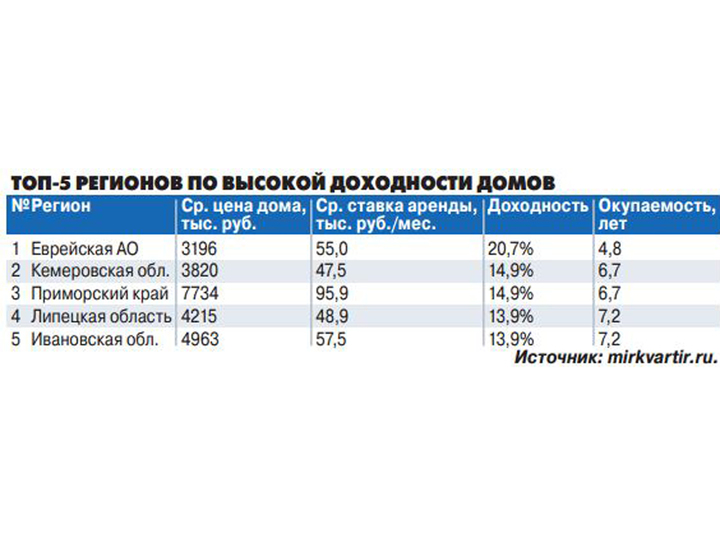
The most profitable region in terms of investment in private houses was the Jewish Autonomous Region, where the profitability rate was 20.7% per annum, and the payback period was only 4.8 years. Analysts from the World of Apartments portal came to this conclusion after comparing the average prices of houses and their rentals in 82 regions of the country. For the calculation, it was assumed that the house is rented out all year round without downtime. Also, the costs of repairs, maintaining the house and finding a tenant, taxes, etc. were not taken into account. Payback was calculated by dividing the cost of real estate by annual income, and profitability — as the inverse of this indicator.
Behind the leader in the list were the Kemerovo region (average income — 14.9% and payback of 6.7 years), Primorsky Territory (14.9% and 6.7 years), Lipetsk (13.9% and 7.2 years) , Ivanovo (13.9% and 7.2 years), Yaroslavl (13.6% and 7.3 years), Pskov (13.5% and 7.4 years), Ryazan (13.5% and 7.4 years), Arkhangelsk (13.1% and 7.6 years) and Novgorod (12.6% and 7.9 years) regions.

Dagestan is recognized as the lowest-income region. In this North Caucasus republic, homes yield just 2.8% per annum and take as long as 35.3 years to pay for themselves. It is also unprofitable to buy houses for rent in the Murmansk region (3% and 33.4 years), Moscow (3.8% and 26.4 years), North Ossetia (4% and 25.3 years), Sevastopol (4. 1% and 24.5 years), Kabardino-Balkaria (4.1% and 24.3 years), Transbaikal Territory (4.3% and 23.4 years), Crimea (4.3% and 23.1 years) , St. Petersburg (4.5% and 22.1 years) and Adygea (4.6% and 21.8 years).
Capital cities invariably fall to the bottom of the rankings due to the high cost of their real estate. But the Moscow and Leningrad regions are ranked better: the profitability there is 5.2% and 6.7%, respectively, and the payback period is 19.1 and 14.9 years. On average in Russia, the profitability of an individual house is 7.4%, and the payback is 13.4%.
As the general director of the portal Pavel Lutsenko noted, some believe that the benefits of renting cottages have increased recently, because rent has become more expensive. “However, our calculations show that there is no need to rush to specifically buy a house for rent. Over the past two years, the profitability of houses has not changed, even fell a little — from 7.6% to 7.4%,” the expert emphasized. The fact is that house prices increased by 40% during this time, and rent by 37%. In addition, you need to take into account that in reality, a house cannot always be rented out all year round, so the indicators of a particular object may vary greatly from average estimates.
However, according to Lutsenko, the price-rental ratio of private houses is better than that of apartments: on average, apartments on the secondary market give 5.6% yield and pay for themselves in 17.9 years, while in the segment of new buildings things are still the same worse – 4.8% and 20.8 years. “So it’s more profitable to rent out houses than apartments,” the analyst noted.
Recall that interest in dachas and private houses for permanent residence began during the pandemic in 2020, when many Russians decided to leave from the metropolis due to the difficult epidemiological situation and began to rent country houses. Restrictions on travel abroad by Russian citizens due to Western sanctions have only strengthened this trend.
This spring, in the country real estate market, the demand for plots, dachas, and cottages increased by 15% compared to last year, the head of the department reported urban and suburban real estate of the company «NDV Supermarket Real Estate» Elena Mishchenko. In her opinion, there are no prerequisites for reducing the cost of houses and dachas. Construction materials, transport and logistics services, and the work of industry specialists are becoming more expensive, which means that the prices of the objects themselves are increasing. Therefore, the “fence” as an investment instrument is suitable not only for further resale, but also for rental, the expert concluded.