


The task is to save money and get drunk at the same time
From July 1, according to the order of the Ministry of Finance, minimum retail prices for strong alcohol will increase. In particular, a half-liter bottle of vodka will rise in price from 281 to 299 rubles. At the same time, in the first quarter of this year in Russia, retail sales of strong alcoholic beverages increased, in particular, cognac — by 9.6%, whiskey and gin — by 18.8%, according to data from Rosalkogoltabakkontrol. Consumption volumes are not declining, although it would seem that this should be facilitated by the rise in price of alcohol on the shelves.
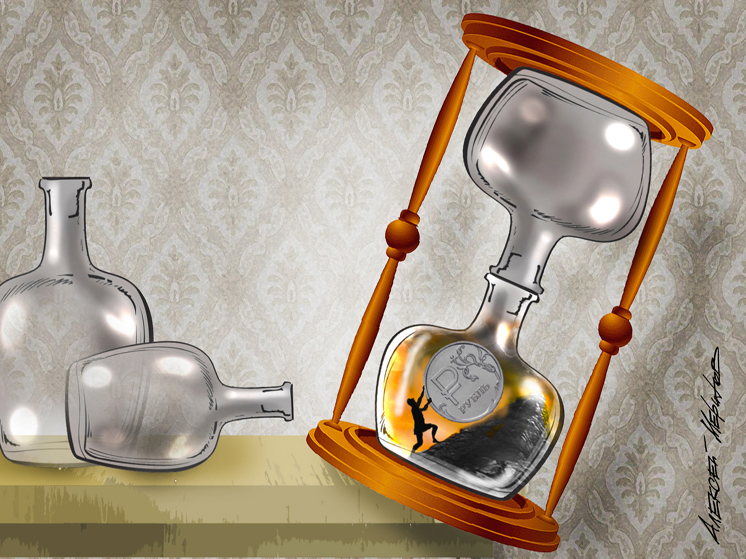
Minimum prices for alcohol have been set regularly by the Ministry of Finance since 2009 in order to combat shadow production. Siluanov’s department justifies the current measure by rising inflation, increasing excise taxes on alcohol with an alcohol content above nine degrees, as well as increasing producer costs. Excise tax rates increased from 613 rubles (in 2023) to 643 rubles (in 2024) per liter of anhydrous ethyl alcohol.
The minimum price for cognac will increase from 517 to 556 rubles, brandy — from 375 to 403 rubles per half liter. From July 1, minimum selling and wholesale prices for manufacturers will also increase: for vodka — from 229 to 246 rubles and from 238 to 256, respectively, for brandy — from 289 to 311 and from 304 to 327 rubles, for cognac — from 397 to 427 and from 419 to 450 rubles. There is also data from the auditing and consulting network FinExpertoza, according to which in 2023, retail sales of strong (above 25 degrees) alcohol increased by 3.6%, to 7.2 liters per capita. This is a record for the last seven years. Vodka accounts for over two thirds of sales. All these data lead to a paradoxical conclusion: no matter how much the authorities raise the price of strong alcohol, its sales continue to grow. And no sanctions, no inflation can reverse this trend.
“The government initially planned to raise minimum retail prices on January 1, 2024, since excise tax rates increased by about 4%,” says Pavel Shapkin, head of the Center for the Development of National Alcohol Policy. “But then the process was moved forward six months. The measure is purely technical, indicative, it reflects the changes that have already occurred in excise tax rates, and does not affect the situation on the market in any way: vodka is cheaper than 299 rubles and is practically not available in stores.
< p>— This indicator is intended for regulatory authorities: by looking at the price tag, auditors must determine whether the product is legal or not. The minimum price for strong alcohol is determined taking into account a variety of components — label costs, markups, profitability, and so on. The bulk of conscientious market players are interested in increasing the minimum price, since this allows them to compete with large holdings that produce, first of all, grain and alcohol, and vodka and cognac as a “makeweight” to their main products. The minimum price is a key factor in competition for customers: it helps some drinks sell faster, while it keeps others on the shelf indefinitely.
— The vast majority of consumers, unfortunately, are extremely illegible. For example, when choosing cognac, people take any bottle with stars and the corresponding inscription, focusing solely on the price: the cheaper, the better. For them, this is a slightly more expensive alternative to slightly boring vodka. True connoisseurs who know how to recognize blends will never buy cognac or brandy in this price niche. By the way, in the category of cognac and brandy there is quite a lot of counterfeit: often in its production the alcohol used is not cognac, but rectified (ethyl) alcohol obtained from grain. Due to this, the price is low.
— Firstly, Russians are interested in trying alternative drinks, and secondly, imports are gradually blowing away: you can hardly buy foreign whiskey and gin. For parallel imports, not everything is brought to us either. Today, cocktails that people have learned to make on their own, using mainly gin, rum and seltzer water as ingredients, are becoming increasingly popular. Many Russians are tired of beer, especially since there is less and less cheap beer. Whiskey sales have doubled over the past three years, and gin sales have even grown fivefold. The current economic situation is pushing people to switch to a more budget-friendly, more accessible type of consumption. By the way, this is a global trend of the last few years: on the one hand, you need to save money, on the other hand, you need to get intoxicated to a certain degree.
— In part, we have learned to import substitute what was previously imported – primarily whiskey, gin and rum. True, the finished blend still comes to Russia from abroad and is bottled here. The same prospect awaits Mexican tequila, Italian grappa and other exotics. Soja, a traditional Korean alcoholic drink that is the best-selling in the world, is quickly gaining popularity in Russia. In its homeland, it is made from sweet potatoes or grains. As for gin (the name itself has a hypnotic effect), there is nothing complicated in its production: in fact, it is vodka infused with juniper berries. Cheap and cheerful.