

Experts explained how the «Big Seven» can be punished for helping Ukraine at the expense of Russian assets
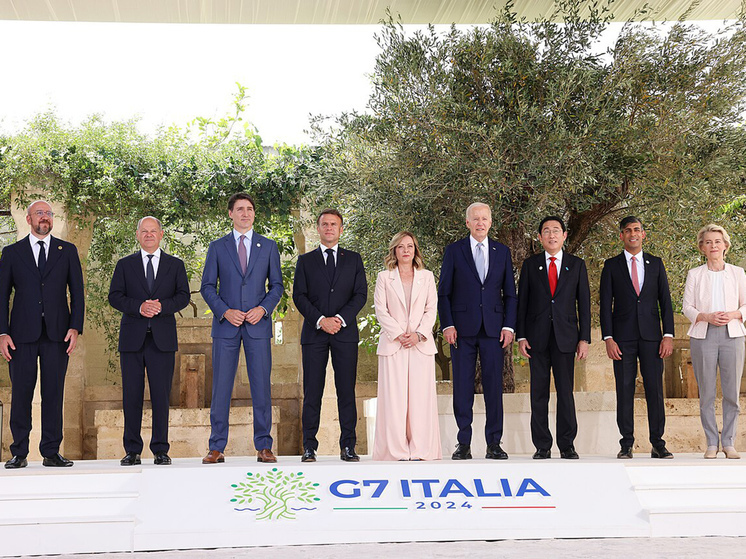
At the summit held in Italy, the «Big Seven» countries confirmed their readiness to transfer $50 billion to Ukraine in the form of a loan, which will be repaid using Russian funds. It is assumed that the profit from our country's frozen assets will be seized first. However, Russia has something to respond to these actions with. According to a study by RIA Novosti analysts, the G7 countries may lose about $83 billion — this is the amount they have invested in our economy in the form of direct investments. What assets are we talking about and whether this response to Western aggression will be adequate, MK found out from experts.
 < span itemprop="width" itemscope itemtype="https://schema.org/QuantitativeValue">
Commenting on the desire of the G7 countries to confiscate the assets of our country, Permanent Representative to the UN Vasily Nebenzya emphasized that Russia will use all possible measures to protect its rights. “The late Libyan leader Muammar Gaddafi is remembered here,” says Alexander Razuvaev, a member of the supervisory board of the Guild of Financial Analysts and Risk Managers. “He had accounts in European banks, and the interest on them disappeared, and they had accumulated there over a long period of time. No one can still say where this money went. Apparently, the EU and the G7 want to repeat the story with Libya.”
The desire of the G7 to transfer $50 billion to Ukraine in the form of a loan allocated from Russian assets, and the profit from the frozen funds belongs to our country just like the frozen assets themselves, Russian President Vladimir Putin directly called an attempt at theft. Let us recall that back in May the head of state signed a decree according to which the assets of foreign investors can be confiscated by a court decision to compensate for losses in the event of confiscation of Russian assets abroad.
And our country has something to respond to the West. At the end of 2022, G7 members invested $82.8 billion in Russian assets, as evidenced by the study’s findings. Britain invested the most ($18.9 billion). It is curious that it was the Prime Minister of this country, Rishi Sunak, in Italy who announced “the final agreement on a new loan for Ukraine for $50 billion,” which will be paid “from proceeds from frozen Russian assets in Europe and around the world.”
< p>Germany and France are in second and third place: they invested $17.3 billion and $16.6 billion in the Russian economy, respectively. Then comes Italy, which invested $12.9 billion in our country. The United States invested $9.6 billion.
What are these assets? “We are talking about companies that operate on the territory of the Russian Federation, but have foreign investors in the form of G7 countries,” explained Associate Professor of the Russian Economic University. Plekhanova Yulia Kovalenko. — If we look at the definition of direct investment, then this is a situation when a foreign investor owns 10% or more of a company. It’s these funds that make up $83 billion of investment in our country’s economy.”
It should be recalled that a number of European countries (for example, Austria, Hungary and Holland) are members of the G7 not directly, but through the EU. As Maxim Osadchiy, head of the analytical department of BKF Bank, pointed out, among the most famous examples of direct investment from G7 countries are Raiffeisenbank (a subsidiary of the Austrian Raiffeisen group), Unicreditbank (a subsidiary of the Italian Unicredit group), ING Bank (a subsidiary of the Dutch ING group), OTP Bank (a subsidiary of the Hungarian group OTP). Citibank (a subsidiary of the American group Citi) also continues to operate in Russia. The bank's capital as of May 1, 2024 amounted to 108 billion rubles.
“The G7 countries bought our shares, bonds and also invested in our country: this is the money we are talking about,” investment adviser Yulia Kuznetsova continues the conversation. — For example, Gazprom shares were purchased through different exchanges. And in fact, this money is frozen: Europeans cannot sell the shares.”
There is also a positive, albeit indirect, effect from the theft of Russian assets planned by the West. “This is a red-handed appearance of swindlers who will never be trusted by investors in the countries of the global South and most other countries,” says Alexander Arsky, associate professor at the Faculty of Economics at RUDN University. “The steps announced by the president to de-dollarize international trade and switch to payments in national currencies will receive a powerful impetus, since the work of the Western banking sector is becoming unpredictable, and the decisions of European bureaucrats are an economic and criminal crime.” Thus, the indirect effect of the theft of Russian assets is tens of times greater than the negative consequences that Russia receives in the short term, the economist believes. At the same time, according to him, Russia should concentrate its efforts on international cooperation between the countries of the global South in the financial and industrial sectors.