


Currently there is strong atmospheric instability in the capital region
Mega showers, storm winds exceeding 20 meters per second, and real tornadoes — it was not for nothing that Mayor Sergei Sobyanin warned about them the day before — hit to the capital on Thursday. Such an “apocalypse,” as Muscovites wrote on social networks, had not happened for a very long time: the wind tore not only billboards from their supports, but literally knocked passers-by off their feet, in some places even along with dry closets. Doctors report almost a dozen casualties. There is also information about one Muscovite who died when a tree fell on him.
We will learn later how many trees were uprooted and cars were damaged, when the city’s emergency services count everything. Apparently there are hundreds of them! We talked to meteorologists about what happened and found out the physicists' version.
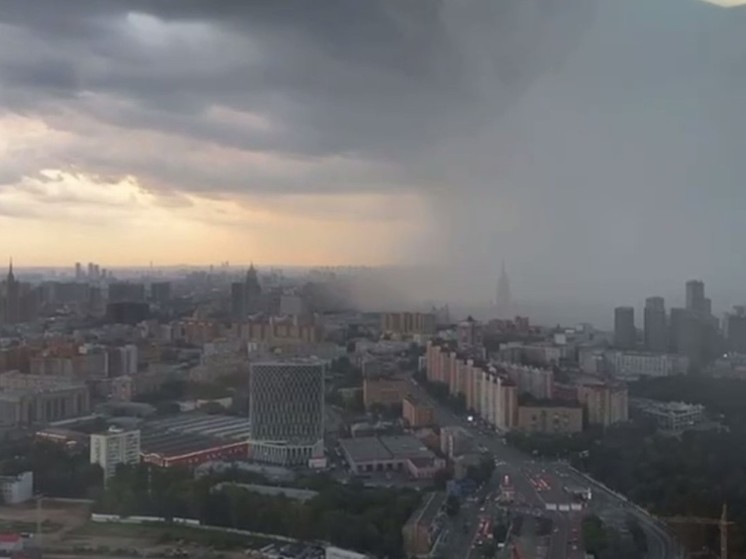
Yes, it’s not for nothing that Moscow Mayor Sergei Sobyanin advised Muscovites to stay at home on June 20. “Tomorrow we will face another test of extreme weather conditions,” he wrote in his Telegram channel the day before. — From June 20, from 3 a.m. to 10 p.m., thunderstorms and heavy rain are expected in places around the city. Strong and squally winds with gusts of up to 18–23 m/s are also possible. From 12 to 17 hours there is a possibility of tornadoes, which is especially dangerous. I ask you to be attentive and careful not to go outside. Take care of yourself.”
Heavy rain, accompanied by almost hurricane-force winds, and even tornadoes — everything was confirmed!
The real atmospheric doomsday began around 13.00. First, the wind came, blowing people, carts, scooters, billboards, even birds from feeders off their feet. Then videos of trees uprooted began to appear — bad luck for those who recklessly left their cars under them. So, on Leningradsky Prospekt an incident occurred that was considered a Guinness World Record — one giant fell on seven (!) cars standing in a row at once. In the very first hours, emergency services reported at least a dozen casualties and one dead man, on whom a tree fell near Dubki Park in the Timiryazevsky district. Another hurricane found him in a dry closet: the wind dropped the light structure with the door down, and he couldn’t get out. Fortunately, when help arrived (the man called emergency services on his mobile phone), it turned out that he was not physically injured.
According to the Baza telegram channel, there were a lot of calls to the rescue service about adults and children caught in the elements. Thus, one woman called an ambulance after a fence fell on her, and a 12-year-old boy was hit by a flying branch.
On Zapovednaya Street, a window in an apartment was broken by a falling tree. But the alarm system, according to the same “Base”, went off where the trees do not even grow to the windows: in high-rise buildings. All residents were asked to go downstairs and — attention — go outside! Don’t they read Sobyanin?!
On Babushkinskaya, the well-known devilish story with a tram that crippled two Muscovites at once was almost repeated. Instead of sunflower oil, fate played a joke with the skin torn from the roof, which landed directly on the carriage traveling along route 17. Fortunately, two of his passengers received minor injuries and were treated at the scene.
Meteorologist Evgeny Tishkovets summed up the first interim results of the rampant disaster at about 16:00 in the afternoon, reporting the following: “A ten-point storm passed through Moscow! Wind gusts reached storm-force 25 m/s, or 90 km/h. On the Beaufort scale, this is a storm of 10 out of 12 possible! Air flow pressure is 45–50 kg per square meter. With such winds, significant destruction occurs; the wind knocks down trees and uproots them. At sea there are high waves with a maximum height of 7–10 m.”
The meteorologist also presented the first data obtained by private weather stations for 1 hour of the storm: 22 mm of precipitation (2 buckets of rainwater per square meter, or 1/3 of the monthly norm in 60 minutes!) — and confirmed the information about the tornadoes that passed through Moscow and the Moscow region: “Atmospheric whirlwinds were recorded in Moscow and Lobnya, which were reported by local residents.”
As the scientific director of the Hydrometeorological Center of Russia previously warned, there is a possibility of tornadoes forming in Moscow, since warm and cold air masses are now colliding in the atmosphere.
According to the weather forecaster, now in Moscow there is a very strong instability in the atmosphere, which is intensified by the sun's rays, which have colossal energy on the eve of the summer solstice (it will come on June 21). Roman Mendelevich, however, did not confirm to MK the information about the tornadoes that occurred in Moscow: “I don’t have information about this yet.” But he reported about a tornado known to him, which took place the day before, on June 19, in the Pskov region. At the same time, the scientist noted that such phenomena in our middle latitudes are still extremely rare.
In his opinion, the Coriolis force (the inertial force that lifts particles in the Earth’s atmosphere perpendicular to their general horizontal movement) causes air flows to rotate in the Earth’s atmosphere. His formula for the formation of tornadoes, or tornadoes, also takes into account the viscosity and thermal conductivity of air.
Sergei Bautin considers the data of American meteorologist Jana Houser from Ohio University, collected by her over five years of observations of tornadoes (or tornadoes). According to these data, tornadoes always occur near the surface of the earth. Bautin also thinks the same: air flows always begin at the heated surface of the earth and go from bottom to top. The fact that the cloud “trunk” descends from top to bottom is just an appearance; it is visible because it is formed by water vapor and dust, but the main, lower part of the vortex can be transparent, the scientist believes.
But Let's get back to the weather reports. After a strong hurricane, cooler weather is predicted in Moscow in the coming days, with night temperatures in the region of +11…+13 degrees and daytime temperatures from +22 to +24. If there is precipitation, it will be short-term.