


A Russian fighter passed next to the Global Hawk
Details of the first “intimidation operation” in the history of the Northern Military District to oust the American Global Hawk drone, which was spying on us over the Black Sea, have appeared the day before. According to a former fighter pilot and administrator of the Fighterbomber channel, our MiG-31 high-altitude fighter-interceptor flew past the “American” at supersonic speed, moving him with a shock wave.
Honored Military Pilot of the Russian Federation, Major General in the Reserves Vladimir Popov, in a conversation with MK, told how such a maneuver is performed, why it is dangerous and what the target “experienced” from the meeting with our legendary fighter.
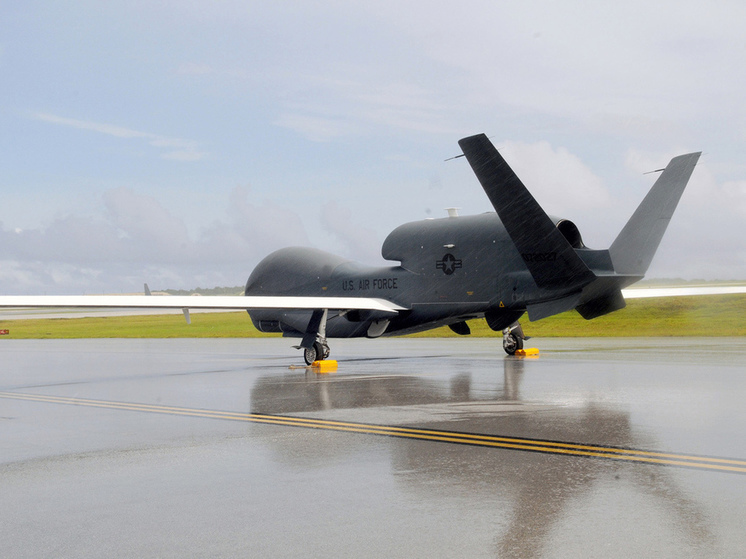
Let me remind you that sensational news of its kind about an indirect attack on an American drone appeared in the aviation channel on June 25. Details arrived only in the evening — on the air of the “333” program, a former fighter pilot said that our fighter “completely by accident” ended up next to the Global Hawk.
“It so happened,” he said, not without irony, “that a MiG-31 plane flew past completely by accident and at very high speed, and over the Global Hawk. …There was no opening of fire, no guns. It just so happened that the situation developed that he flew over the Global Hawk at a very high speed, at which only the MiG-31 can fly…”
As a result of such a maneuver, according to him, “ Some changes occurred with the flight parameters of the Global Hawk, after which it abruptly changed its mind about carrying out its combat reconnaissance mission, turned around and went home.
Everything happened, the expert said, because “the Americans do not coordinate the flight route with us, just like we do with them in neutral waters.”
According to him, there were two passes, at different speeds. At the same time, the maneuver to dislodge the enemy drone was possible only the second time, when the MiG-31 accelerated to a speed that was 2.3 times the speed of sound — Mach 2.3 (Mach 1 is the speed of sound in the air at a certain altitude, approximately 1200 km per hour).
“No one has ever ‘met’ anyone at such altitudes and speeds.” The MiG-31 was chosen as the only aircraft that can perform this task from the entire fleet in service with the Aerospace Forces at such an altitude,” he said.
According to his data (not officially confirmed), the pilot and navigator are presented to the Order of Courage.
He did not rule out that similar incidents over the Black Sea could be repeated if US drones continue to spy on us.
According to the honored military pilot Vladimir Popov, most likely our fighter was performing a maneuver in pursuit of the target.
“It’s effective and safe for the crew to carry out a catch-up maneuver,” he said, “because this way the pilots can see the target, come closer, say, at a distance of 10-15 meters, and go with a slight excess in order to be sure to pass this object and ensure their safety.” .
The jet of disturbed air flow after the passage, which the plane leaves as it flies, especially at supersonic speed, will be very powerful. In addition, there will be a very powerful shock wave when the aircraft goes supersonic. The pilot himself does not hear the shock wave. Physically, it is clearly heard by those on the ground. It is heard as a “clap of thunder.” And, accordingly, the physical impact is very large.
— As a result of the flight of a supersonic aircraft, air is compressed, which greatly affects the environment. This dense “film” of compressed air, like it or not, hits the entire fuselage, the wings of the object that is flying nearby. And, of course, those who fall into the wake are also affected by this impact force. This is a very dangerous phenomenon, it is quite difficult to get out. And you need to be prepared for this. And if you are not ready, then, accordingly, you will have some deviations in piloting.
— The first time, perhaps, he went at a lower speed. The effectiveness was insignificant. When I went at high supersonic speed, it, of course, produced a very strong effect.
— If the first time a fighter passed from above, then, most likely, it also passed from above again, but with a slight decrease so that the object was better visible along the horizon, and then occupied its height or slightly higher — literally 10-20 meters in order to pass over it, ensuring your safety.
— It is always there, because the drone can really maneuver. The question is, will he be able to do it at that speed? But there is always some risk. And flight is always a theory of probability. When you sit in the cockpit, you never know how the flight will end. This is always a big risk.
— The difficulty lies only in the large turning radius — you leave and lose your target. You have to navigate using a contrail, and at high altitudes, a trail remains from a jet and turboprop aircraft. Or you have to briefly turn on your 360-degree locator in order to see the target again, and then turn it off for a moment so that it doesn’t detect you. In addition, the combat control system of the command posts, which guides you, can give a hint as to what course to take if our target suddenly changes course.
— Quite a piece of jewelry work. The pilot can immediately turn off the afterburner and try to brake in order to make a turn not at a speed of 1200 or 3000 kilometers per hour. It takes a very long time to complete — the larger the turning radius, the more time it takes. Therefore, the turn is made in afterburner, with a large overload and loss of speed. Thus, we get out of the situation so as not to lose sight of the goal. But, as I already said, they can help us from the ground, or we ourselves can detect the target with a locator or visually using a contrail, if the weather conditions are good.
— A pilot who pilots at supersonic speed experiences practically nothing special at high altitudes. During such flights, I myself could notice the transition to supersonic only by the arrows of the speed indicator, and what was happening outside the plane was unknown to me; supersonic was not felt at all. Therefore, I don’t care at what speed I pass next to my target. The only thing is that at low speeds I had the opportunity to see the object better. In this case, I have a period of time to identify him, even, perhaps, with numbers and some kind of insignia. And at high speeds, accordingly, I don’t have this period of time at all, I’ll overshoot the target, I’ll just record that it was somewhere. I can’t identify what it was. That's the difference.
— Surely this has happened. It’s just that in Soviet times they didn’t write about it or talk about it. Everything was closed, and we studied such flights corporately. In general, this is not some very rare thing. We intercepted targets at supersonic speed in training flights in the same way. Otherwise, how will you actually intercept a supersonic target when catching up, when you have turned on, say, Mach 3? In any case, the pilot overtakes the target after using the weapon and still manages to catch it with this wave.