


Pensions, benefits and insurance payments
Work is the most important part of our lives. Finding a job you like and a friendly team – isn’t that happiness? In Russia, in order for any person to realize their need for work, a fundamental system of supporting working citizens has been created. It includes pension and social insurance and the provision of various support measures and payments. We will tell you more about what a working Russian is entitled to if he is officially employed in the MK material.
 Photo: senivpetro-ru.freepik.com
By signing an employment contract, employees receive social guarantees. Firstly, workers are protected by the Labor Code. And these are the rights to a 40-hour work week, a salary, a lunch break, an organized workplace and vacation (more about this — see below). Secondly, social guarantees are provided through contributions that the employer pays to the Social Fund.
The support measures provided by the SFR include:
• temporary disability benefits in the event of illnesses, injuries;
• insurance payments in case of industrial injuries and occupational diseases;
• maternity benefits;
• pension provision for an employee for old age or disability.
On For these purposes, employers deduct insurance premiums from the wage fund. In 2024, a single tariff is applied, which is:
• 30% of the wage fund — until the maximum amount of income is reached (2 million 225 thousand rubles per year);
• 15, 1% — from exceeding the limit amount.
Additionally, in some areas, employers also contribute from 0.2 to 8.5% for insurance against occupational risks — industrial accidents or occupational diseases.
In addition to full-time employees, some of the work in the company can be performed by individuals under a civil-law contract. This may be, for example, the provision of legal services, preparation of financial statements, repair of premises or equipment. In such cases, if the contractor has the status of an individual entrepreneur or self-employed person, the employer is exempt from the obligation to pay insurance premiums. Working citizens from the specified categories can voluntarily enter into social insurance relations, independently paying contributions to the Social Fund.
Social guarantees for employees form the basis of social policy in the sphere of labor, which can be considered in two aspects:
• from the position of the state, seeking to establish uniform principles of relations between employees and employers;
• from the point of view of the employer, who creates working conditions that are attractive to employees.
Social guarantees at the state level can be:
• national — established by the Labor Code of the Russian Federation for all workers;
• sectoral — determined by the relevant legislative acts depending on the characteristics of labor in specific industries;
• regional — introduced at the level of the subject by its laws.
Industry and regional guarantees can significantly expand the guarantees established by the Labor Code of the Russian Federation, but cannot reduce them. For employers belonging to the relevant industry or region, providing employees with social guarantees provided for by law at any level is mandatory. However, they have the right to expand their circle by committing to additional guarantees for persons who are their employees.
It includes insurance against temporary disability (sick leave), industrial accidents and occupational diseases. Insurance benefits protect employees and guarantee them assistance in difficult life situations.
In 2024:
• Sick leave is paid in the amount of 620 to 4039 rubles per day of incapacity (this is the minimum and maximum amount, the specific amount of payment is determined individually depending on the length of service and average earnings of the employee for the billing period);
• One-time and monthly insurance payments in case of an accident at work or occupational diseases can reach a maximum of 141 thousand and 108 thousand rubles, respectively. 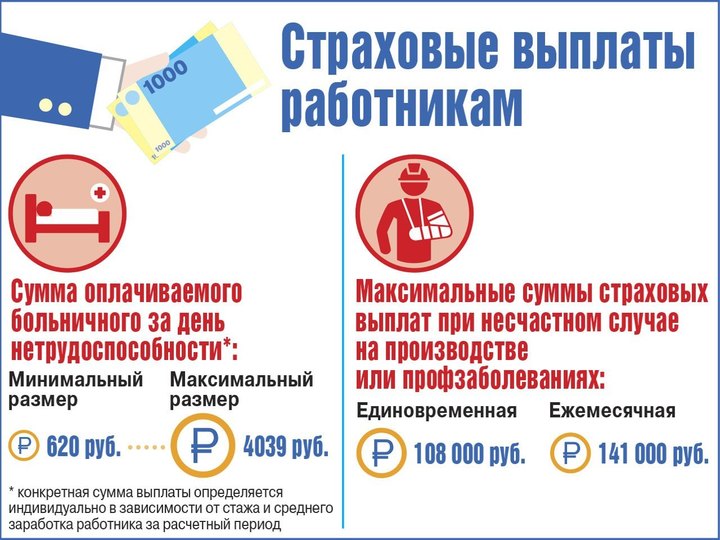 Infographics: Victor Blinov
Note that from January 1, 2022, the issuance of certificates of incapacity by medical organizations is carried out only in electronic form document (ELN). To issue a sick leave certificate, the insured person just needs to tell the attending physician his SNILS number.
The ENL does not indicate the place of work and type of employment (main, part-time). Therefore, when working on an external part-time basis, temporary disability benefits are assigned and paid based on the same ELN number.
There is no need to print out the ENL and present it on paper to the employer’s HR department. The Social Fund automatically notifies employers online about the opening of certificates of incapacity for work for their employees, as well as about each change in the status of the ELN (extension, closure, cancellation).
< /p>
Providing benefits to working citizens is carried out in the following cases:
1. Loss of ability to work due to illness or injury, including in connection with an operation for artificial termination of pregnancy or in vitro fertilization;
2. The need to care for a sick family member;
3. Quarantine of the insured person, as well as quarantine of a child under 7 years of age attending a preschool educational organization, or another family member recognized as incapacitated in accordance with the established procedure;
4. Carrying out prosthetics for medical reasons in a hospital specialized institution;
5. Treatment in accordance with the established procedure in sanatorium-resort organizations located on the territory of the Russian Federation, immediately after the provision of medical care in a hospital setting.
The benefit is paid when an insured event occurs during the period of work of a citizen under an employment contract, performance of official or other activities, or when an illness or injury occurs within 30 calendar days from the date of termination of said work or activity.
Funds from insurance premiums go to various social purposes. In particular, to support pregnant employees. They are paid maternity benefits. Its amount depends on the official salary. The benefit is accrued for the entire period of maternity leave, which can range from 140 calendar days for normal childbirth (70 days before birth and 70 after) to 194 days for the birth of two or more children. The maximum payment amount is RUB 783,707.62.
One of the parents of the baby is paid a lump sum benefit upon the birth of the child. If the parents work, then any of them can become a recipient of the benefit. If one of the parents does not work, the benefit will be assigned to the working one.
The benefit amount is 24,604 rubles. It is indexed annually.
If a parent works in a region where regional coefficients are provided, the benefit is paid taking them into account.
Young parents are also supported from insurance premiums . They are paid child care benefits up to 1.5 years old. Its amount is 40% of the employee’s official salary.
The maximum monthly payment is 49,123 rubles.
The minimum benefit is calculated based on the minimum wage and is 9,227 rubles.
< p>In addition to parents, any working relative caring for a child can apply for benefits. To do this, you need to take out the appropriate leave.
Most of the insurance contributions go to ensure the pension rights of citizens. They are formed in the form of an individual pension coefficient (IPC). You can find out information about the amount of accumulated IPC as follows:
• log into your personal account on the “State Services” portal, for this you need a confirmed account;
• go to the “Pensions and Benefits” section;
• order an “Extract from your personal account in SFR» and read the document.
The value of the individual pension coefficient is a guarantee of the size of the future pension. The higher it is, the larger the pension payment will be. IPC has its own cost. It is indexed annually. In 2024 — 133 rubles.
Since 2014, all insurance contributions for compulsory pension insurance paid by employers for their employees are directed towards the formation of an insurance pension. Despite this, many citizens form pension savings. They may consist of:
• insurance contributions made before 2014;
• additional insurance contributions paid by citizens or their employers;
• government contributions for co-financing transferred within the framework of the Program of state co-financing of funded pension;
• maternity capital funds allocated for this purpose;
• income from investing pension savings.
All citizens with pension savings have the right to entrust their management to:
• The Social Fund of Russia, choosing this is a management company (MC), one of those that the Social Fund selected through a competition and with which the SFR entered into an agreement on trust management of pension savings, or a state management company (GMC) VEB.RF with one of its investment portfolios;
< p>• you can also choose a non-state pension fund (NPF), which carries out compulsory pension insurance activities, as an insurer for compulsory pension insurance. The choice of management company in this case is the prerogative of the fund.
IMPORTANT! In 2014–2023 all insurance contributions for compulsory pension insurance paid by employers for their employees were directed towards the formation of an insurance pension.
Officially employed citizens are protected by law from the arbitrariness of employers. Labor guarantees include several important points:
• The right to conclude, amend and terminate an employment contract. This is the main document that establishes the rights and obligations of the employer and employee. For example, you cannot fire a person without reason. And he himself can leave at any time, but will be required to work for two weeks;
• The right to perform only the work and duties described in the employment contract. No one can force an accountant to work as a cleaner;
• The right to receive wages without delay. The employer is obliged to transfer money to employees at least twice a month;
• The right to vacation, time off, and a break. Each employee is entitled to a minimum of 28 days of paid leave per year. In addition, the right to weekends (at least 42 hours of continuous rest per week) and to a lunch break (at least 30 minutes per day);
• The right to compulsory social insurance. The employer must pay insurance premiums for the employee. And they give the right to a future pension, sick leave, maternity leave, free treatment and compensation due to possible injuries at work;
• The right to a safe workplace and labor protection. The employer must provide the employee with a workplace. It must be safe and comply with regulations;
• The right to protect your interests. If an employee's salary is delayed, he is not allowed to go on vacation, or he is fired without any valid reason, the employee has the right to defend his interests, including in court.