


Scientists cannot come to a consensus
Scientists confirm that the Earth's core has slowed down so much that it is moving backward. Here's what it could mean. Deep inside the Earth, CNN says, is a solid metal ball that spins independently of our spinning planet, like a top spinning inside an even larger top, shrouded in mystery.
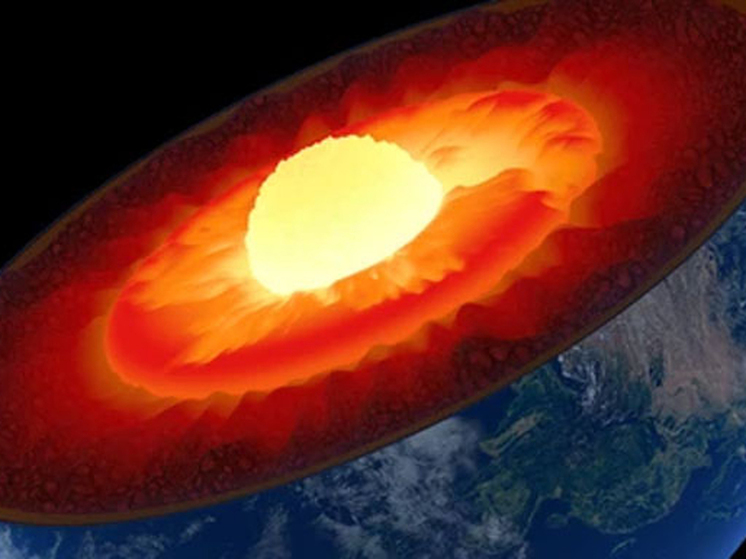 Photo: Argonne National Laboratory
This inner core has intrigued researchers since its discovery by Danish seismologist Inge Lehmann in 1936, and how it moves — the speed and direction of its rotation — has been the subject of debate for years. There is growing evidence that the core's rotation rate has changed dramatically in recent years, but scientists still disagree about what exactly is happening and what it means.
Part of the problem is that the Earth's interior cannot be observed or sampled directly. Seismologists have gathered information about the movement of the inner core by studying how waves from large earthquakes that reach this area behave. Oscillations between waves of the same strength that passed through the core at different times allowed scientists to measure changes in the position of the inner core and calculate its rotation, CNN reports.
«Differential rotation of the inner core was proposed as a phenomenon in the 1970s and 80s, but seismological data were only published in the 90s,» said Dr Lauren Waszek, a senior lecturer in physical sciences at James Cook University in Australia.
But researchers have debated how to interpret these results, «primarily because of the difficulty of making detailed observations of the inner core due to its remote location and the limited data available,» Dr. Wasek said. As a result, “studies conducted over the following years and decades disagree on the speed of rotation, as well as its direction relative to the mantle,” she added. Some studies have even suggested that the core was not spinning at all.
One promising model proposed in 2023 described an inner core that in the past spun faster than the Earth itself but is now spinning slower. According to scientists, for some time the rotation of the core corresponded to the rotation of the Earth. It then slowed down even more until the core began to move backward relative to the surrounding layers of liquid.
At the time, some experts warned that more data was needed to confirm this conclusion, and now another group of scientists has provided compelling new evidence in favor of this hypothesis about the rotation rate of the inner core. The study, published June 12 in the journal Nature, not only confirms the slowdown in core growth, but also confirms the 2023 assumption that the slowdown is part of a multi-year trend of slowing and accelerating growth.
The new findings also confirm that changes in rotation speed occur on a 70-year cycle, said study co-author Dr. John Vidale, professor of geosciences in the Dornsife College of Letters, Arts and Sciences at the University of Southern California.
“We've been arguing about this for 20 years, and I think it speaks for itself, – says Dr. Vidale. – I think we're done with the debate about whether the inner core is moving and what its pattern has been over the last couple of decades.
But not everyone is convinced that the issue is settled, and the question of how the inner core slows down may affect our planet is still an open question, although some experts say the Earth's magnetic field may play a role.
The solid metal inner core, located about 3,220 miles (5,180 kilometers) deep inside the Earth, is surrounded by a liquid metal outer core. The inner core is composed primarily of iron and nickel and is estimated to be as hot as the surface of the Sun — about 9,800 degrees Fahrenheit (5,400 degrees Celsius).
The Earth's magnetic field acts on this solid ball of hot metal, causing it to spin. At the same time, gravity and the flow of the liquid outer core and mantle exert resistance on the core. According to Vidale, over many decades, the impact of these forces causes changes in the speed of rotation of the core.
The squelching of metal-rich liquid in the outer core generates electrical currents that power the Earth's magnetic field, which protects our planet from deadly solar radiation. Although the direct effect of the inner core on the magnetic field is unknown, scientists previously reported in 2023 that the slower rotation of the core could potentially affect it, as well as slightly shorten the length of the day.
When scientists try to “see” across the planet, they typically track two types of seismic waves: pressure waves, or P-waves, and shear waves, or S-waves. According to the USGS, P waves travel through all types of substances; S waves only travel through solids or extremely viscous liquids.
In the 1880s, seismologists noticed that S waves generated by earthquakes did not travel through the entire Earth, and so they concluded that the Earth's core was molten. But some P— waves, having passed through the Earth's core, appeared in unexpected places — “The shadow zone,” as Inge Lehmann called it, creating anomalies that could not be explained. Lehmann was the first scientist to propose that traveling P waves could interact with a solid inner core within a liquid outer core, based on evidence from the great 1929 New Zealand earthquake.
By tracking seismic waves from earthquakes that have passed through Earth's inner core on similar trajectories since 1964, the authors of the 2023 study found that the rotation occurred on a 70-year cycle. By the 1970s, the inner core was spinning slightly faster than the planet. Around 2008 it slowed down, and from 2008 to 2023 it began to rotate slightly in the opposite direction relative to the mantle.
For the new study, Vidale and his co-authors observed seismic waves caused by earthquakes in the same places at different times. They found 121 examples of such earthquakes that occurred between 1991 and 2023 in the South Sandwich Islands, an archipelago of volcanic islands in the Atlantic Ocean east of the southernmost tip of South America. The researchers also studied core-penetrating shock waves from Soviet nuclear tests conducted between 1971 and 1974.
According to Vidale, when the core rotates, it affects the arrival time of the wave. Comparing the travel times of seismic signals as they touched the core revealed changes in the rotation of the core over time, confirming a 70-year rotation cycle. According to the researchers' calculations, the core is about to start accelerating again.
Compared with other core seismograph studies, which measure individual earthquakes as they pass through the core — regardless of when they occur — using only paired earthquakes reduces the amount of data used, “which makes the method more complex,” says Laurent Waszek. But it also allowed the scientists to measure changes in the core’s rotation with greater precision, Vidale says. If his team’s model is correct, the core’s rotation will begin to speed up again in about five to 10 years.
The seismographs also showed that during its 70-year cycle, the core's rotation slows down and speeds up at different rates, «which requires explanation,» Vidale said. One possibility is that the inner metal core is not as strong as expected. If the core is deformed as it spins, it could affect the symmetry of its spin rate, he said.
The team's calculations also show that the core has different spin rates when moving forward and backward, adding “an interesting contribution to discussion”, says Vashek.
But the depth and inaccessibility of the inner core means uncertainty remains, she added. As for whether the debate about nuclear rotation is truly over, «we need more data and improved interdisciplinary tools to study this issue further,» Vasek said.
Changes in nuclear rotation, although they can be tracked and measure, are virtually invisible to people on the Earth's surface, Vidale notes. When the core spins slower, the mantle speeds up. This shift causes the Earth to spin faster and the length of the day shortens. But, according to him, such rotational shifts in the length of the day amount to only thousandths of a second.
Scientists are studying the inner core to learn how the Earth's interior formed and how activity throughout the planet's subsurface is connected. The mysterious region, where a liquid outer core surrounds a solid inner core, is particularly interesting, Vidale added. As the place where liquid and solid matter meet, this boundary is «filled with the potential for activity,» as are the core-mantle boundary and the mantle-crust boundary.
“For example, we may have «volcanoes are at the inner edge of the core, where solid and liquid meet and move,» he said.
Because the rotation of the inner core affects the movement in the outer core, the rotation of the inner core is thought to contribute to the strengthening of the Earth's magnetic field, although more research is required to elucidate its exact role. And there is still much to be learned about the overall structure of the inner core, Wasek said: “New and emerging methodologies will play a central role in answering current questions about the Earth's inner core, including the question of rotation.”