


Moscow and Beijing discussed their joint future: a new “Atlas of Investments”, projects on the Northern Sea Route and energy security
The VI Russian-Chinese Energy Business Forum (RCEBF) ended in Moscow. More than 500 people took part in it, among whom were politicians, representatives of the largest Russian and Chinese companies in the energy and related industries, scientists, academics and analysts. Experts discussed the most pressing problems of cooperation between Moscow and Beijing, geopolitical challenges, new investment opportunities and global changes in logistics routes due to penetration into the Arctic. About further plans for the development of relations between the PRC and Russia — in the material «MK».
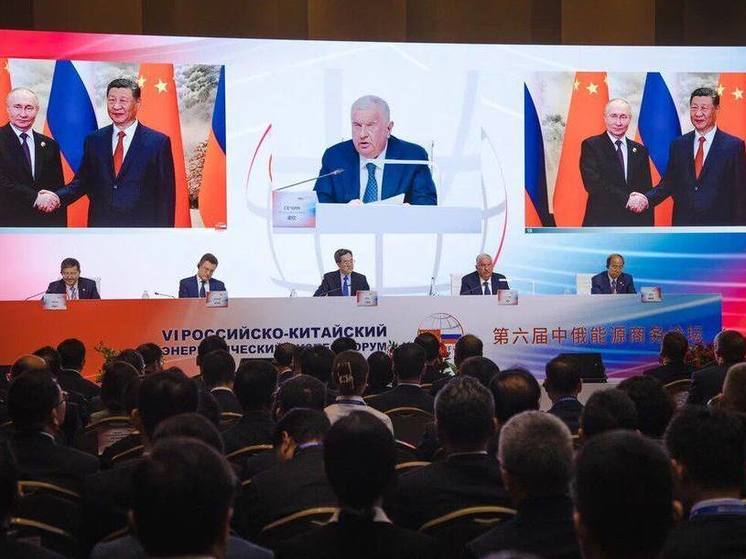 PHOTO: PJSC NK Rosneft < /span>
In 2024, RKEBF celebrates its sixth anniversary. Russian President Vladimir Putin and Chinese President Xi Jinping sent welcoming words to the forum participants. In the message of the Russian leader, which was read by the executive secretary of the Commission under the President of the Russian Federation on the strategy for the development of the fuel and energy complex (FEC) and environmental safety, the head of Rosneft, Igor Sechin, it was emphasized that cooperation between Moscow and Beijing is comprehensive. Supplies of Russian energy resources to China are reaching record volumes, and specialists from both countries are working together to improve technologies for “extraction, processing and transportation of raw materials, increasing their environmental safety.”
The letter from the Chairman of the People's Republic of China was read by Vice Premier of the Chinese government Ding Xuexiang. Xi Jinping noted that cooperation between Moscow and Beijing in the energy sector is acquiring a mature, sustainable and lasting character, bringing real tangible benefits to the peoples of the two countries.
Companies participating in the RKEBF account for up to 40% of trade between Russia and China. At the same time, energy accounts for more than 70% of the structure of Russian exports to China. The head of the oil company recalled that this year the People's Republic of China celebrates its 75th anniversary. Today, relations between Moscow and Beijing are at an unprecedented high level. In 2023 alone, trade turnover between the Russian Federation and China increased by 26% and reached $240 billion. In terms of scale, Russian-Chinese cooperation in the field of energy supplies is no longer equal in the Eurasian space. In 2023 alone, Russia exported 107 million tons of oil, 34 billion cubic meters of natural gas and more than 100 million tons of coal to China. The next stage of development of the two countries should be aimed at creating value chains in energy and related areas, including the development of advanced technologies, mechanical engineering, modern shipbuilding, supply of industrial equipment, alternative energy, emissions reduction and joint participation in R&D, says Igor Sechin. In his speech, he pointed out the futility of attempts by Western countries to complicate relations between Moscow and Beijing and the readiness of the two countries to strengthen cooperation, despite powerful sanctions pressure. To facilitate bilateral relations, the head of Rosneft called for increasing trade turnover in national currencies.
In his report, he paid special attention to the importance of developing the Northern Sea Route. This will require a high ice-class tanker fleet, which can be created in cooperation with Chinese shipbuilding companies and component suppliers.
Then the executive secretary of the Presidential Commission on the Strategy for the Development of the Fuel and Energy Complex presented at the forum the updated “Atlas of Investments” of Russian-Chinese energy cooperation. This document is a practical guide to the implementation of joint projects.
Vice Premier of the People's Republic of China Ding Xuexiang said in his speech that interaction between Russia and China on the energy track remains highly dynamic. “I would like to note a solid package of practical results,” the politician emphasized. — The first is the steady growth of trade in energy resources. The second is the progressive promotion of particularly significant projects. Third, a sustainable expansion of areas of cooperation. The parties are actively working to open new horizons for cooperation in the oil and gas field.” He added that in the future, trade and investment cooperation in the energy sector should be systematically promoted and the high dynamics of cooperation in energy trade should be consolidated.
Deputy Chairman of the Government of the Russian Federation Alexander Novak noted that over its six-year history, the RKEBF has already become a productive platform for dialogue between Moscow and Beijing. The fuel and energy complex remains one of the priority tracks of Russian-Chinese strategic interaction. “Russia plays a stabilizing role in overcoming the global energy crisis,” Novak emphasized. Supplies of resources from Russia increase the energy security and socio-economic sustainability of friendly countries. According to the deputy chairman of the Russian government, long-term contracts of large Russian oil companies are the key to reliable supply of Russian energy resources to the PRC at fair market prices.
The head of the board of directors of the China National Petroleum Corporation (CNPC) Dai Houlian noted that in the international energy market Turbulence is increasing, trade patterns are changing, and in this regard, the value of Chinese-Russian energy cooperation is very high. He promised to continue cooperation with Russian partners and use the RKEBF platform and other mechanisms to reach a new level of relations.
The event was also attended by Deputy Head of the Administration of the President of the Russian Federation Maxim Oreshkin, Minister of Energy of the Russian Federation Sergei Tsivilev, Head of the State Energy Administration of the People's Republic of China Zhang Jianhua and other top managers and market experts. The next, VII Russian-Chinese Energy Business Forum will be held in China in 2025.