


The first cold breeze ran through the housing market
The results of July on the primary housing market of the Moscow macro-region puzzled experts. But, despite the collapse in sales, prices are still stuck. The new trend in the largest and most liquid local real estate sector in the Russian Federation is being watched with interest not only by Muscovites, but also by residents of other regions of the country. How will developers react to the cooling in demand and where will prices for new buildings go next?
In July 2024, retail sales of apartments and flats under equity participation agreements and assignment of rights fell by 40% compared to June. Revenue from the sale of real estate last month decreased by 30%: 185 billion rubles against 266 billion rubles in June, reported analysts from the Dataflat service, which compiles databases of sales and prices in new buildings. According to their calculations, in July, sales of new housing in lots within the old boundaries of Moscow fell by 31%, in New Moscow — by 41%, in the Moscow region — by 50%.
During the second month of summer, 10.9 thousand new apartments with a total area of 517 thousand square meters were sold in the macro-region. This is 7.4 thousand apartments less than the figures for June. The average price of a lot without a discount was 17 million rubles, 17% more than a month earlier. 1 square meter in new buildings increased in price by 8%, to 335 thousand rubles. The average area increased to 47.4 square meters (+5% month-on-month). In Moscow, the number of transactions with mortgages decreased from 76% to 63%. This figure remains the highest in New Moscow: 85% against 92% in June. In the Moscow Region, 81% of transactions were completed with the help of a mortgage (-9% compared to June).»The main reasons for the decline in sales were the increase in mortgage rates, the cancellation of preferential mortgages with state support and a significant change in the terms of family mortgages,» said Elena Chegodaeva, head of the analytics and consulting department at NDV Real Estate Supermarket. According to her assessment, the main blow fell on the mass segment, whose sales fell by 39.3%, and the share of mortgages decreased by 9% (from 86.6% to 77.3%).
According to Valery Kochetkov, Director of the New Buildings Department at INKOM-Real Estate, after the cancellation of mass preferential mortgages, the market has slumped, but there are still demands, people are interested in buying primary housing, but many are stopped by expensive mortgages. «Now we are adapting to the new conditions, buyers are looking at preferential offers from developers, demand is accumulating. I think there will be growth in the fall,» the analyst noted.
According to him, developers are working to maintain demand by offering buyers various programs. Some are in demand among clients. For example, now 35% of buyers of new buildings use the installment program against 10-12% before the cancellation of preferential mortgages. The fact is that the conditions have changed and have become more favorable for clients. If earlier developers offered installments for only a few months, now — until the commissioning of the building, i.e. for two years. The client can reserve the apartment they like with a fixed price and switch to a mortgage in two years if its conditions become more favorable. Buyers with a mortgage have reoriented themselves to this offer, which increased the share of installments in the total demand in July.
About 20% of buyers use another option — they apply for a joint program of developers and banks, where the mortgage rate for the first five years can be 8%, and then either the market rate or refinancing at a lower interest rate, perhaps by that time the mortgage will become cheaper. This program was announced in June. «For now, many clients prefer installments, since it does not involve paying interest. But the share of those who choose such a joint program from developers and banks will increase, since a decrease in mortgage rates is unlikely by the end of this year,» Kochetkov noted.
In the mass segment, as always, buyers often choose the most budget-friendly options with targeted government support or under developer programs. For buyers in the business and premium segments, the cancellation of preferential mortgages did not have any noticeable impact.
According to Chegodaeva, last July the share of apartments in the overall sales structure grew by 3% and amounted to 8.9%. In old Moscow, the share of comfort and business classes in the sales structure by class equalized — 46.5% each. The share of the comfort class decreased over the month, and the share of sales in the business segment remained unchanged. This indicates that all changes in mortgage conditions have not affected the business class, which has long adapted to stricter mortgage conditions.
By lot format, the largest share of sales is for one- and two-room apartments — 36% and 27%, respectively. In third place is the demand for studios with a share of 22.1%. Compared to last month, the sales structure has remained virtually unchanged.
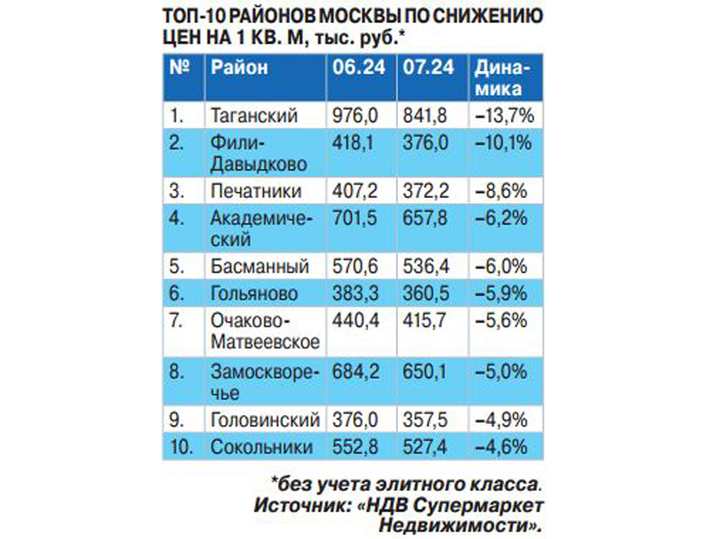
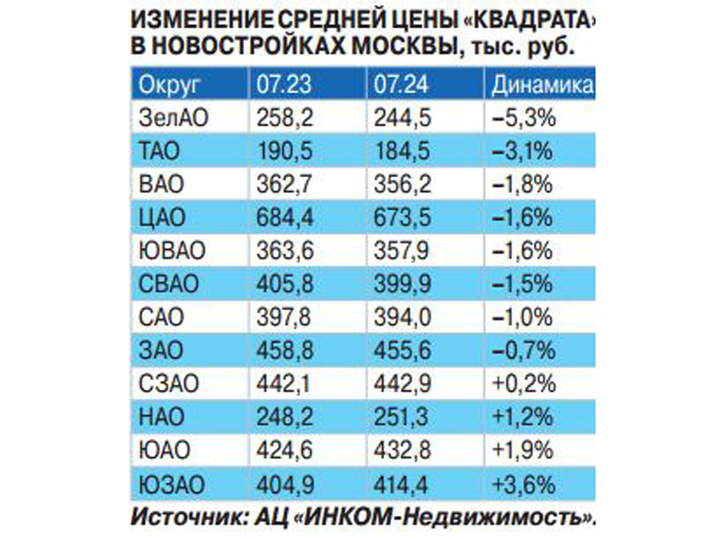
According to Kochetkov, the average price of 1 sq. m. on the primary market of old Moscow is 421.1 thousand rubles. It has not changed since June (+0.1%), has increased by 7.1% since the beginning of the year, and has grown by 16.3% over the year (compared to the July 2023 figure). In New Moscow, a square meter in new buildings is valued at an average of 249.7 thousand rubles: +1.2% per month, +2.9% since the beginning of the year, +9.3% per year.
According to Chegodaeva, in the near future, the dynamics of demand will be influenced by mortgage factors and interest rates. They are especially important for the mass segment, in which the share of mortgage transactions over the past year was almost 80%, and in some projects reached 100%. The share of family mortgages currently amounts to no more than 20-25% of sales, but may grow to a maximum of 30-35%. «We should not expect a significant reduction in prices, since developers depend on project financing and filling escrow accounts. With high mortgage rates, price reduction is also not a panacea for sales growth. Therefore, in the short term, the market will be in a state of stagnation and search for a new equilibrium with different input data,» the analyst emphasized.
According to Kochetkov, in the new buildings segment, the primary influence on pricing is now the cost of construction, inflation and expensive project financing for developers. «Therefore, in response to the cooling of demand, there will be no direct price reduction. But compensation of part of the interest at the expense of developers, which was previously carried out by state preferential programs, is the only really feasible task today. And in the coming year we will live with sales stimulation programs from developers,” the expert is sure.