


A giant space rock has wiped out many living things on our planet
Scientists believe that the crater was formed as a result of the Earth's collapse caused by a carbon-rich C-type asteroid. Experts studying materials about the event that occurred 66 million years ago have found signs indicating how the Chicxulub impact crater was formed.
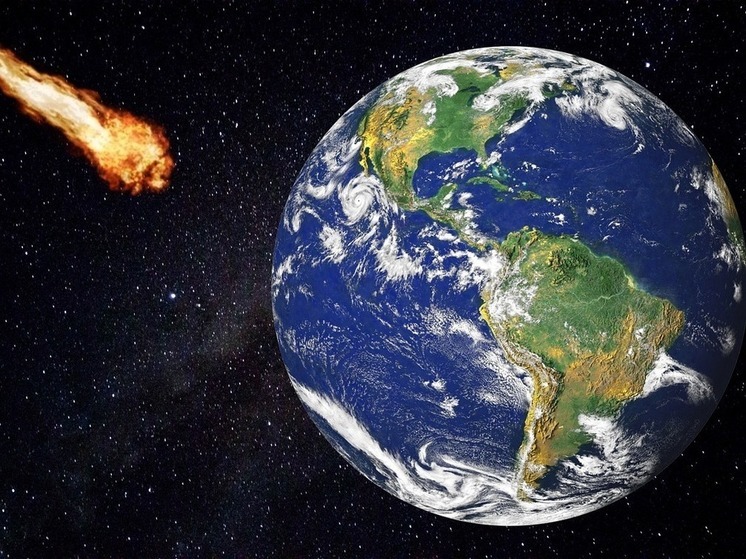
When a massive space rock crashed into Earth 66 million years ago, it wiped out countless living organisms and ended the reign of the dinosaurs. Now scientists say they have new information about what it was made of, writes The Guardian.
Experts studying materials collected during the event say they have found clear signs supporting the idea that The Chicxulub impact crater was formed by a carbon-rich C-type asteroid that originally formed beyond the orbit of Jupiter.
Mario Fischer-Goedde, a co-author of the study from the University of Cologne, said the team is now interested in studying sediments from the impact that is thought to have caused a major extinction event around 215 million years ago.
“Maybe we could then find out whether C-type asteroid impacts are more likely to cause mass extinctions on Earth,” he said.
In a paper published in the journal Science, the researchers report how they studied different types, or isotopes, of ruthenium in a layer of material that was deposited on the globe after an impact 66 million years ago.
«This layer contains traces of asteroid debris,» Fischer-Gedde said.
The team chose ruthenium because the metal is very rare in the Earth's crust, The Guardian notes.
«So the ruthenium we find in this layer is almost 100% from the asteroid,» Fischer-Gedde said, adding that this allows scientists to determine the composition and therefore the type of impactor itself.
The team found that samples from Denmark, Italy and Spain had the same isotopic composition of ruthenium.
The result is different from what is typically found on Earth, Fischer-Gedde said, ruling out the theory that the presence of ruthenium and other metals such as osmium and platinum is due to past eruptions of the Deccan Traps volcanoes.
The team also cast doubt on the possibility that the impactor was a comet, saying the ruthenium isotope composition of the samples differed from that of meteorites, which are thought to be fragments of comets that had lost their ice.
Instead, the ruthenium isotope results matched the average composition of meteorites from carbonaceous (C-type) asteroids – carbon-rich space rocks that may have formed early in the solar system beyond the orbit of Jupiter.
But questions remain about where exactly the asteroid came from before it headed toward Earth.
Fischer-Gedde said C-type asteroids are found today in the asteroid belt between Mars and Jupiter because Jupiter migrated shortly after the solar system formed, scattering asteroids in the process.
As a result, he suggests that the ill-fated space rock likely originated there.
«There may have been a collision between two asteroid bodies in the belt, and then the piece sort of crossed Earth's orbit. «That could be one scenario,» the scientist said, although he noted there were other possibilities, including that it came from the Oort cloud, which is thought to surround the solar system.
Dr Craig Walton, from the University of Cambridge, who was not involved in the work, said the research was exciting, although he said it remained unclear whether the impactor was an asteroid or a comet.
«However, this kind of work is giving us an increasingly detailed understanding of the nature of the objects that have so dramatically shaped Earth's history,» he said.