

Economists argue about the consequences of the West's tough restrictive measures
At the end of February 2023, the European Union introduced the tenth package of sanctions against Russia, thus marking a kind of anniversary of a tough sanctions attack. Igor Nikolaev, chief researcher at the Institute of Economics of the Russian Academy of Sciences, Alexander Razuvaev, member of the Supervisory Board of the Guild of Financial Analysts and Risk Managers, and director of the Institute for Socio-Economic Research of the Financial University under the Government spoke about the course of the sanctions war with Russia, losses and prospects at the MK press center Alexey Zubets.
I would single out three sectors: the defense complex, the banking sector, the energy sector . But the restrictions affected many sectors of the economy, it is easier to name those that were not affected by the restrictions.
The most tragic thing, of course, is the freezing of our international reserves: about $300 billion. Another negative point — our stock market has suffered significantly.
The main blow fell on those industries where the role of the West in organizing business was greatest. First of all, it is air transportation. Problems began with spare parts for aircraft.
Colleagues have already spoken about finances. In addition to aviation and banks, the automotive sector was also hit hard. But who among us has fallen yet and hasn't wrung out — this is the aircraft industry, which we simply did not have.
Second branch: civil automotive industry. Plus, the fuel and energy complex, of course, suffered heavy losses. This is due to the export embargo and the reorientation of Russian oil and gas flows from European markets to Asian markets, and this process will drag on for a long time. It will take years before we can earn as much in the Eastern markets as we did in the West.
If we talk about the consequences of Western sanctions in general, then I do not share the point of view that this is a destructive story. Yes, the shake-up was large-scale, on the one hand. But on the other hand — finally, we began to solve the problems of those industries that should have been solved 15-20 years ago. As they say, thunder struck, the peasant began to cross himself.
I propose to focus on our main macroeconomic indicator — minus 2.1% of GDP. This is the dynamics of the decline. When 2022 was just beginning, before the special operation and sanctions, the authorities predicted a growth of 3%. Therefore, answering the question about losses-gains, we have a minus. Small, but minus.
Let's look at the situation from the point of view of ordinary people. As a result of the sanctions, they received very high inflation. And the rise in prices — this is a serious story. And, of course, there is a moment that the authorities do not like to talk about, this is a growing budget deficit. And behind it there are big risks, including in the social sphere.
If we look at the real disposable income of the population, then, according to Rosstat, in 2022 the drop was only one percent. Probably, if not for the sanctions, real incomes would have grown by 1-1.5%. It turns out that the decline in the real well-being of citizens is extremely small.
If we take real wages, then there is the same story. That is, people who work in Russia have lost practically nothing and have hardly become poorer compared to 2021. Consequently, the Russian economy responded well to challenges in 2022.
According to our estimates, the recovery of commodity markets is possible in the second half of this year, but it will be relative. Commodity markets will not reach the indicators of 2021. But, on the other hand, the government will spend a lot of money. And just budget spending will stretch the economy as a whole.
As a result, according to the results of 2023, we will most likely receive an optimistic GDP growth of 1.5%. Real wages will grow, real incomes too, within 1%. Thus, by the end of 2023, we will get good results. The main circumstance that should contribute to the development of the economy is an ideologically new, nationally oriented industrial policy, which has become a vital necessity for us. I will say more: if we do not have this new policy, then we will not win the conflict.
The main indicator of people's financial well-being — real disposable income of the population — indeed decreased very slightly: only 1%. Therefore, it is not surprising that many people said that they were not affected by these sanctions in any way.
But, nevertheless, more than half of the people still faced certain restrictions. In my opinion, the results of your survey quite reflect the reality. But we must understand that in fact, nothing has ended yet. We have yet to experience the worst consequences of the sanctions.
You can, of course, try to rectify the situation by increasing budget expenditures — for the indexation of pensions, as was the case last year, when hundreds of billions of rubles were spent on raising wages. But, despite this, the real disposable income of the population still declined. So, I'm afraid that over time, the proportion of those who believe that international sanctions have not affected them in any way will decrease.
Last year, not a single significant bank collapsed in our country. The authorities did not raise personal income tax. But one way or another, the situation is quite alarming. More and more Russians feel the sanctions, because one way or another they affect life.
It is possible that those who say that the sanctions did not affect them, — these are pensioners. That is, people living on state payments. Pensions in Russia were actively indexed last year, and the standard of living of pensioners did not fall, it even increased a little.
Retirees have not changed much in their lives. They do not travel abroad, they do not use Western media services. It turns out that they have everything left as it was. Indeed, the main factor that hits people is high inflation. Here she hit almost everyone.
As for the long-term results of the sanctions, I do not agree with colleagues who say that the worst is yet to come. We went through this last spring, when we were promised a catastrophe. But it was not.
Today, there are factors that will work to worsen the situation, but there are also those that will benefit our economy. A number of post-Soviet countries have increased imports of European goods to exactly the same extent that corresponds to the import of the same goods in 2021 from Europe to Russia. Now the same imports go to Russia, only through other countries or through parallel imports.
We will not be able to replace everything, and it is unlikely that such a task should be in principle. What is the main problem here? The economy, when under the pressure of sanctions, is looking for how to survive. In this case, the task is to ensure that production works, products are produced, people receive a salary. Let the technical level of products be lower, but the products themselves will be. The main thing is that production works. In this case, the economy begins to simplify. This is her defense mechanism. In the end, everything will work, but more or less. There will be no replacement for everything. Most likely, some goods, components will simply disappear from the market.
No, of course not. Another thing, and here I agree with my colleague, — the economy will be more primitive. We must be aware: we can produce something, we can’t produce something.
There will certainly be new packages of sanctions. Because this is not even a question of economics, but of psychology. This is an attempt to create some kind of informational pressure on the brains of an ordinary Russian layman who always expects things to get worse.
Now, in order to maintain psychological pressure, restrictions are being introduced gradually. But if we take some large segments that have remained in the Russian economy and which may still be subject to sanctions, then, in my opinion, there is only one — Atomic industry. But in this area, many countries are critically dependent on Russia, for example, France, Bulgaria, Hungary, Belgium. Therefore, there are no such restrictions in the 10th package of sanctions. And it is not a fact that they will ever be adopted.
If we talk about what the West will do next, then most likely it will try to close the loopholes associated with circumventing already adopted sanctions. For example, with secondary and unlicensed parallel imports. They are trying to put pressure on Turkey, India, China to reduce the volume of trade with us. But I do not foresee any serious strengthening and expansion of sanctions pressure on Russia. So, we can say that we have more or less coped with economic sanctions.
I do not know if there will be an 11th package of sanctions or not, but it is a fact that the information pressure continues. What you need to be prepared for in the economy is the consequences of the restrictions already imposed on our energy and raw materials sector. There is a transitional period going on, and we have yet to experience the consequences of these sanctions. So far, we can conclude that the sanctions pressure is not getting smaller.
All the restrictions that Western partners wanted to introduce have already been introduced. There will be political pressure. We need to get used to the new reality and develop our stock market, develop our own economy. This is a new reality in which we live, and I think it will be for a long time.
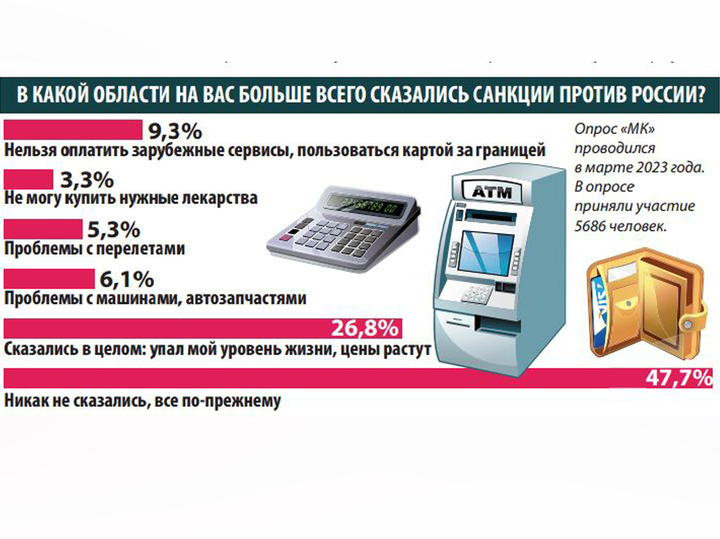
You cannot pay for foreign services, use a card abroad — 9.3%
I can't buy the necessary medicines — 3.3%
Problems with flights — 5.3%
Problems with cars, auto parts — 6.1%
In general, my standard of living has fallen, prices are rising — 26.8%
No effect, everything is the same — 47.7%