


The first evidence of Homo sapiens presence in Altai was found
The first evidence of Homo sapiens presence in Altai, or rather, in Denisova Cave, was found by scientists from the Institute of Archeology and Ethnography of the Siberian Branch of the Russian Academy of Sciences and the German Institute of Evolutionary anthropology of Max Planck. The DNA of an ancient Upper Paleolithic woman was isolated from her jewelry, a red deer incisor. Head of the Department of Stone Age Archeology of the IAET SB RAS Corresponding Member of the Russian Academy of Sciences Mikhail SHUNKOV told MK about the amazing find and the difficult work carried out by an international group of scientists.
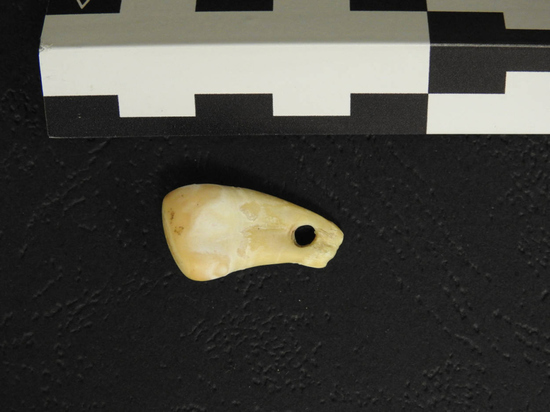 Photo: Max Planck Institute for Evolutionary Anthropology.
Recall that the first sensational discovery of the Denisov man (it was the phalanx of the finger of a 7-12 year old girl) was made in Altai in 2008. The name of the newly discovered species came from the name of the cave itself, located in the Soloneshensky district of the Altai Territory.
It is believed that Denisovans separated from the common evolutionary tree about a million years ago. It appeared in Denisova Cave presumably 300 thousand years ago, having come to Altai from the Middle East.
In 2010, the Denisova Cave revealed another secret: at one time, about 40 thousand years ago, representatives of two species lived together in it: Denisovans and Neanderthals, this was revealed thanks to the found phalanx of the little toe of the left foot, which belonged to a Neanderthal woman. Genetic analysis of the little finger also showed that it contained features of both species. This indicated that the two species interbred. The mother of the cave dweller was a Neanderthal, and her father was a Denisovan.
And finally, in 2023, we learn that in addition to Denisovans and Neanderthals, representatives of Homo sapiens lived in the famous cave! A pendant made from a red deer incisor, from which the DNA of a modern-type woman was subsequently isolated, helped to find out. Scientists reported this in the journal Nature.
The DNA of modern man differs from the DNA of the Neanderthal by 202 nucleotides (letters of the genetic “alphabet”), and from the Denisovan man by 385 nucleotides.
< /p>
– A pendant – a deer tooth with a drilled hole – was discovered in the southern gallery of Denisova Cave back in 2019. Teeth are a very informative material, in which, as it turned out, even the genetic material of the people who use it can be preserved. This was proved by paleogenetics four years after the discovery.
— Perhaps this was done for later, ancient or medieval finds. But before us — the Paleolithic! Age from 19 to 25 thousand years. Nothing like this has yet been received for this age.
A combination of factors played a role here: the most modern equipment that our colleagues from the Max Planck Institute have, new methods for isolating genetic material from fossil material, and the good preservation of this very material in Denisova Cave. The degree of preservation of the finds could be compared with the remains from the Bacho Kiro cave in Bulgaria, where not so long ago the bones of the most ancient Homo sapiens in Europe, 45 thousand years old, were found.
But in our case, let me remind you, DNA was isolated for the first time not from bone remains, but from the jewelry worn by a woman, most likely the North Eurasian population of Paleolithic man! According to the so-called genetic clock, the age of the find was established — 19-25 thousand years.
— You can say so, except for the fact that two or three years ago we already sequenced the DNA of Homo sapiens from the local loamy deposits, from the cultural layer. But this is the first time this has been made from the bone material of the decoration.
— Yes, it turns out that in the Paleolithic era it came from the West and began to settle in Altai. There is nothing particularly sensational about this. Another thing is interesting: how did representatives of different species interact with each other? Was there interbreeding and cultural interaction between them, as between Denisovans and Neanderthals?
— Theoretically, yes. But we will know for sure only if we find hard facts testifying to such contacts. DNA isolated from the pendant is still considered indirect evidence of the stay of Homo sapiens in Denisova Cave.