


«Replacing a market economy with a mobilization economy will lead to disaster»
In recent weeks, a rather unexpected discussion has flared up in Russian political and financial circles about which path the domestic economy should follow — privatization or nationalization? An exchange of views in absentia on this subject was initiated by VTB Board Chairman Andrey Kostin and head of the Investigative Committee of the Russian Federation Alexander Bastrykin. The head of the second most important state bank raised the issue of resuming large-scale privatization in Russia. And just a few days later, the head of the federal investigative agency proposed «to take the path of nationalization of the main sectors of our economy.» Which of the two opposing recipes will most help the development of the Russian economy at the present stage, we found out in a conversation with Oleg Buklemishev, director of the Center for Economic Policy Research at the Faculty of Economics of Moscow State University named after M.V. Lomonosov.
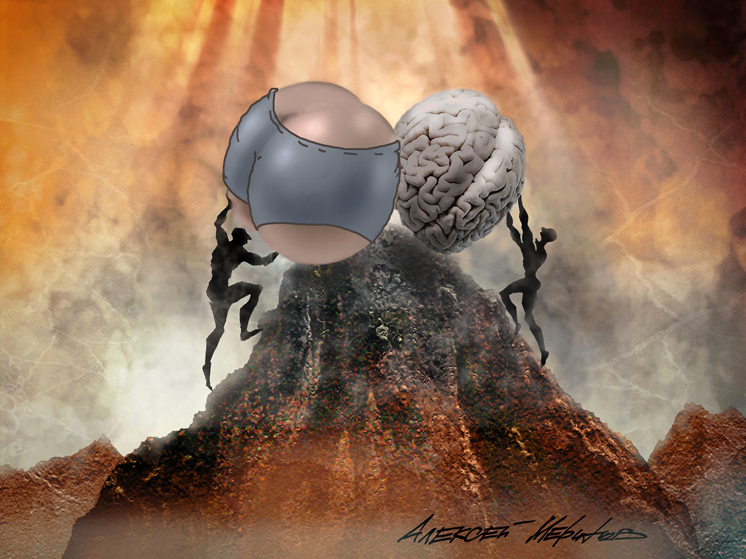
— These are views from two poles on the same situation, conceptually and functionally contradicting each other. On the one hand, we are talking about a purely administrative, command management model, about the finalization of the economy in the status of a mobilization one. According to this logic, market factors, private property are the main obstacle to achieving goals. Another point of view comes from the head of the state bank, which is one of the key players in the financial market. So there are two motives here: mediation in transactions and the purchase of undervalued assets with subsequent resale. The past privatization showed that the latter is extremely beneficial for insiders.
 Oleg Buklemishev. Photo: carnegieendowment.org
— Complex issue. It can be measured in different ways, for example, by ownership, by control, by sales, by the number of employees. For example, in Gazprom, the state directly owns a little more than a third of the shares. Is it a private company? And then Gazprombank is even more a private company, since it belongs to a non-state structure? Obviously, from the point of view of actual control, this is not the case. For example, for a clear answer to the question, «Which banks are more efficient — public or private?» — even professional researchers sometimes find it difficult how to separate one from the other. In general, many calculations of this kind are incorrect. Even in narrow segments it is difficult to achieve clarity, and what can we say about the economy as a whole, where everything is intertwined. The Federal Antimonopoly Service once reported that the state directly or indirectly controls 70% of the economy. Since then, this figure has often been mentioned, although no one has ever shown calculations that would confirm it.
— Well, it's still a question — it fits or not. What is structural transformation? If in a simple way — this is a kind of redistribution of resources between sectors, industries, regions, and so on. Within the framework of nationalization, everything can be wonderfully transformed. Suppose the state decided that it needs to develop military-industrial complex enterprises, and with this priority goal for itself, it began to actively absorb some private economic objects, redistribute labor and capital in favor of the defense industry. The transformation is evident, how much it will benefit the economy is another question.
As for the future of our economy, this is the biggest mystery. Everyone is talking about the same thing about what is happening now: it is difficult for us, we are under sanctions, but we continue to resist. But about the future of the economy — not a word. In general, a sane person cannot imagine that Russia, like North Korea, will live in isolation from the world community for decades. At the same time, there is no holistic vision of the future, a strategic direction for the development of our country. There are only scattered representations of various social, political and economic groups. The level of uncertainty is going through the roof, and this is due not only to military-political factors, on which much depends today, but also to a host of other issues. Who could have guessed a year ago what would happen to Russian oil exports today?
— It's just the thesis of nationalization that is less clear to me. Well, let's say the state closed factories, newspapers, steamships … But in any case, it will have to establish a management system, structure it, link enterprises together, and solve a bunch of issues — financial, organizational, conceptual. The projects that the Soviet Gosplan was involved in 40 years ago look rather simple compared to modern ones. To declare today the idea of nationalization means not to represent the complexity of administrative processes. After all, it is necessary to take into account how much the economy has become more complicated (still remaining open), how much its post-industrial sector has grown. Even just finding adequate managers, performers who will take care of this is a task from the category of unsolvable in the current conditions.
As for privatization, everything is clear here. This process is usually initiated by the government for two reasons.
The first is to improve the efficiency of enterprises that perform poorly. Seeing that the state manager is not coping with his duties, the state changes him to a private trader, who removes unnecessary links, reduces costs, and makes the company profitable. But then the idea should have been voiced at least by the head of the Ministry of Economic Development, and not by a bank, even a large one.
The second is fiscal, when the state simply plugs holes in its financial shell with the help of this source. I think there is another important factor in this story — the gloomy state of the budget, which may need support through the sale of certain state assets.
“I believe that the increase in defense and law enforcement spending in recent years represents a major permanent shift in the budget. With a shrinking revenue base (at least in terms of oil and gas revenues), we have a structural, and not temporary, cash gap, since spending has grown not one-time and not by billions, but by trillions of rubles. But a very simple conclusion follows from this: if a state has a structural gap, then it must somehow be closed on a regular basis. And a temporary source like privatization or borrowing won't work.
Only two sources can give Russia an inflow of trillions of rubles. This is a value added tax and oil exports. Everything else is a trifle, mere pennies. VAT was already raised in 2020 by 2 percentage points, which then brought an additional 700 billion rubles to the budget. Today it is about 1 trillion rubles a year. Probably, according to the same logic, it is possible to increase the fiscal burden on the oil and gas sector. However, under the sanctions, it is already difficult for oil companies: the constant forced change of trading partners and logistics directions, the need to use the services of a shadow tanker fleet, transship raw materials at sea from side to side, and so on — all this does not encourage them to constantly remove from them any that's extra money. Something can be additionally “cut”, but obviously not trillions of rubles. And if the treasury continues to go into negative territory, sooner or later the government will have to carry out a structural correction, rebalancing the fiscal system.
— It seems to me that there is no clear understanding at the top of what awaits the Russian economy in the strategic plan. Therefore, all current measures are exclusively situational, adaptive. At best, these actions are designed for the next few years and do not concern long-term challenges. At the same time, we must give the government its due: in the spring of 2022, it showed a fair amount of efficiency, responsiveness and awareness compared to the same pandemic months, when the authorities hesitated for a long time, not understanding what should be done. It is difficult to give a general assessment of the current state of the economy, it is very mixed, contradictory: in some sectors the situation is better (construction and the food industry), while in others it remains frankly a failure (for example, the auto industry).
— The truth is in the middle. On the one hand, the main shocks are indeed over. At a distance of one year, the Russian economy turned out to be more stable than it was thought. But the real strength of any material object is tested not by a single impulse, but over a long period of time. Now this check on the sanctioned roads continues. We are constantly receiving evidence that the sanctions imposed in 2022 are manifesting themselves in a new way, with a delayed effect. For example, AvtoVAZ sends employees on long vacations due to the lack of electronic components for production, cinemas suffer multimillion-dollar losses, half the country has been closed for civil aviation flights for the second year now, and now also for drones, there are no spare parts for aircraft, which, by the way, increases the risk accidents. And so on…
In general, we resisted, but when we peer into the distance, look for new horizons, we realize that there is nothing special to be inspired by. Today there is a redistribution of markets, huge unfilled niches appear somewhere, and on the other hand, some sectors (automotive industry, aircraft industry, gas industry, woodworking) inevitably sag. This is the same structural transformation that we discussed above. The economy «dumps» some types of activity, replaces them with others, tries to develop others, but in the end the overall picture is blurred. We have largely lost the raw material rent, so the pie for the distribution of income will inevitably lose in volume, costs will grow, and the productivity of the entire economy will fall. According to available data, real incomes of the population are now 8-9% below the level of 2013.
— Exactly the same as with the economy as a whole. Unfortunately, over the past 10 years, the state has not been able to provide a clear increase in real disposable income in a situation that was much better than today. Now it's pointless to talk about it. And we are discussing the «average temperature in the hospital.» Different categories of citizens are in different situations. For recipients of social benefits, it is one, for employees of the automotive industry — another, for the personnel of IT enterprises — the third. But since the incomes of the economy as a whole collapse, sooner or later the same happens with the incomes of all participants in the process.
— We teach our students at the Faculty of Economics of Moscow State University a simple idea: look not at the numbers themselves, but at what stands behind them. The same indicator can mean completely different things in different conditions. It's one thing when you produce a modern consumer product, such as a car that people want to buy, and quite another when you produce «pieces of iron» paid from the budget with explosive filling and a very short lifespan. They do not bring joy to anyone, because they are intended for another. Their «consumption» is not stimulating, but depressing for the economy. From the point of view of formal statistics, cost indicators, both of these products can give the same figure for industrial output. But in terms of content, these are two completely different things.
The Soviet Union demonstrated this quite clearly in the last years of its existence. If the economy produces a certain product (especially in large volumes) that does not have consumer demand and does not improve people's lives, then in the end it stumbles upon certain limitations in the supply of products available to people.
Today, the domestic economy is shrinking in volume, becoming less and less significant against the global background. Occupying 1.5-2% of global GDP, we are trying to counter a coalition of countries whose combined economic power is at least 20 times greater. That's what really oppresses me, and not thoughts about the results of the current year. The dynamics of GDP may be plus 1% or minus 1% (as the Central Bank determined in its forecast), but the first will not please me much and the second will not upset me. It's time to start thinking about how to interact with the outside world.
— His main economic lesson is that Russia has a market economy, and it works. I am sure that replacing it with a mobilization one can lead to catastrophic consequences. A simple example: when people decide whether to go to the army under a contract, they are sure to have a conversation with them, persuade them, tell them about the conditions of service, about the amount of remuneration … They may well refuse. A mobilization, fully state-owned economy is not like that. Relatively speaking, you come to a person, hand him a summons, you can even pay him 200 thousand rubles a month's salary, but any negotiations in this case are excluded. And they are necessary! It is very important that all participants in the process have freedom of expression, the ability to say “no” at some point and choose another deal. This is exactly what distinguishes dynamically developing economic systems from archaic and isolationist ones.