

600px . s://cdnn21.img.ria.ru/images/07e7/07/13/1885130625_0:358:3006:2048_640x0_80_0_0_c71c647d5c55cda4721e9c7a8ed683d8.jpg 640w, https://cdnn21.img.ria.ru/images/07e7/07/13/1885130625_0:358:3006:2048_1280x0_80_0_0_035c2a9fa001ec8e631c640b2df67857.jpg 1280w . The results of a study conducted by scientists from Tomsk Polytechnic University together with Russian and foreign colleagues will simplify the search for deposits of environmentally friendly fertilizers for agriculture, the authors of the work published in Applied Clay Science say.
According to the head of the research group, Associate Professor of the Geology Department of Tomsk Polytechnic University Maxim Rudmin, the scientific team managed to establish direct relationships between various ancient volcanic rocks (volcanites) and potential deposits of specific clay mineral fertilizers.< br />Unlike nitrogen and phosphate fertilizers, clay minerals with a high content of iron, silicon and potassium are completely environmentally friendly. At the same time, as previously reported, they improve soil properties and increase yields.One of these minerals, according to Rudmin, is a potassium-containing layered aluminosilicate, glauconite. Glauconite can be used on a farm or home floriculture both independently and in combination with other fertilizers.
Scientists believe that the search for glauconite deposits will be simplified by the patterns identified by scientists thanks to the mineral and geochemical analysis of rock samples from the North Minusinsk depression (Siberia).
«
"We found out the dependencies of the appearance of clay minerals based on ancient volcanics. So, the main product of the change of a volcanic rock called trachyte in a marine setting will be the mineral glauconite, for rhyodacite it is illite, and smectites and chlorites are found mainly in trachyandesite,” Rudmin said.
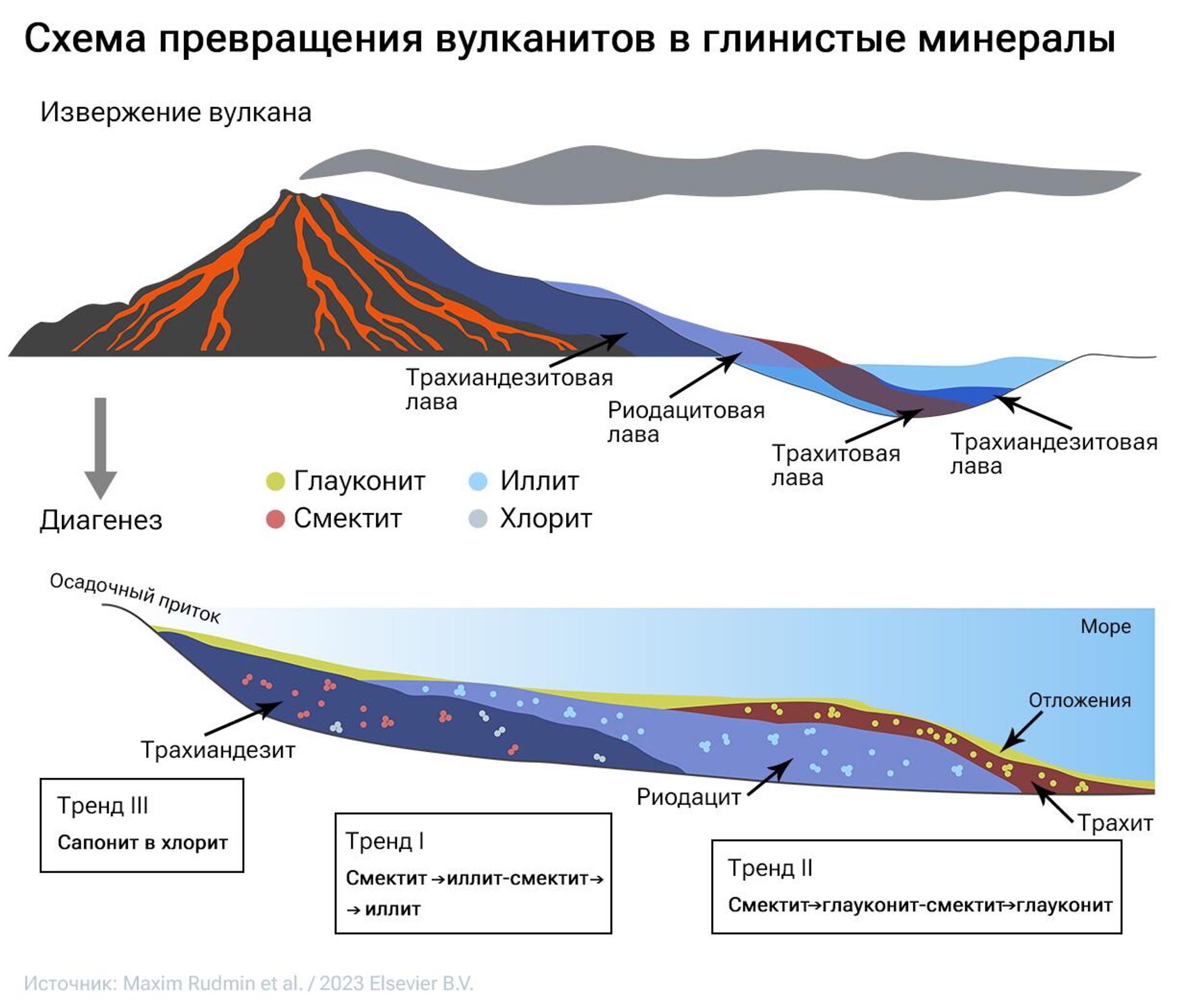
According to the scientist, the results of the study not only simplify the search for deposits of clay rocks, but are also of fundamental importance: understanding the evolution of minerals will help dating ancient volcanic eruptions around the world.
The further task of the scientific team a — to gain new knowledge about the conditions for the formation of other secondary minerals in the studied rocks. This will make it possible to describe the conditions and stages of transformation of the volcanic substrate in the seabed environment, the university explained.
The study was carried out in cooperation with specialists from other Russian universities, as well as scientists from India and Spain. It was supported by the RSF grant No. 22-77-10002 «Nanocomposites based on clay minerals as new environmentally friendly controlled fertilizers».