


Scientists are rotating the participants of the unique expedition «North Pole-41»
The ice-resistant self-propelled platform «North Pole» continues to drift along with a huge ice floe in the Arctic Ocean. On Wednesday, the organizers of the expedition from the Arctic and Antarctic Research Institute announced the rotation of participants.
In the last days of July, the scientific expedition ship Akademik Tryoshnikov will set off for high latitudes with new crew members, additional scientific equipment and food, and will bring back those who have worked in the ice for almost ten months. AARI Director Alexander Makarov spoke about the progress of the unique project and its first scientific results.
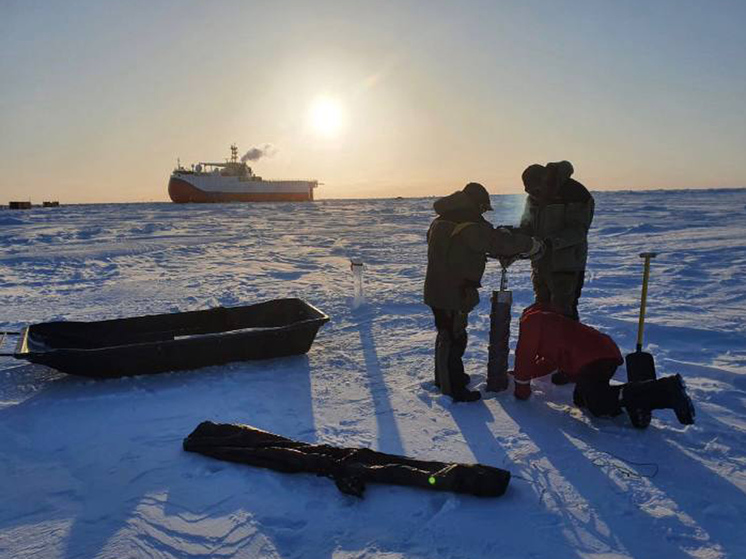 The work of scientists on a drifting ice floe with a core against the background of the «SP» platform. Photo courtesy of AARI.
Since the beginning of the work of the world's first Soviet polar research drifting station «North Pole-1» 86 years have passed under the leadership of Ivan Dmitrievich Papanin. Its ice floe swam over 2 thousand kilometers in 9 months, was carried south to the Greenland Sea, where the expedition members were removed by icebreaking steamers.
The last Soviet expedition — «North Pole-31» in 1991, it ended more dramatically: the ice floe, where the polar explorers' camp of 40 houses was located, began to actively collapse – by the time people were evacuated from it, the area of the ice floe was only 200 by 300 meters, a huge crack passed through the residential complex, a wardroom, a bathhouse, houses of mechanics, a magnetologist, hydrologists, two houses with food were in the water … Fortunately, 23 the members of the expedition were then rescued.
Then there were other drifting stations – a total of 40 expeditions «North Pole» were carried out over 75 years, each with its own serial number. The last team of polar explorers from the SP-40 station was evacuated in 2013. The program was suspended for almost 10 years.
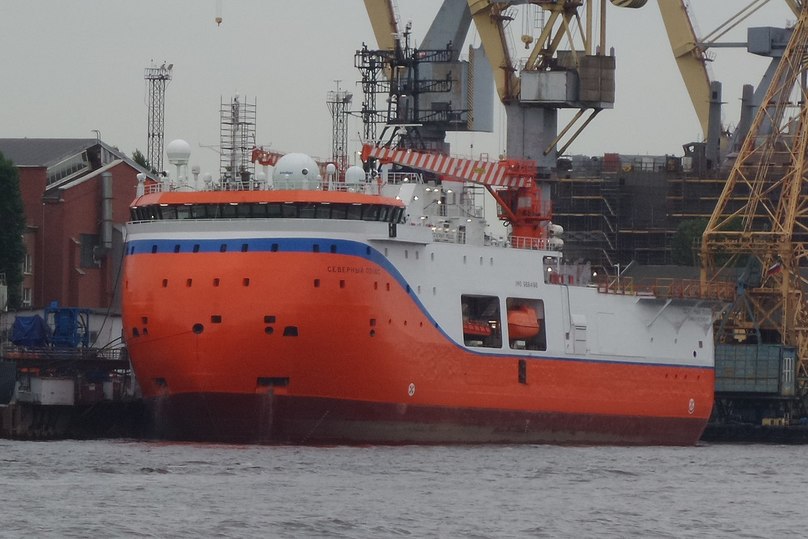
During this period, in order to no longer risk the lives of people and valuable scientific equipment, by 2022 a unique ice-resistant self-propelled platform «North Pole» was created in Russia. On September 17, 2022, she left Murmansk, passed three seas – Barents, Kara and Laptev – and «voluntarily» frozen into a giant ice floe with an area of about 42 square kilometers. She will not be crushed by ice, as happened with the ship «Chelyuskin» in 1934, because it was specially reinforced for such compression.
For more than 9 months, the North Pole platform has been drifts along with the ice floe, moving in high latitudes.
From the starting point in the area of the New Siberian Islands, the drifting expedition moved more than 1,300 kilometers, covering a distance of over 2,700 kilometers. The direction of movement corresponds to the calculated one: in the course of free drift, the station follows the polar region towards the North European basin of the Atlantic Ocean.
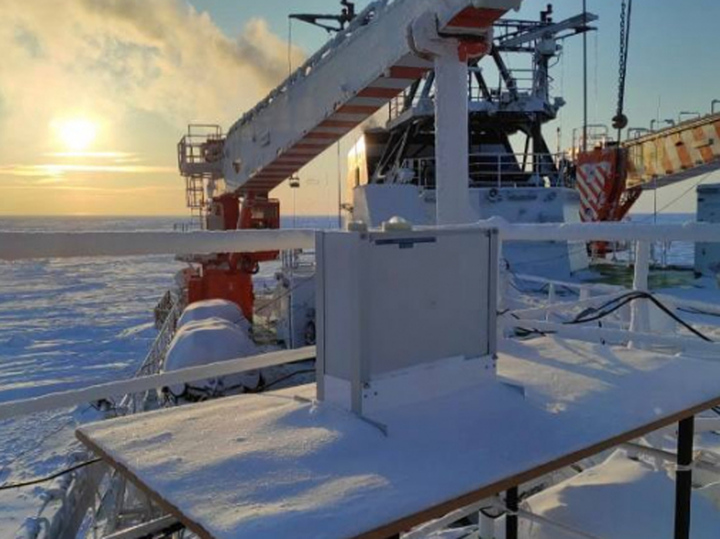 View from the North Pole platform. Photo courtesy of AARI.
It is both a scientific base and a safe home. Of course, Papanin and his colleagues could only dream of such conditions. On the platform – cozy single cabins and 17 state-of-the-art laboratories, a conference room, a lounge, a sauna and a gym with a swimming pool.
Like the previous stations, SP-41 carries out a complex of studies in the field of oceanology, meteorology, geology and biology seas in the «atmosphere — snow cover — sea ice — the surface layer of the ocean».
– At present, a group of 34 scientists has obtained unique scientific data on the geology of the northern seas, patterns of movement of ocean waters, – Alexander Makarov says – A separate result can be considered the study of the processes of deformation of the hull of the platform itself under the influence of ice. For the first time in the world, the ship's hull itself is considered by scientists as an independent measuring device!
 An ice sample obtained by the expedition members. Photo courtesy of AARI
In general, according to Makarov, in addition to his institute, more than 40 organizations of the Academy of Sciences and various departments are interested in the research carried out within the framework of SP-41. Thus, specialists studying the mechanical and strength properties of ice are actively working at the station, – glaciologists. It is assumed that the data they collect will increase the safety of navigation along the Northern Sea Route.
And meteorologists who study heat and mass transfer will supplement their research on the patterns and causes of climate change in the Arctic with their results. As a tool, they have a network of 15 autonomous sea buoys located within a 16-kilometer range around the station.
Among other things, the scientific program of the expedition includes a series of experiments that are designed to improve the results of deciphering and interpreting  ;images received from space satellites.
 An ice sample obtained by the expedition members. Photo courtesy of AARI
We managed to contact one of the expedition members, Leading Engineer of the Ice Quality Department of AARI vessels Vladimir Likhomanov.
– It is very convenient for work and living. All have private cabins with a bathroom, excellent food, a lot of options for leisure activities. In addition, we have a very well-coordinated team, many of whose members have repeated wintering experience. Thanks to this, all emerging issues of a working or domestic nature are resolved with us very quickly.
– We had an extreme: during the seven months of my stay at the station, I found two periods of active ice movement, during which cracks passed through the territory of the ice camp located next to the platform. We had to evacuate part of the equipment and laboratory houses on board the station. After such advances, it took several weeks to wait for the resumption of work on the ice. But the work continued from the ship.
Local predators — polar bears – I met twice, but both times they approached the station in the evening, when none of the employees were already on the ice, so the animals did not threaten anyone.