


In the absence of competitors, domestic producers can give up on quality
Russian gourmets were again puzzled by the message that they were going to ban something from their favorite food: this time it is about limiting the import of fish and seafood from unfriendly countries — the Ministry of Economic Development of the Russian Federation made the corresponding announcement. True, you can immediately exhale: there is nothing new here … well, almost. The embargo on the import of fish and seafood from the European Union and the United States has been in effect for almost a decade, since 2014. It's just that then canned fish — sprats, caviar, canned tuna, anchovies, and so on, were not banned, but now this «flaw» has been eliminated.
 < span itemprop="width" itemscope itemtype="https://schema.org/QuantitativeValue">
“A ban is being introduced on the import into the Russian Federation of finished fish and seafood products originating from unfriendly countries. According to the Russian Ministry of Agriculture, the rejection of imports from the European Union, the United States, and Norway will free up certain market niches that will be filled by domestic producers whose capacities can fully meet the needs of the domestic market for such products. Russian companies will have the opportunity to increase production volumes, expand the range and increase the number of jobs,” the agency’s website says.
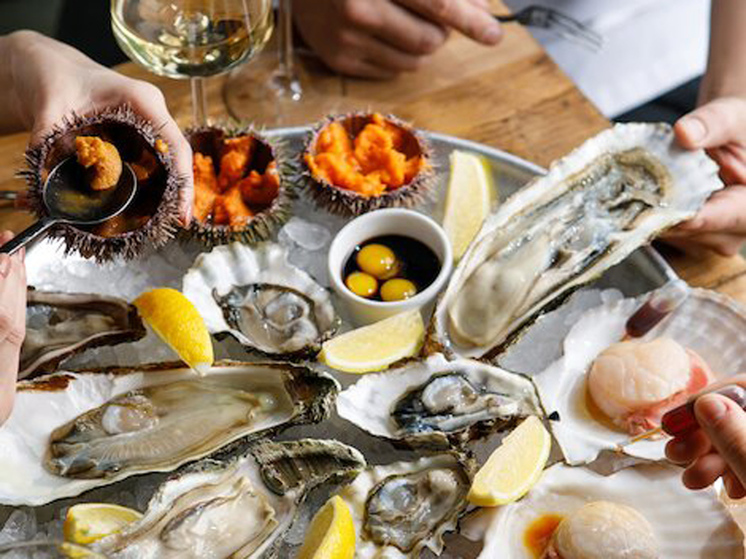
It is unlikely that the new restriction will be fatal: give us a little time — our chefs will learn how to replace anchovies with sprat. If you want to live — know how to spin. There is nothing else to say about the rest: since 2014, we have had enough time to switch to using Murmansk salmon instead of Norwegian, Vietnamese shrimp instead of Italian and Crimean oysters instead of French ones. There is nothing new here: our main importers have long been not Europe, but Southeast Asia or South America. Connoisseurs of Thai noodles or, for example, Peruvian ceviche will not let you lie: everything is good with fish and sea food.
Perhaps the problem is more psychological. The fact that Russia is washed by 14 seas, not counting the closed Caspian Sea, seems to be known to everyone who studied at school. It would be logical to assume that where the sea is, there are seafood … But there are also river fish, and even crayfish (Volga lobsters!), But that's another story. However, for many, very many, seafood is associated with overseas countries. We traveled, remember that same paella in a coastal restaurant in Alicante, delicious fresh oysters for 1 euro per piece in the market in Normandy, beautiful mountains of cheap shrimp in Thailand and this funny lobster, which you wanted to try at least for fun and which turned out to be similar to chicken? Certainly. Here is the result: we say “shrimp”, we mean “import”. At least subconsciously. But in vain!
Let's take a look at a popular fish and seafood cafe at low prices (when this establishment opened a few years ago, such a concept seemed an oxymoron). On the menu, on the shelves and in the freezers — a summary of the cartoon about the Little Mermaid, only with a bad ending: everyone was caught by evil fishermen. Shrimps of all colors and styles, tuna, eel, salmon and trout, sea bream and sea bass, scallops, oysters, octopus and squid … well, and a couple of types of herring, of course, you can’t do without herring either. Quite enough to mentally transport yourself to some Greek seaside tavern …
— Where did you get the octopus from? — I ask the cashier-seller after I order it. — Interesting.
— Octopus?
— Well, yes. Where does he come from?
— This needs to be clarified, — the cashier frowns. — Vasya! Vasya, where do we get octopuses from?
— Where do octopuses come from? Murmansk, — Vasya readily responds. — They are bred there. Aquaculture.
The term is unfamiliar. I had to nod with a smart face, and then urgently study the Internet. Yeah, so, sir, octopus aquaculture is the artificial cultivation of this reptile for commercial purposes (in the sense of being eaten). True, all publications report that aquaculture is only being discussed … but maybe they have already discussed it? Well, even if the boys were cunning, the octopus still has many options for where to come to Russia: from Indonesia, Seychelles, Morocco, even from Peru. Please note: there are no unfriendly countries in the list.
While we wait for the order, we will study the assortment carefully. So, the frozen vongole shells that most eaters associate with northern Italy say they come from China. Excellent: China seems to be a friend to us, it will not leave us without shells! Langoustines are labeled as imports from Bangladesh, while large shrimp are from Argentina. Mussels were brought from Chile, but plump, pretty scallops came from the Kuriles. Salmon in assortment — from Murmansk. Many seafood and fish are from Turkey or Uruguay, as proud posters proclaim.
Nothing that could change or deteriorate after innovation. Even if a French saboteur oyster is hiding somewhere under a fake label, you shouldn’t worry about its fate — crafty ways to circumvent sanctions were invented by craftsmen back in 2014, and it would be naive to think that something will change in 2023 . The main thing is that the documents for this oyster are correct.
Meanwhile, the widespread fear of Russian consumers is not at all connected with the disappearance of European fish — as we have already said, after 2014 everyone got used to this. The alarm is different: there are suspicions that due to the disappearance of healthy competition, domestic suppliers will no longer see the coast (pun intended when talking about seafood) and will offer worse quality goods at inflated prices. Like, neither the inhabitants nor the restaurateurs will go anywhere, they will buy salmon and exorbitant prices, there are no options!
According to the head of the Federation of Restaurateurs and Hoteliers of Russia, Sergei Mironov, such fears are completely fair and justified — and such a risk really exists. In an interview with an MK correspondent, the expert noted that the opposite would be a much more effective measure — a ban on the export (especially to unfriendly countries) of those fish and seafood that are rightfully considered the pride of the Russian seas:
— Any ban on the import of something should, in response, turn into a ban on the export. For example, it would be worth discussing a ban on the sale of Far Eastern shrimps and our best fish to the unfriendly country of Japan. However, these sales bring in more money than domestic sales. We also have king crab, our pride, and it would also be worth deploying it inside the country, not releasing it for export. Then, you see, the price of crab would have dropped, because today it is very expensive. The export of red fish, coho salmon and chinook salmon also fits into this scheme, because on the world market our chinook salmon is valued more than Norwegian salmon, the expert explains.
Mironov also added that rumors about the uniqueness of Crimean oysters are greatly exaggerated , and this is where the role of imports should not be underestimated.
— If you need Russian oysters, it is better to prefer Far Eastern ones. In Crimea, oysters are grown, they are purely for the domestic market, no one will buy them abroad. They are inferior to any competitors. Today I would recommend paying attention to oysters from African countries. For example, they bring a lot from Morocco and Tunisia, and good ones at that.