


On July 28, the leading figure in Russian cosmonautics celebrated a round date — 90 years!
It is appropriate to call people like Academician Mikhail Marov people from the future, even though this “future” was more than half a century ago. He is one of those who, for the first time in the world, landed spacecraft on the Moon, Mars and Venus, who was the first, among the pioneers, to see the surfaces of other planets. Can modern space specialists do this? We will find out soon, because it so happened that they seemed to have specially planned the launch of the Luna-25 lunar apparatus for the anniversary of the coryphaeus of space robotics. It should take place on August 11th. Having met Mikhail Yakovlevich on the eve of his birthday in his office at GEOKHI (Institute of Geochemistry and Analytical Chemistry named after V.I. Vernadsky RAS), we talked about the most important thing: true friendship and devotion to our beloved God and those who are now fleeing their native country.
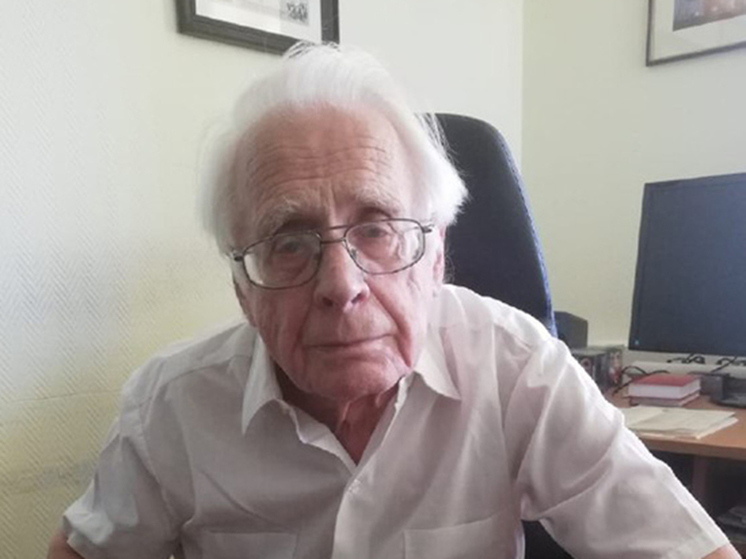 Mikhail Marov. Photo: Natalia Vedeneeva
Mikhail Yakovlevich Marov is an outstanding Soviet and Russian scientist in the field of space mechanics and physics, astrophysics and planetary research. He is an academician of the Russian Academy of Sciences, a laureate of the Lenin Prize and the State Prize of the USSR, the Demidov Prize, the International Galaber Prize in Astronautics, etc., the owner of a NASA diploma for a leading role in the study of the solar system. The scientist was awarded the Orders of the Red Banner of Labor, Honor, Friendship, Alexander Nevsky and many medals, including the Gold Medal. M.V.Keldysh RAS «For outstanding scientific work in the field of applied mathematics, mechanics, as well as theoretical research on space exploration.»
Mikhail Marov was born in Moscow. Father Yakov Semenovich Marov was a Komsomol leader and a party worker, Mother Maria Ivanovna Ignatova was a physical education teacher, Moscow champion in gymnastics in the 1930s. During the Great Patriotic War, while his father fought at the front, Mikhail, his mother and grandmother were evacuated. After the evacuation, everyone returned to Moscow again, where Mikhail Yakovlevich graduated from school No. 330 with a gold medal.
For further education, he chose mechanics, in particular the complex problems of nonlinear oscillations, which he comprehended in the famous Baumanka. From 1958 to 1962, Marov worked in the nuclear and then in the rocket and space industries, including the famous OKB-1 of Sergei Pavlovich Korolev. In 1962, at the invitation of the President of the USSR Academy of Sciences Mstislav Keldysh, he moved to work in the academic system — until 2007 he worked as the head of the department of applied mechanics and planetary physics at the Institute of Applied Mathematics, while simultaneously being the scientific secretary of the Interdepartmental Scientific and Technical Council for Space Research at the Academy of Sciences. From 2007 to this day, Mikhail Marov has been the head of the Department of Planetary Research and Cosmochemistry of the Geochemical Institute of the Russian Academy of Sciences.
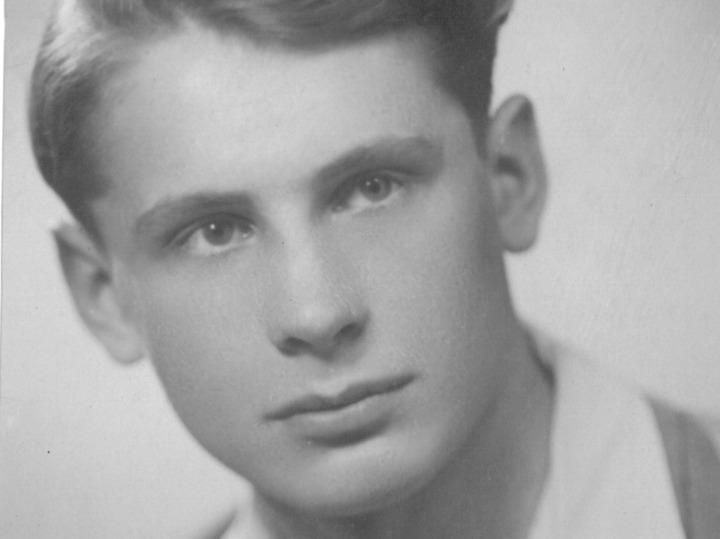 Mikhail Marov in his youth. Photo from personal archive.
We are talking with Mikhail and Yakovlevich in his office at GEOKHI.
— I have lived to a respectable age, when it is time to sum up the results of life, — the hero of the day begins the conversation. — For some reason, now I am especially sad that almost none of my peers are left nearby. Many colleagues left one after another, school friends, people very dear to me, almost like relatives.
— It's hard for me to do this… Probably, in the first place for me is my childhood friend Yura Kodashevich. We knew each other from the second grade (I finished the first grade in the evacuation, in Udmurtia), both were gold medalists. Yura is a very gifted person who played the piano brilliantly.
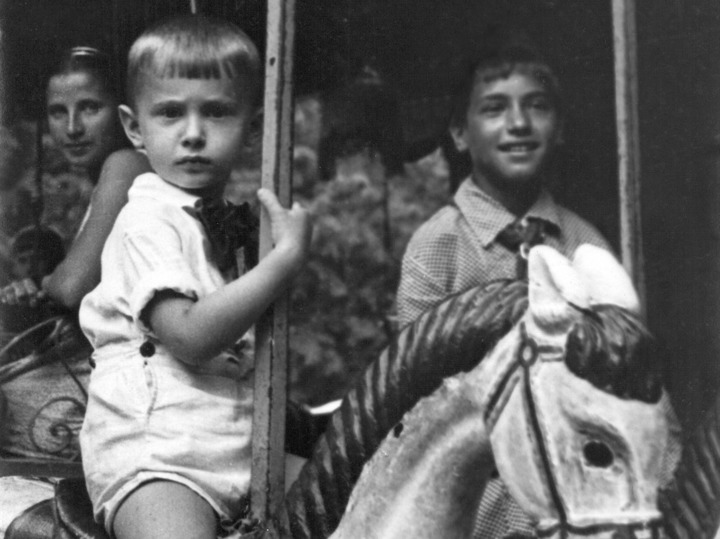 Mikhail Marov in childhood. Photo from personal archive.
No, he was a metallurgist, took part in the construction of a plant in Bhilai (India). He had an apartment on Sokol, a very sweet wife Natasha, who is alive, we keep in touch. Probably 5-6 years have passed since our last meeting with Yura, which I somehow especially remember … A cozy office in the twilight, two soft comfortable chairs. We sit and drink whiskey. Yura was especially fond of good, as he said, whiskey … In the 43 years that we knew him, so much happened! Including the first girls with whom they had absolutely magnificent gatherings. He played, and how he played! His closest colleague in piano playing was Alexander Tsfasman, artistic director of the jazz orchestra of the All-Union Radio! Sometimes they played four hands.
– Lots of stuff! About what worked, what didn’t work, what you can be proud of, and what you should be ashamed of. Looking ahead, I can say that I am a very happy person. Among other things, because I did not do unworthy things, did not harm anyone. Somehow already in the post-perestroika period, I tried to explain this to an American colleague — Bill Hartmann, a professor at the University of Arizona, but he could not understand me.
— He did not know our complex history, and I told him about denunciations of neighbors, on which some built a career. In the mid-90s, the KGB archive was opened, and some people were trembling because denunciations began to surface that they wrote about their colleagues. That's what's scary: when you, under the influence of mood, evil, resentment, did an unworthy deed, and now you can’t change anything. In September, the Tsiolkovsky readings are coming up, which I will again hold in the homeland of the founder of cosmonautics in Kaluga on September 18th. At the plenary session, I presented the report of a person who devoted a lot of time and effort to what is connected with the restoration of historical truth in our rocket and space industry. In particular, we definitely need to restore the bright name of the Soviet scientist Georgy Langemak, the creator of rockets for the famous Katyusha. He suffered from such a denunciation, he died early. He was rehabilitated, but that was not enough.
— Touched! In the early 1970s, I went through a very difficult period in my life, when a denunciation was also written against me. This was done by a man whom I cannot call otherwise than a bastard. On all foreign business trips, which we, scientists, had a lot of, the delegation was accompanied by the so-called «Ivan Ivanovich» — a KGB officer. His job was to watch. I remember that shortly before one trip, he somehow turned to me and asked me to watch my people. I sharply rejected this, saying: “This is not my specialty!”. He remembered this, apparently holding his anger. It spilled over in 1972 after our next joint trip to America for a large scientific congress. You understand that at such congresses, in addition to scientific meetings, there are many friendly meetings, receptions. And at one of the receptions, my colleague, an American, handed me a completely meaningless box with cufflinks and a tie clip. Nice gift in gold color. But “Ivan Ivanovich”, upon returning to Moscow, rolled a “cart” on me. I was accused of excessively friendly relations with the Americans… I have good English, I communicate quite freely in it, allowing myself both humor and all kinds of comparisons… So this comrade wrote: “M. Marov, freely communicating, betrays our secrets (it was an absolutely unfounded statement — M.M.) and for this he received golden cufflinks as a gift.
— Of course not! They were then taken away from me, checked: ordinary metal with some kind of galvanized coating.
– Yes, I have them now, I kept them as a souvenir.
— Called to the Lubyanka. There were colleagues, some envious people who were interviewed, and they also threw out their attitude towards me on paper. Therefore, a solid folder has accumulated on me.
— There is no one else. And I would never call them. Why?
— It all subsided after a year and a half, at that time they stopped letting me go abroad. Keldysh acted very wisely. Of course, it didn’t cost him anything to pick up the “Kremlin” (a phone for direct communication with the Kremlin — Auth.), Talk to the deputy chairman of the KGB and say: “End this bodyagi!”. But he didn't. In one of the conversations, he told me: “Mikhail Yakovlevich, you have to be patient. This period will pass, there will be a traditional trial, absolutely nothing will be found, and everything will be closed. And if I intervene, it will be considered that something happened, and I took you under protection.
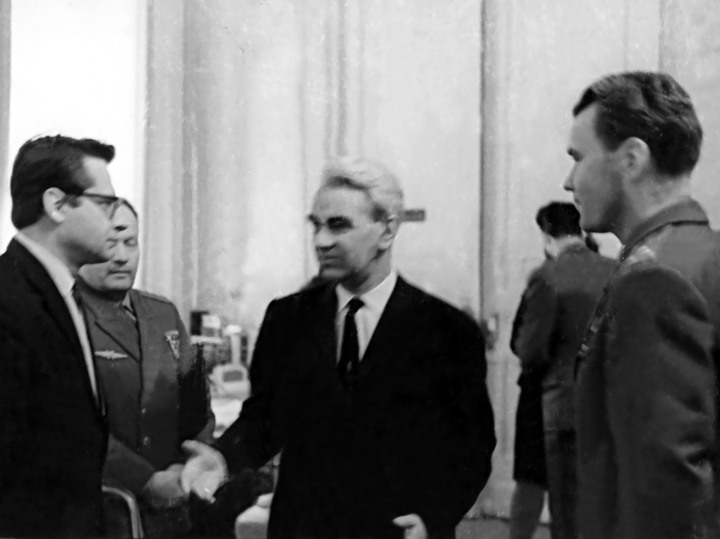 Admission to the USSR Academy of Sciences after completion of the flight of V.A. Shatalov on the Soyuz-4 spacecraft and manual docking with the Soyuz-5 spacecraft. From right to left: V.A. Shatalov, M.V. Keldysh, Colonel-General N. P. Kamanin and M. Ya. Marov.
— Over the problems of our landing vehicles to the Moon, Mars, Venus. It was the culmination of my entire scientific career, the incident with the denunciation added drama to it. But I, as they say, spent the day and night at the NPO. Lavochkin, the lunar-planetary program was extremely rich. Suffice it to say that it was the USSR that was the first to land its spacecraft on the surface of all the named bodies of the Solar System, the first to automatically return samples of lunar soil to Earth. Mstislav Keldysh made a great contribution to the development of Venus — from the very beginning he said that this planet was of exceptional interest for planetary research. With it, you can compare the causes of natural conditions on Earth and its neighbors. We did not miss a single «launch window» when the position of the planets was optimal for launching the spacecraft. It was opened about once every one and a half years, and during this time a new spacecraft was created each time. Headed at that time NPO them. Lavochkin, Georgy Nikolaevich Babakin then did what now seems to many a miracle: in six years — 16 spacecraft! Just imagine this figure against the background of the fact that we have not planted our robots on other planets for 47 years.
– It is true. And when it was especially hard, he wrote books about the planets. Many of them will soon fill up the museum corner, which the Kaluga Museum of Cosmonautics decided to dedicate to my work.
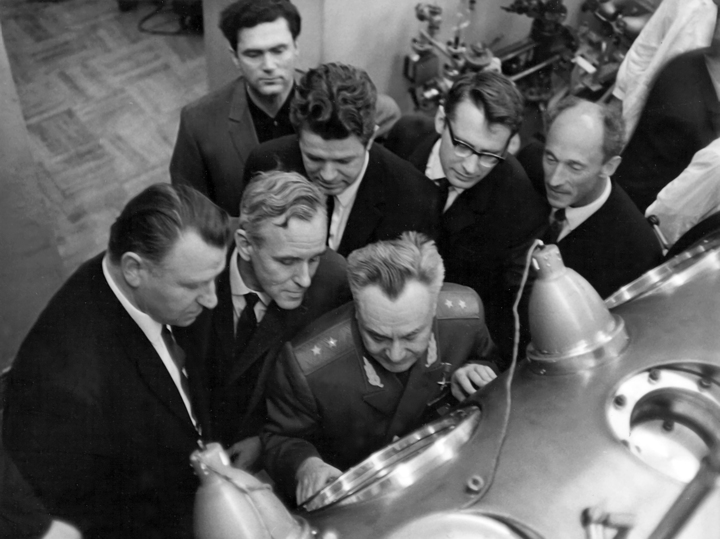 The first lunar soil brought to Earth by the Luna-16 apparatus on September 12, 1970, in a special box. From left to right: Minister of General Mechanical Engineering S.A. Afanasiev, chief designer of NPO them. Lavochkina G.N. Babakin, Chairman of the State Commission G.A. Tyulin, behind him on the right — M.Ya. Marov. Photo from personal archive.
– It cost me two years of my life to write a book called “Soviet robots in the solar system. Technologies and discoveries. It contains the history of the creation of all our automatic spacecraft. And absolutely frank: without hiding accidents and technical problems. The book was co-authored with a fairly close colleague of mine, former NASA Assistant Administrator Wesley Huntress.
– He supplemented my information. NASA very carefully monitored our entire space program, the secret services were actively working. I was sometimes amazed that they had more information than in our archives than I do. But Huntress himself offered to publish them. The book was published in 2011 by the very prestigious Springer publishing house. It received the first prize of the International Academy of Astronautics, and in 2017 it was published by us in Russian translation, it sold out instantly…
– Everything that is there is in 70-80 years was secret, and for any information I would have been imprisoned or exiled. But in the 90s, our state removed the secrecy stamp from these materials.
And this allowed me to present many materials with photographs in our joint book. At the suggestion of my co-author, the words on its cover are: «First on the Moon, first on Venus, first on Mars.» This is an estimate! Do you understand? And this gives me a feeling of great satisfaction, because in these achievements there is also my work.
The second most important book I would call «Cosmos: from the solar system deep into the universe.» In it, I outlined what is known today about planets, stars, galaxies, but also touched upon the problems of the origin and evolution of the Universe. The book has gone through three editions.
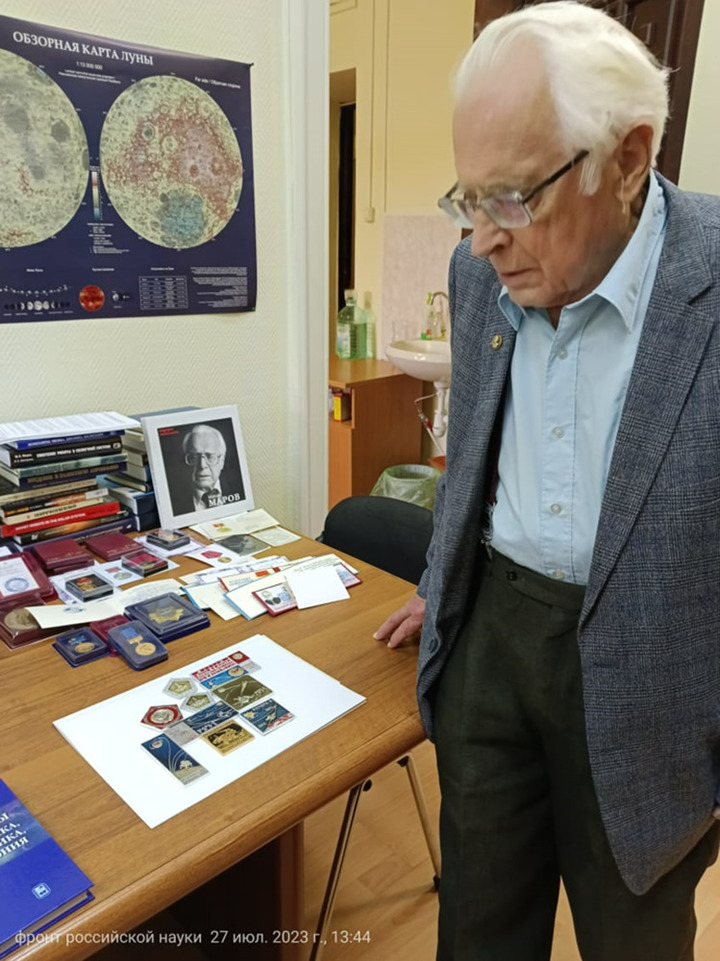 Mikhail Marov shows a collection of replica pennants for landers to the Moon, Mars and Venus. Photo by Natalia Vedeneeva
– What happened to us since the beginning of the so-called perestroika, with the collapse of the Soviet Union, has become one of the most tragic pages in our history and in my life. The country that gave me everything, that I loved, from which I drew both inspiration and strength, perished. This tragedy led to the fact that we chopped off a lot of our technologies. I somehow came across data that tens of thousands of enterprises were destroyed during that period! There was a false concept that even brooms could be imported from abroad and paid with oil and gas, not to mention high technologies. This stupid philosophy is what has led us to today's highly technologically dependent situation. As a result, we have lost our leading position in space, with the possible exception of manned astronautics.
Some are overwhelmed when we state that we have forgotten how to land on the Moon, on Venus.
— Yes, but they did not destroy anything of their own, they kept the technology, and we lost it. In the 90s, our salaries were completely collapsed, people worked half-starved — Americans never dreamed of it. And in such an environment, with the last of our strength, we created the Mars-96 apparatus — a colossal «monster» with a wide range of scientific tasks. Unfortunately, when it was launched, the upper stage did not work in orbit, and all our tremendous work «left» into the ocean.
— A lot of the most talented specialists either went to some kind of coven in order to earn at least something, to work that were unworthy of their qualifications, and whoever could — faded away.
– I do not blame those who changed the country, striving to continue their scientific career, those who did not have the proper equipment and opportunities for work here. Another thing is when the departure is motivated by completely different messages — the desire to eat fatter. These people can only sympathize. But this begs a reproach to our government: how can you allow brain drain? It is not the worst who leave, but the most talented, in demand, and you cannot return them back with some episodic grants, there must be a stable, long-term policy in the country.
— The question is very difficult. Many of the people you are talking about are completely inadequately motivated. They do not take the trouble to think about the future of the country, about the alignment that is taking place in the modern world. For example, I am not indifferent to whether I will live in a country that has its own traditions, its own culture, in the end, its own vision of the future, or in a country that “lies” under the hegemon and follows principles alien to me. From this point of view, I have a very negative attitude towards those people who are motivated in this way, even embittered by something. These are shortsighted people. For example, I would not want my children or grandchildren to change sex, to be led by supporters of same-sex marriages. I remember how disgusted I felt when, in Denmark, in Copenhagen, I came to one of the streets and saw a large number of painted peasants sitting on each other's knees. I will never be able to accept it! Today we are called to simply treat it with tolerance, but tomorrow it will become a way of life, because there will be no other way out. This inspires a very serious concern.
— This is what I attribute to the distortions of civilization. It is possible that special ideas are deliberately implanted.
– Perhaps.
– Many Europeans and Americans tend to be apolitical. They are carried away by their very narrow world. I met many of my colleagues abroad during my numerous business trips, sometimes I flew to the USA two or three times a year, lived there with the families of my friends. Communication with them led me to the conclusion that our and their experiences, ideas about the world are not comparable in their level. For example, many Americans consider it a tragedy if they run out of toilet paper…
— Certainly. They are often not interested in anything outside their own profession. Let's say my colleague comes home, prepares a cocktail, throws his legs on the ottoman and spend time in front of the TV in this way until his wife invites me to dinner. And nothing else — day after day the same thing.
In North Carolina, I had the chief dean of the faculty, Fred de Jarnet. Shortly after we met, he says to me breathlessly: “Mikhail! I got a ticket for a baseball game, a famous team is playing! I say, «Fred, I'm not interested.» — «How?!». I say: «I'd rather sit and work.» «But it's the weekend!» he wonders. I won't forget how disgusted I was with the audience, endlessly chewing popcorn and drinking soda in the stadium. I think I can still smell it.
Yes, I gave up. But I thought even more about how we and they are different. We are still an amazing nation that can appreciate something more important in this life than everyday life and everyday life. Perhaps this is because we, like no other, have experienced a huge number of social and political upheavals in our history.
 Copy of Landing Pennant apparatus Mars-3. Photo by Natalia Vedeneeva
< /p>
– My wife and I, if we go to the cinema, then we go to the Ryazanov Club, he is not there.
– A difficult question. Probably, in my youth I would say — literature, but in parallel with this, of course — music. Previously, I was a regular at the conservatory, the Concert Hall. Tchaikovsky, now, I'm ashamed — there is neither time nor energy for such trips.
— In spirit, Rachmaninov is closest to me. Of course, I also listen with delight to Tchaikovsky, whom some consider a little “lightweight”, but I don’t think so. As for painting, I became much closer to it in my much more mature years, when I began to travel abroad. Then I was able to enjoy the collections of the Louvre, Prado, Metropolitan. And, you know, it's hard to separate it from the art that science itself is connected with. I experienced these sensations at the Natural History Museum in London, just as fascinated as I walked around the Acropolis in Greece. Indian culture left a lot in my soul. I have been to India six times and had the opportunity to meet many interesting people. When, for example, I now hear that Agra is threatened by a flood, I am not indifferent to it.
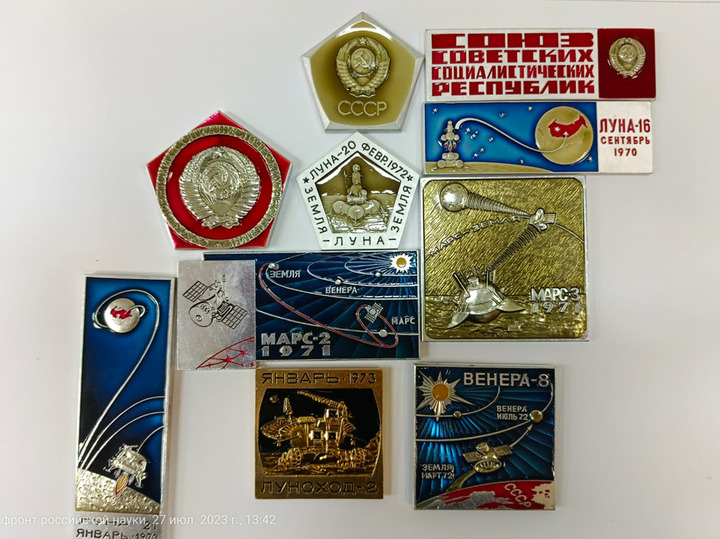 Lander Pennants. Photo by Natalya Vedeneeva
– The connection between reality and fantasy. Some other world that I don't know anything about. Indian philosophy is connected with it, about which my wife Olga can tell much more. She is also my guide when we visit other countries.
— Sincerely! For many years I have been friends with an Indian scientist (I happened to be at his house), who is engaged in advanced areas of theoretical physics and at the same time begins every morning with a prayer service and ends the day with it, going to bed. He worships the god Hanuman, revered by the Hindus.
– No, these people are very modest, they do not like to talk much about their feelings. Maybe I should lament that the same thing didn't happen in my life.
— A very simple answer: first of all, you need to choose the right parents, this is art (smiles). Second: once in Voltaire's Candide, I read very short but wise words: «The moderate is his own doctor.» I have never greatly abused what youth seemed to allow. The third is the choice of close people who love you and will not leave you in old age. And finally, another component that provides a solid foundation is creativity. When there is a purpose in life, when you want to learn something, understand and, if possible, contribute, that is what keeps it on the surface.
 Copies of landing craft pennants. Photo by Natalia Vedeneeva
< /p>
— Of course I'm watching.
— I have been involved in our new lunar program for the past 20 years. «Luna-25» as its basis was proposed by the director of GEOKHI Eric Mikhailovich Galimov and myself. In addition to the landing station, it included a system of penetrators (impact penetrating sensors that penetrate into the ground — Ed.), That is, it had to answer the question not only about the nature of the landing site, but also on a global scale — about the internal structure of the entire satellite. Unfortunately, little is left of that project, which was not accidentally called the Luna Globe. «Luna-25» is mainly focused on learning to land on the moon again, and God forbid we solve this problem.
By the way, not so long ago, at the request of Anatoly Petrukovich, director of the Space Research Institute of the Russian Academy of Sciences, I wrote an article about the work on launching automatic vehicles to the Moon in the academic journal Space Research. I hope it will come in handy for young scientists.
I wish every success, first of all, to the technical specialists who put a lot of effort into making the device fly and work successfully on the Moon. I'll tell you a secret (smiles) when I was at the NGO. Lavochkin, in the workshop where Luna-25 stood, its model, I really wanted to cross it, and I could hardly restrain myself. I really hope that luck will accompany us. And secretly from everyone on the day of the launch of the flight model, I still cross myself (smiles).