


And they argued about how harmful it is for the country's economy
To increase the minimum wage (minimum wage) by the planned 18.5% in 2024, according to the calculations of the Ministry of Labor, budgets various levels and private business will have to allocate more than 193 billion rubles. The biggest concerns in this regard are workers in the private sector. After all, not all enterprises here can afford to raise the wage fund. To comply with the requirements, they will have to come up with something — switch to part-time work or pay only the “minimum wage”, and give out the rest “in envelopes”. What is the size of the shadow sector of the Russian economy today and is it dangerous to grow, «MK» found out from experts.
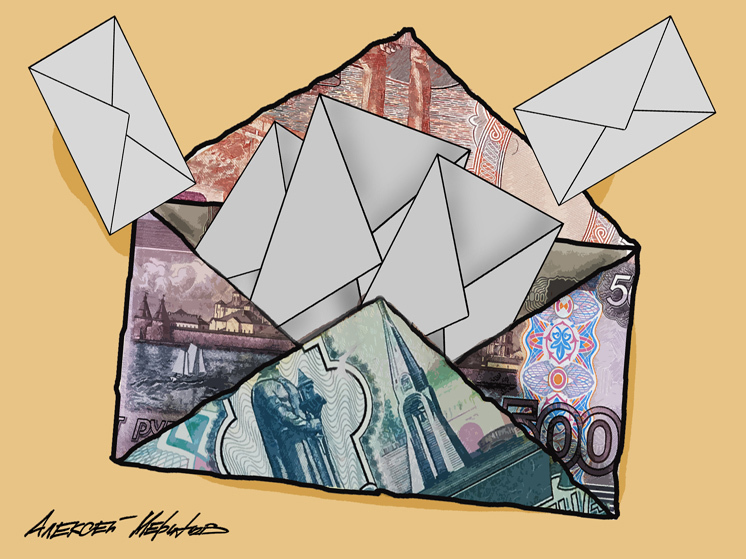
From January 1 next year, the minimum wage will increase by 18.5% to 19,242 rubles. The main financial burden in this regard will fall on the regional and municipal budgets: their additional costs will exceed 125 billion rubles. Another 20 billion rubles will come from the federal treasury. The real sector of the economy will spend 45 billion rubles on this item. Given the state of the business climate in Russia, persistent sanctions and an uncertain outlook, many may opt to go into the shadows. “It is more profitable for business than paying a completely white salary,” believes financial expert Alexei Krichevsky. “You don’t need to pay 40% of your salary to state funds – it’s easier to ask a person to transfer to self-employment, become an individual entrepreneur or negotiate a raise when receiving cash money.”
Data on how many Russians are given salaries “in envelopes” vary today. So, on the air of the radio station «Moscow Speaks», Candidate of Economic Sciences Nikolai Kulbaka claimed that there are from 30% to 40% of such people in our country. “There is a discrepancy between the data of the Federal Tax Service on working citizens and information from Rosstat,” says Artem Tuzov, director of the corporate finance department at IVA Partners. — The difference is about 22%. At the same time, citizens, being self-employed, can consider themselves working, so the real percentage can be about 15%.
The Federation Council cited data that up to 30-40% of Russians can receive “grey” salaries in full or in part. However, according to VTsIOM polls, 86% of the citizens polled by the agency answered that they receive a completely white salary. The assessments of the same “indicator” by the World Bank, made back in 2019, were very close to the figures given in the Federation Council. As a result, as Tuzov notes, the budget loses annually about 3 trillion rubles of lost taxes, that is. about 2% of GDP.
“Shadow” salaries exist because the taxation system for businesses, and individuals, too, despite the low tax rates compared to Europe and the United States, is very inflexible. “A large number of direct and indirect taxes on businesses are forcing many employers, especially those in small and micro businesses, to bring salaries into the shadows,” continues the topic, Leading Analyst at Freedom Finance Global Natalia Milchakova. “At the same time, the formally low rate of personal income tax, which some employees pay far from all their income, is often “compensated” to the state and especially to regional budgets by other taxes and fees — from extortionate property tax to excessively inflated car parking fees. Given that in Russia, with its unstable ruble, real wages are very far from the average European level, unfortunately, one can hardly expect a significant improvement in this area in the very near future.
Curiously, not everyone agrees that «gray schemes» in the payment of salaries will certainly harm the Russian economy. “Perhaps it will seem strange, but the salary “in envelopes” stimulates the growth of the economy, says Natalya Hotya, head of a consulting company, founder of Doing Business Together. — It is clear that it is more interesting for an employee to receive, say, 60 thousand rubles in hand than 42.6 thousand rubles, and the employer will send 6.4 thousand rubles to the budget in the form of personal income tax and 9.8 thousand rubles in the form of insurance premiums . From my example, it can be seen that with a white salary, 42.6 thousand rubles fall into free circulation, that is, in shops, service companies, and the service sector, and when paid “in an envelope” — all 60 thousand. Therefore, it is unlikely that at the moment payment «in envelopes» hurts the economy. To the country's budget, yes, but not to the economy.
The problem of «gray» wages in Russia is connected not only with the interests of employers, but is often caused by the desire of the workers themselves to arrange their cash flow in this way. Many employees choose to earn the minimum wage to hide their true income from mandatory child support payments or to avoid bailiffs collecting bad loans. “There is a social problem,” Tuzov agrees. — Some citizens, especially «in the north» and in the villages, have reached a situation where their alimony payments plus deductions for debts to bailiffs practically nullify their white income, so they simply do not go to the «white» salary, but «in the north» there is no queue of the unemployed.”
In general, increasing the minimum wage is a good step, but business and society in Russia live in a slightly different reality than the state, so often the effect of quite positive steps taken by the authorities is not so impressive and understandable, as the powerful of this world would like.