


«In six months the device could be assembled, in another six months it could be tested and sent again in a year»
Academician of the Russian Academy of Sciences Mikhail Marov called for a conceptual repetition of the Luna-25 project as soon as possible. In his opinion, which he expressed in a conversation with an MK columnist, this would allow our space industry to do an excellent job of correcting the mistakes, so that after that they could move forward more decisively in accordance with the national lunar program. We thought with the creators of space technology, scientists and industry veterans, how real such a scenario is and what kind of mistakes the creators of the new Luna-25 would have to solve.
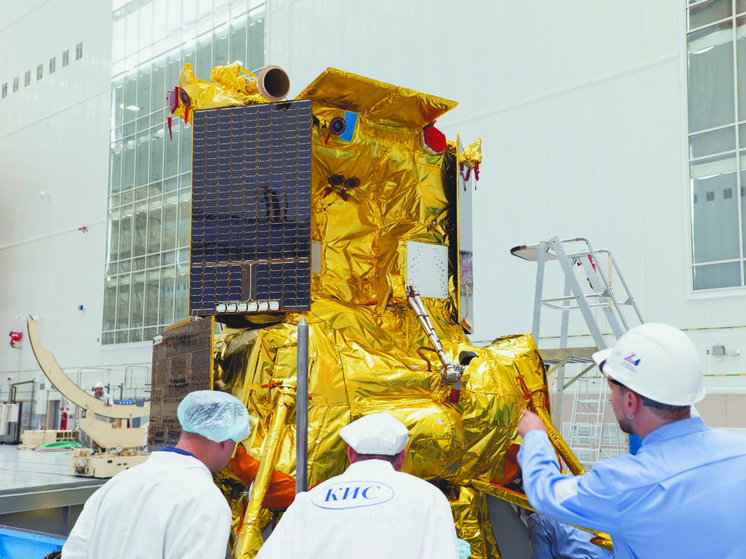 This is Luna-25 at the Vostochny Cosmodrome before launch. Photo: TSENKI
Let me remind you that Mikhail Marov is the oldest representative of our space science, the head of the Laboratory of Planetary Research and Cosmochemistry of GEOKHI named after. Vernadsky RAS, which participated and was the organizer of many successful Soviet interplanetary missions. He was very much looking forward to a new soft landing on the Moon of the domestic apparatus after almost half a century of break, and when he heard about his fall, he went to the hospital … Now he is at the Central Clinical Hospital, we talk to him on the phone.
— When the spacecraft is being created apparatus, nothing is being done in the singular, — Mikhail Yakovlevich argues his proposal to create an analogue or even a copy of Luna-25. “So it would be a very economical option. In six months it would be possible to assemble it, in another six months — to test it and send it back to the moon in a year.
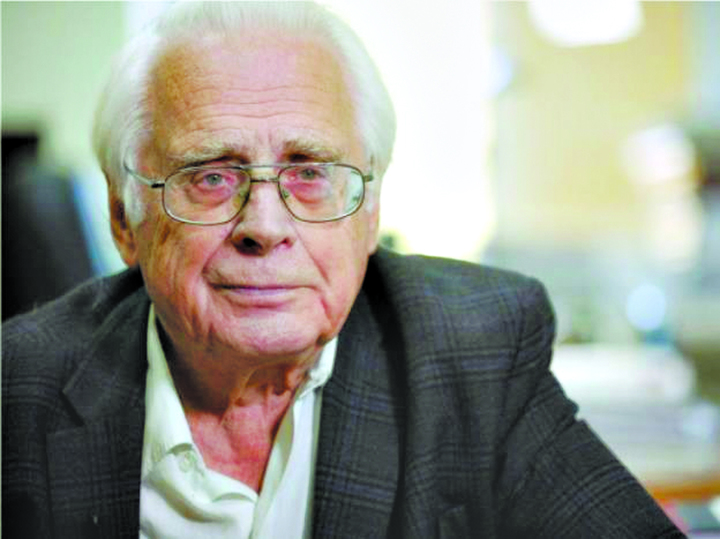 Academician Mikhail Marov.
— Yes. And I think it's quite real. The savings would be 30-40%, and besides, we would go through all the controversial systems again, do real work on the bugs and still land the device on the moon.
Marov can be understood. It is very difficult for people like him, who have devoted their whole lives to the development of domestic astronautics, to come to terms with the fact that we have long forgotten how to fly to the moon.
True, I’ll get better: the young shift nevertheless managed to “fly” to the Moon, the Luna-25 apparatus even flew around it as an artificial satellite for two days, collecting data on the radiation situation, fixing the main components of the lunar soil with the help of their instruments. Yes, I didn’t sit down, and our veterans, such as Marov, are surprised at this.
This is the conversation I had the other day with one one of the experienced employees of space science, whose name I do not name at his request.
“A lot of things were destroyed in our country in the post-perestroika years,” my interlocutor says, “and we still cannot overcome this! The saddest thing is that we are repeating mistakes like the one that led to the fall of «Phobos-Grunt» into the ocean.
— Firstly, there are very few sensible personnel. Surprisingly, our schoolchildren and students win international computer science olympiads, but we fail to create a normal apparatus control system. How can this be understood? And I'll tell you: the reason is small, unattractive salaries in our institutes and at the enterprises of Roskosmos. Most of the talented guys seem to pass them by. Meanwhile, the staff of executives (some of them are very far from our science) are disproportionately inflated, and their salaries are many times higher than those who are directly involved in the creation of complex space technology.
Secondly, bureaucracy, the so-called tenders, have not yet been eliminated at our enterprises … I can imagine how surprised the same Georgy Nikolayevich Babakin (ex-head of the Lavochkin NPO) would be if he were offered to choose one of the two radio systems. which is worse, but cheaper. Naturally, he would choose the best one, regardless of the price, because we used to work for the result. The current directors for this will immediately be invited to the prosecutor for «overspending public money.» That is, now the whole system is arranged in such a way that a positive result, the success of a new mission, is rather an accident, because a lot, in fact, is aimed at putting spokes in its wheels. I'm not talking about a specific «Luna-25» now, this was a common problem for everyone for a long time.
— It's hard for me to say, I no longer work in the industry, but, judging by the description of the emergency situation by Roscosmos, the onboard control system failed. You understand?! And this is 10 years after the failure with Phobos-Grunt, whose control system also failed! All this causes unpleasant feelings.
“To be honest, today I myself am surprised how we managed to do it. But complex devices have been landed on both the Moon and Mars. They were controlled by the so-called autonomous program-time device. This was the series switching of mechanical relays. At the right moment, somewhere in the orbit of Mars, voltage was applied to the device, and the necessary contacts closed. And it is surprising that all this worked reliably and consistently and led to soft landings.
— That's right, they could assemble and successfully send a space station to the Moon or Mars in six months. And now, with such a technique, such modern programs, we make them for 20 years — and the result is almost zero.
■ ■ ■
But let's return to Mikhail Marov's proposal to create a new Luna-25 in the shortest possible time, because it would just help us avoid long intervals between programs. I conveyed this idea to Anatoly Petrukovich, director of the Space Research Institute of the Russian Academy of Sciences, and this is what he replied:
—The proposal, of course, is interesting, but, to be honest, this is a very optimistic view of things. It would be nice to create a second «Luna-25», but I'm afraid that this is impossible. We would very much like to move forward, without delay, in accordance with our lunar program. The next stage, which Yury Borisov spoke about at the Roscosmos cosmodrome, is Luna-26, the launch of which is scheduled for 2027.
— Such is the logic of creating projects. It is impossible to assemble complex devices on the knee: something needs to be ordered, worked out, tested, something needs to be developed anew because of the need for import substitution.
There are other points of view on the crash problem «Luna-25», which we will return to in the near future.